Under the scalpel of AI: India's healthcare year in 2025
2025 didn't flip Indian healthcare on its head. It nudged it forward under pressure. Crowded wards, long queues, and tight budgets stayed. But AI moved from demos to daily use, and that quiet shift mattered.
What didn't change: a system still stretched thin
Public hospitals in metros fought relentless patient loads. Rural districts still lacked specialists, forcing families to travel for scans, consultations, and follow-ups.
Out-of-pocket costs stayed painful. One serious diagnosis could drain savings. Non-communicable diseases kept rising, demanding long-term, continuous care in a system built for episodic treatment. Mental health demand grew faster than the workforce could handle, especially outside big cities.
AI steps into diagnostics
This is where the needle moved. Radiology saw AI go from pilot to standard support. Tools flagged TB on chest X-rays, spotted bleeds on CT, and highlighted suspicious lung nodules to reduce misses during long shifts.
In breast cancer screening, thermal imaging plus AI brought early detection to camps and smaller hospitals without mammography units. Large private centers leaned on "second reader" platforms to cut fatigue-related errors. Not a replacement. A safety net.
- Chest X-ray and CT triage for TB, lung cancer, and brain hemorrhage
- Thermal imaging for accessible breast screening in low-resource settings
- Real-time flags for stroke and internal bleeding to speed decisions
Telemedicine grows smarter
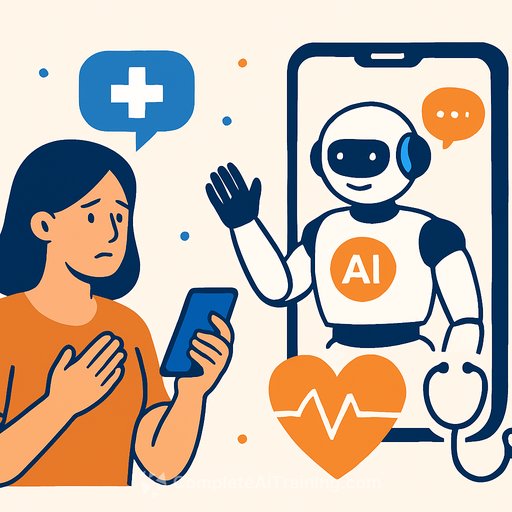
Virtual care matured. Symptom triage, appointment routing, and automated follow-ups got AI help. Patients in smaller towns waited less and received clearer next steps.
Clinicians, however, pressed for guardrails. Symptom checkers trained on urban data can mislead in different populations. Oversight stayed non-negotiable.
Planning and surveillance move to foresight
Hospitals and public health teams leaned on predictive analytics to prep for spikes in dengue and influenza-like illness. Bed capacity, medicine stocks, and staffing plans became less guesswork and more data-informed. Teams working on inventory planning and forecasting can follow the AI Learning Path for Supply Chain Analysts to build practical skills for these problems.
The limiter: uneven data quality across states and districts. Better inputs are the bottleneck to better forecasts.
Private sector moves faster than the public system
Corporate chains invested heavily in AI-assisted radiology, pathology, and patient management, often presenting them as premium features. Startups pushed chronic disease tracking and AI-enabled EMRs to keep longitudinal care on track.
The risk is obvious: a growing digital divide. Urban, high-end hospitals advance first while resource-limited settings wait for trickle-down benefits.
Ethics, privacy, and accountability
As datasets grew, so did questions. Who is responsible when software misses a diagnosis-the clinician, the hospital, or the vendor? How are models audited for bias across gender, age, and marginalized communities?
India's digital health stack progressed, but governance still lagged real-world deployment. For reference, see the Ayushman Bharat Digital Mission and WHO's guidance on AI ethics in health here.
The human element still matters
AI sped up triage. It widened access. But outcomes still hinged on trained staff, stable workflows, and trust. In several sites, limited training turned AI into extra clicks, not relief.
Patients needed clarity: the machine assists; the clinician decides. Teams that communicated this well saw smoother adoption and better adherence.
What healthcare leaders can do next
Leaders responsible for procurement, governance, and scaling AI across networks may find practical guidance in the AI Learning Path for Supply Chain Managers.
- Set clinical guardrails: Define when AI can support decisions and where it cannot. Keep a clear human-in-the-loop protocol.
- Demand local validation: Insist on performance metrics by age, sex, and region. Test on your patient mix before scale-up.
- Build a lightweight AI formulary: List approved tools, intended use, owners, and fail-safes. Review quarterly.
- Train for workflows, not features: Short, role-based modules for radiologists, nurses, technicians, and admins. Practice failure modes.
- Integrate, don't bolt on: Push vendors for seamless PACS/LIS/HIS integration and minimal extra clicks.
- Track real outcomes: Monitor turnaround times, miss rates, false alarms, and patient wait times. Tie renewal to measured gains.
- Protect data by design: Minimize collection, anonymize where possible, and log access. Map your data flows and retention timelines.
- Audit bias and drift: Schedule periodic rechecks of model performance. Recalibrate with fresh, diverse data.
- Plan for scale in low-resource settings: Choose tools that work offline or with variable bandwidth and basic hardware.
- Communicate with patients: Simple consent language, clear purpose, and an opt-out path where feasible.
Procurement checklist (use before you sign)
- Intended use, regulatory status, and performance on local data
- Integration effort (PACS/LIS/HIS), downtime plan, and on-call support
- Data handling (storage, encryption, deletion), audit logs, and access controls
- Bias evaluation, monitoring plan, and retraining commitments
- Liability terms, indemnity, and incident response procedures
- Total cost of ownership: licenses, compute, integration, and training
Bottom line
2025 proved AI can relieve pressure points-diagnostics, triage, and planning-without fixing everything. The wins show up where leaders pair tech with training, governance, and steady change management.
Keep it simple: validate locally, integrate well, measure outcomes, and keep clinicians in control. If you're building internal capability, structured upskilling helps-see AI courses by job.
Your membership also unlocks: