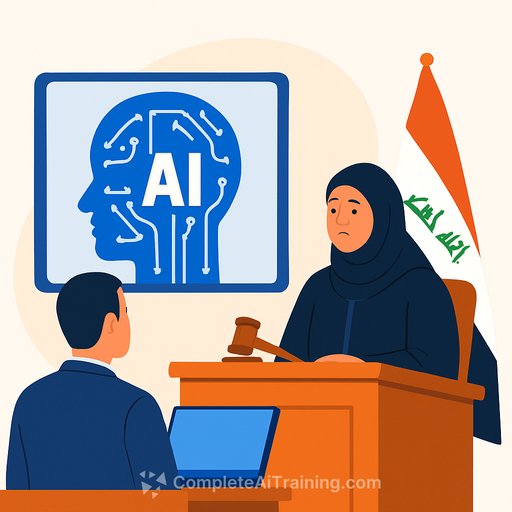
UNESCO backs AI studies at Iraqi Judicial Institute: what this means for judges, prosecutors, and court administrators
UNESCO has confirmed that the Iraqi Judicial Institute has added a new course on artificial intelligence and judicial processes to its curriculum. It is the first formal AI-focused course inside Iraq's judicial education system.
The subject is already live for the 48th Judicial Training Course and the 49th Public Prosecution Course. The program title: Artificial Intelligence and Judicial Processes: Legal, Criminal, and Ethical Frameworks.
This update follows a strategic decision by the Supreme Judicial Council to modernize the Institute's curriculum and match global digital shifts in court operations. Instruction is led by Diaa Al Sarai, a communications and information expert at UNESCO Iraq, signaling confidence in national expertise and local capacity building.
What the new course actually covers
- International comparative experiences where courts and justice institutions already use AI.
- Legal and criminal liability issues tied to AI-assisted decisions, with attention to due process and fair trial guarantees.
- Ethical safeguards, including bias mitigation, transparency, explainability, and auditability.
- Hands-on work with prominent AI applications that relate to judicial tasks, plus risk identification and scenario planning for secure deployment.
A practical guide accompanies the course as a core reference, placing Iraq alongside regional peers that are formally integrating AI into judicial training.
Why this matters for legal professionals
See AI for Legal for practitioner-focused resources and training paths related to courts, counsel, and prosecution.
- Case management and filings: Expect more AI-assisted triage, document analysis, and scheduling support. Counsel should anticipate AI-generated summaries and prepare to challenge or adopt them based on reliability.
- Evidence and procedure: Courts will need clear standards for admitting AI-derived insights, validating methods, and preserving an auditable chain for models, data, and prompts.
- Rights and accountability: Parties may seek disclosure about model provenance, datasets, safeguards, and known limitations. Judges will balance efficiency with transparency and the right to contest automated outputs.
- Data protection and confidentiality: Any deployment must respect privilege, witness safety, and sensitive-state data. Strong access controls and logging are non-negotiable.
- Procurement and oversight: Vendor contracts should include testing for bias, error rates, update policies, and independent audits. Human-in-the-loop controls should be explicit.
How this aligns with international guidance
The course theme maps closely to global instruments focused on safe AI use in public institutions, including judicial bodies. For context, see the UNESCO Recommendation on the Ethics of AI and the OECD AI Principles:
For policy analysis and methodological studies that inform governance and ethics in AI, consult AI Research.
Practical next steps for courts and practitioners
- Bench and policy notes: Draft guidance on the use of AI in legal research, drafting assistance, risk screening, and evidence handling.
- Disclosure protocols: Define when parties must disclose AI use in filings and expert work, including methodology and validation details.
- Pilot projects with guardrails: Start small (e.g., admin workflows or non-dispositive tasks), measure accuracy, bias, and time saved, then iterate.
- Oversight and record-keeping: Require audit trails for datasets, model versions, outputs, and human reviews.
- Training pathways: Extend AI literacy to judges, prosecutors, defense counsel, and court staff to ensure informed, consistent practice.
Who is teaching and how it will be implemented
Delivery by Diaa Al Sarai reflects a push to develop local capability rather than outsource expertise. The course's applied design-comparative analysis plus hands-on labs-gives trainees a realistic view of opportunities and risks before any technology is embedded in core judicial functions.
The bigger picture
This move is framed as a path to a more efficient and transparent justice system, while protecting judicial independence, fair trial guarantees, and the rule of law. Expect measured experimentation, policy refinement, and a growing body of practical doctrine as Iraq's courts engage with AI in a controlled, accountable way.
If you're building your own AI literacy plan for legal work, you can review curated training paths here: AI courses by job role.
Your membership also unlocks: