
AI news ·
Uneven access to radiology AI deepens healthcare disparities
Medicare's AI stroke payment favored large hospitals, with the tool used in under 15% of cases. This uneven access risks widening healthcare disparities at poorer facilities.
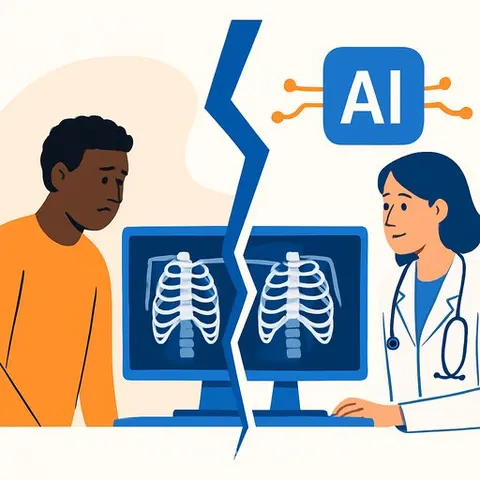
Uneven patient access to radiology artificial intelligence could deepen America's healthcare disparities, according to new research from the Neiman Health Policy Institute. Medicare's New Technology Add-On Payment (NTAP) gives hospitals extra money to adopt new technologies, but the economics of adoption may still leave low-resource sites behind, researchers reported June 24 in the American Journal of Neuroradiology.
To understand the divide, researchers analyzed a 5% sample of Medicare claims from 2020 to 2023, covering more than 2,100 acute ischemic stroke episodes across 1,100 healthcare facilities. The add-on payment was created for an AI tool that detects large vessel occlusion, a blockage in a major artery supplying the brain. Quickly identifying this condition is critical so patients can receive prompt treatment.
Where AI use concentrated
Use of the add-on payment peaked at around 21% of stroke cases in 2022, then declined in 2023 as the temporary code began to sunset. Overall, AI was used in fewer than 15% of analyzed cases. The payment-backed AI use was most common in episodes involving CT imaging, comprehensive stroke centers, or hospitals with more than 1,000 beds. No disparities emerged across patient demographics or stroke severity measures.
But deeper analysis revealed geographic and institutional divides. In 2022, AI use was about six times higher among beneficiaries in the Southeast's "Stroke Belt," and roughly 1.5 times higher at comprehensive stroke centers. Hospitals serving more socioeconomically deprived areas were significantly less likely to use the payment-supported AI. "AI tools have the potential to improve speed and accuracy in stroke detection, but our findings show that access to these technologies depends more on where a patient is treated than on their clinical needs," said lead author Casey Pelzl, MPH, principal research scientist at the Neiman Institute.
Operational barriers limit wider use
Co-author Maria X. Sanmartin, PhD, an assistant professor at the Zucker School of Medicine at Hofstra/Northwell, said that even when AI tools are available, operational readiness, infrastructure, and clinical workflows determine whether they are actually used. "When adoption is concentrated in facilities that already excel in stroke care, it misses the opportunity to improve care in less-resourced settings where potential gains are the greatest," she said.
Common barriers include challenges integrating AI into existing workflows, provider distrust, and steep learning curves for staff. Those learning curves hit harder at facilities that are not designated comprehensive stroke centers. Smaller sites also face tougher economics, needing more resources to support deployment. The researchers point to shared AI-as-a-service hubs as a way to bridge the gap. "Centralized service models have proven effective in helping under-resourced facilities move to more advanced, efficient and effective care," they wrote.
This uneven distribution reflects a broader challenge in AI for Healthcare: ensuring that innovations reach the patients who need them most. The authors cautioned that selective access to AI at hospitals with greater financial, technological and training resources may further increase disparities in stroke evaluation and management. They called for future research to evaluate the impact of NTAP code approval on diffusion and uptake of AI and on patient outcomes. The study was supported by a grant from the American Heart Association.
Why this matters for healthcare professionals
For hospital administrators, radiologists, and stroke program leaders, the study signals that reimbursement incentives alone won't close the AI access gap. The findings suggest that where a patient is treated can determine whether they benefit from AI-enhanced stroke evaluation. Leaders should examine whether their own institutions are deploying AI equitably and consider shared service models or partnerships that can extend AI access to smaller or under-resourced facilities. Without deliberate effort, the technology risks widening the very disparities it could help narrow.