Unilever partners with Google Cloud to scale AI across marketing and commerce
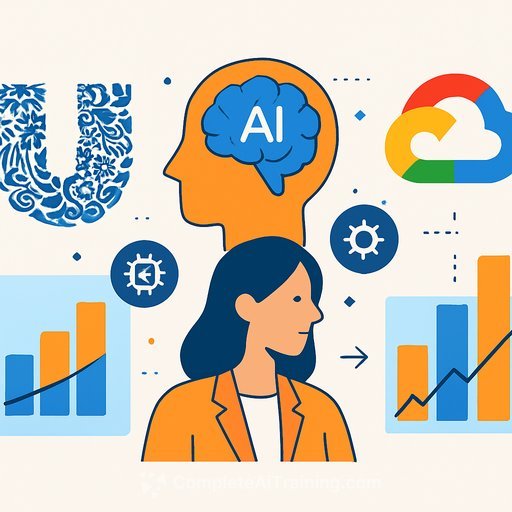
Unilever has signed a five-year deal with Google Cloud to push AI deeper into marketing, measurement, and shopping experiences. The goal: unify data, speed up insight cycles, and test "agentic commerce" where AI systems guide product discovery and purchase flows.
For marketers, this points to a clear shift-less tool sprawl, more connected data, cleaner attribution, and faster experimentation at global scale.
Why this matters
Most brands still struggle to connect marketing data with commerce outcomes. Complex stacks and scattered data slow decisions and hide true ROI.
By linking marketing intelligence to cloud systems, Unilever is aiming for real-time signals, stronger conversion tracking, and faster media optimization across markets.
What "agentic commerce" could look like
Agent-supported commerce means AI guiding actions across the funnel. Think dynamic product recommendations, search-tuned listings, and checkout guidance that adapts to customer intent.
In practice, this can reduce friction from first touch to purchase, help teams prioritize high-intent moments, and close the loop between media and sales.
What Unilever is building with Google Cloud
- Unified data systems: Bringing consumer, campaign, and commerce data into shared platforms for always-on analysis.
- AI-driven measurement: Smarter conversion tracking, faster incrementality testing, and more reliable signal loss workarounds.
- Agent-led experiences: Exploring AI agents that improve discovery, search visibility, and merchandising across channels.
- Global-to-local scale: Central insights shared across 190+ markets, with local teams adapting offers, timing, and creative.
The bigger shift in martech
Marketing tech is moving from isolated tools to integrated platforms where data, media, and shopping are tightly connected. Many organizations still underuse their stacks-Gartner reports marketers use about half of available martech capabilities, which limits outcomes.
Gartner's findings underline why simplification and integration matter as AI becomes standard in search, retail media, and social algorithms.
What marketers should do now
- Unify first-party data: Map customer, product, and media tables to a common ID strategy. Kill duplicate dashboards.
- Tighten measurement: Pair MMM for budget strategy with MTA/conversion APIs for in-channel optimization. Predefine incrementality tests.
- Ship agent use cases: Start with high-impact flows-on-site search, recommendations, PDP content, cart recovery.
- Create a signals plan: Define what "good" signals look like by channel (intent, quality, cost). Automate feedback loops into bidding and creative.
- Governance and safety: Set data access rules, human-in-the-loop approvals, and PII/consent controls before scaling automations.
- Talent upgrade: Train media, analytics, and ecom teams on AI workflows, not just tools. Codify playbooks and reusable prompts.
KPIs to watch
- Speed to insight: Time from data arrival to decision (hours, not days).
- Signal quality: Share of conversions with modeled or direct attribution; lift vs. holdout.
- Commerce impact: Product discovery rate, add-to-cart rate, CVR, and AOV by audience and placement.
- Media efficiency: ROAS, CAC, contribution margin after media.
- Reuse rate: % of campaigns using shared data assets, agent components, and measurement templates.
Execution watchouts
- Data drift: Keep schemas, taxonomies, and consent states consistent across markets.
- Attribution bias: Balance short-term platform metrics with incrementality and MMM to avoid overfitting.
- Model debt: Version models, monitor degradation, and retrain on fresh signals and creative changes.
- Local nuance: Centralize infrastructure, decentralize tactics. Protect cultural context in creative and offers.
Tools perspective
Google Cloud brings data processing, predictive modeling, and campaign insights that plug into existing stacks. Vertex AI, for example, supports custom models and agents that can be embedded in commerce and marketing workflows.
Explore Vertex AI for model training, evaluation, and deployment across markets and channels.
Bottom line
Unilever's partnership signals how large brands plan to connect marketing and commerce with AI at the core. The winners will standardize data, prove causality, and ship agent-led experiences that make buying easier-without sacrificing governance or local fit.
If you're building a multi-year roadmap, start with a clear operating model, a small set of high-value AI use cases, and training that brings your team along. See the AI Learning Path for CMOs for strategy, governance, and rollout frameworks.
Your membership also unlocks: