Healthcare unions call for worker-led rollout of AI in Ireland's public health service
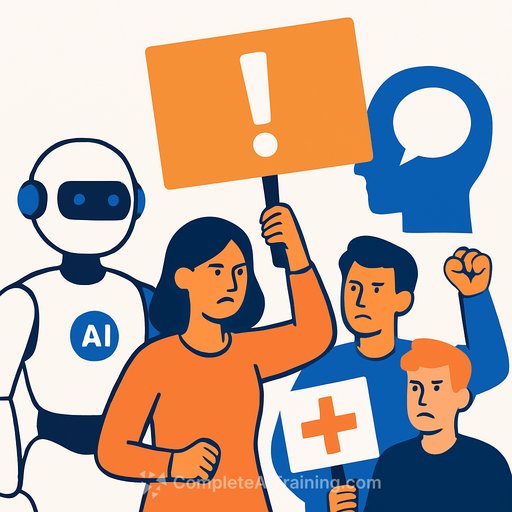
Healthcare unions want a seat at the table as Ireland rolls out AI for Care, the first national strategy for AI in health and social care. They say the plan was published without adequate engagement and warn that benefits will only land if frontline staff help design how AI is used.
The strategy promises practical gains: faster diagnosis, smoother patient flow, less paperwork for clinicians, earlier detection of disease, more consistent care, and better use of resources. The question on the floor is how to deliver those outcomes safely, with clear accountability and trained teams.
What AI for Care promises
- Faster diagnosis and earlier detection to reduce delays and missed disease signals.
- Improved patient flow and triage to ease bottlenecks across settings.
- Less administrative burden for clinicians so time shifts back to patient care.
- More consistent decision support, aiming for safer and more equitable care.
Unions: progress must be human-led, co-designed, and safe
INMO Deputy General Secretary Edward Mathews said, "For the potential benefits of AI to be seen in our public health system, or for the significant risks to be appropriately mitigated, the members we represent must be involved in development and implementation, with codesign at the heart of all steps." He added that safeguards, training time, resources, and clear accountability are essential "to protect patients."
SIPTU Head of Health Division Kevin Figgis said the future of care must remain human-led: "The Irish public health service must be seen as an attractive place to work that is at the cutting edge of future technology but is one that is staffed correctly and safely."
Fórsa's Head of Health and Welfare Division, Ashley Connolly, said unions have sought an urgent meeting with the HSE Chief Technology Officer to discuss implementation. "Any advancement of AI initiatives must be accompanied by appropriate protections to ensure that patient care remains safeguarded through effective human oversight," she said.
Department of Health response
The department acknowledged the HSE's central role in delivering AI for Care and welcomed union input. It noted concerns about staff engagement, training, and human oversight, and said it supports ongoing collaboration to ensure AI supports-rather than replaces-healthcare professionals while enhancing patient care.
Why this matters for your team
AI will change workflows before it changes headcount. The fastest wins usually come from admin relief and clinical decision support, which only work well when clinicians shape prompts, thresholds, and escalation rules-and when every tool has a clear owner.
If you lead a service, your early moves will determine whether AI reduces pressure or creates rework. Start small, measure hard outcomes, and keep a human in the loop on every safety-critical step.
Practical checklist for safe AI rollout
- Governance: Assign clinical, data, and operational owners for each AI use case. Define stop/go criteria and escalation paths.
- Clinical validation: Require prospective piloting with agreed metrics (accuracy, false positives/negatives, time saved, impact on outcomes).
- Human oversight: Keep clinicians as decision-makers. Make "AI suggestions" clearly visible, explainable where possible, and easy to override.
- Training and time: Ring-fence hours for staff training and backfill so learning doesn't happen on overtime.
- Safety and accountability: Document responsibilities, audit trails, and incident reporting that include the AI component.
- Data protection: Confirm lawful basis, minimisation, retention, and security. Use de-identification where practical.
- Patient communication: Inform patients when AI is involved and how clinicians supervise it. Offer a way to raise concerns.
- Equity and bias: Monitor performance across demographics. Set triggers for review if disparities appear.
- Workflow fit: Map steps before and after AI. Remove duplicate clicks and double entry, or the burden shifts to clinicians.
- Vendor management: Specify service levels, model updates, validation after updates, and exit plans.
What happens next
Unions have requested an urgent meeting with the HSE CTO to shape implementation. Expect early pilots to be scrutinised for training provision, staffing impact, and whether human oversight is built into each pathway.
For teams preparing now, identify one or two low-risk, high-friction processes-discharge summaries, referral triage, or imaging worklists-and blueprint how AI could help. Start with a small pilot, collect baseline data, and publish results for staff and patients.
Further reading: AI for Healthcare
Your membership also unlocks: