Universities Race to Teach Students How to Spot AI-Generated Scientific Fraud
Generative AI now produces scientific misinformation that looks credible. It includes convincing explanations, citations that may be fabricated, and professional visualizations. For students still developing academic judgment, distinguishing between legitimate research and AI hallucinations has become genuinely difficult.
Universities face a straightforward pedagogical problem: how do you train students to evaluate scientific claims critically when AI can convincingly simulate the language of scholarship itself?
Building Mental Antibodies Against Misinformation
One effective strategy borrows from psychology. Inoculation theory suggests that exposing people to a weak dose of misinformation, followed by clear refutation, builds resistance to persuasion techniques.
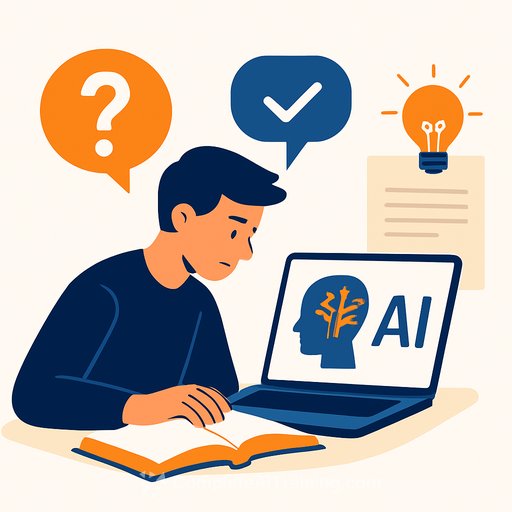
In practice, this means showing students actual AI-generated scientific claims and walking them through verification. An instructor might present a fabricated infographic or research summary, then debrief students on its misleading tactics. Students learn to spot logical fallacies, false dichotomies, and ad hominem attacks commonly embedded in misinformation.
The key: this cannot be a one-time workshop. Because AI systems generate new variations of misleading claims instantly, a single inoculation fades quickly. Brief, recurring exercises scattered across courses throughout a semester work better than a single session.
If students analyze an AI claim about genetic modification in one module, they should encounter a different example about climate policy or public health later and apply the same analytical tools. Repeated exposure teaches students to recognize persuasion patterns across different contexts.
Scientific Media Literacy Across Disciplines
Inoculation works best paired with scientific media literacy-understanding scientific content while evaluating how claims appear in news, social media, and AI outputs.
This cannot stay confined to science departments. Different courses can teach critical reading:
- A politics class analyzes how media frames scientific uncertainty during policy debates
- A business course examines sustainability reports to assess how evidence is presented
- A literature seminar explores how fiction constructs narratives about science and technology
- A computer science course examines where generative AI produces hallucinated citations
Using AI-generated summaries alongside real research papers gives instructors a direct way to test whether students can judge evidence quality and identify bias. Ask students to verify the references in an AI summary. Fabricated citations make AI limitations immediately visible.
Why This Matters for Teaching
Students should understand that scientific knowledge is often contested. During the Covid-19 pandemic, evolving guidance was frequently misinterpreted as incompetence rather than normal scientific revision. Classrooms can clarify how consensus forms, why recommendations change with new evidence, and how uncertainty differs from unreliability.
Making these processes visible reduces the likelihood students will misinterpret disagreement as failure.
Universities cannot eliminate misinformation. They can equip students to navigate it. This requires sustained, interdisciplinary attention to how evidence is produced, communicated, and contested-not a single module added to the curriculum.
In an era where AI generates persuasive scientific misinformation at scale in seconds, the ability to evaluate claims responsibly is no longer optional. It is a core outcome of higher education.
For educators building these competencies, resources on AI for Education and AI Research Courses can support faculty development and curriculum design.
Your membership also unlocks: