University of Nevada Builds Autonomous Robot to Track Sheep Health on Open Range
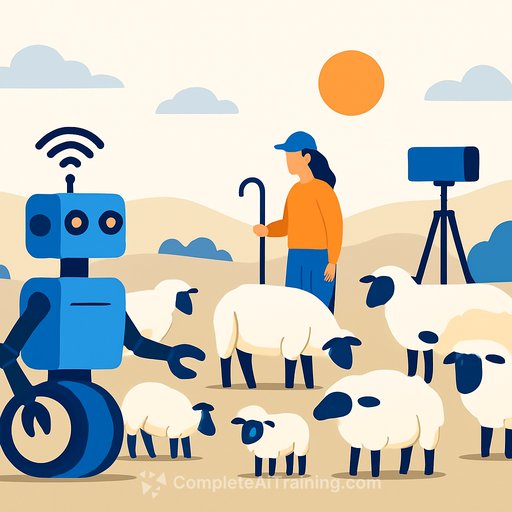
Researchers at the University of Nevada, Reno are developing an autonomous robot that carries water to sheep across open pastures while using facial-recognition AI to identify individual animals and monitor their health. The "RoboHydra" system represents the first project of its kind in the sheep industry.
The university received $1.15 million in federal funding over four years for the project, awarded by the Agriculture and Food Research Initiative, a program of the U.S. Department of Agriculture's National Institute of Food and Agriculture.
How RoboHydra Works
The robot carries a closed water tank and uses a push-activated bowl so sheep can drink on demand. A flow meter tracks water consumption for each animal, while onboard sensors capture facial images, thermal data, movement patterns and activity levels as sheep approach to drink.
Parikshit Maini, assistant professor of robotics, leads the project. His team will build the system in stages, starting with a 110-pound prototype. The full-size version will weigh up to 4,000 pounds and carry enough water to support about 50 sheep.
The robot's onboard computer analyzes grazing and water-use patterns to determine when and where to move next. This approach eliminates the need for fixed troughs and allows the robot to guide sheep to underused pastures without fencing or direct human involvement.
"We're putting autonomous robots and sheep together in real pastures, not controlled labs, and developing advanced algorithms to let them interact safely," Maini said.
AI Identifies Individual Animals
Ankita Shukla, assistant professor of artificial intelligence, leads development of AI models that analyze sensor data. The system will be trained to recognize individual sheep based on facial features and link those identities to physical condition, movement and behavior patterns.
This approach could eventually reduce the need for ear tagging and extensive manual record-keeping. By drawing from multiple data sources rather than single observations, the system aims to produce a more objective picture of each animal's health.
Andrew Hess, assistant professor of animal genetics and breeding, will pair the collected data with genetic information to understand how performance is shaped by both DNA and management. The insights could help improve wool and meat quality while supporting overall flock health.
Testing Begins With University Flock
The team will test RoboHydra at the university's Main Station Field Lab using 300 Rafter 7 Merino yearling rams. The Rafter 7 line, developed by the university more than 30 years ago, is internationally recognized for fine wool and meat quality.
Tracy Shane, an Extension livestock specialist, will translate research findings into course materials for a new university class on precision livestock management using AI, robotics and genomics. She will also lead outreach to producers across Nevada through workshops and demonstrations.
National Data Collection Effort
A second complementary project, also funded with $1.15 million, will expand data collection to the national level. Led by Hess, this effort will generate a broader dataset from multiple sheep operations and research flocks in Nevada, North Carolina and Wyoming.
The project will pair health indicators, feed intake, wool quality and movement data with genetic, microbial and economic information. The goal is to develop breeding indexes and decision-support tools to help producers predict disease risk, estimate time to market weight and track feed efficiency.
Data collected will be contributed to the National Sheep Improvement Program, a nonprofit that provides genetic evaluation services to sheep producers. Hess noted that sheep producers have had fewer resources available compared to cattle and swine industries.
"Sheep producers are being asked to do more with fewer resources and under increasingly unpredictable conditions," Hess said. "By combining genetics, health records and real-time data from flocks across the country, we can turn complex science into practical tools."
Building the Next Generation of Researchers
The projects will train graduate students and early career researchers in data-driven livestock production. The team includes doctoral and master's students as well as collaborators from Purdue University, North Carolina State University, the University of Wyoming, and the U.S. Department of Agriculture's Agricultural Research Service.
Outreach to K-12 students will occur through Washoe County schools, summer camps, Extension's 4-H program and after-school robotics programs. Students will explore how robotics and AI support animal care through short videos and hands-on activities.
The university sees these projects as an important first step in addressing persistent challenges in sheep production. A successful pilot could lead to a future where robotics and AI work alongside sheepherders to deliver data directly to producers through reports or dashboards.
Your membership also unlocks: