University of Virginia researchers release free AI tools to accelerate drug design
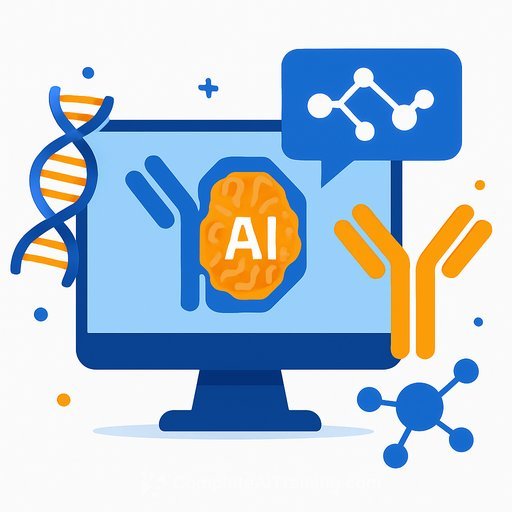
Scientists at the University of Virginia School of Medicine have built three AI-powered tools that model how proteins actually move when drugs bind to them, addressing a fundamental problem in pharmaceutical development.
The tools - YuelDesign, YuelPocket, and YuelBond - use diffusion models and neural networks to design drug molecules that fit proteins as they shift shape, rather than treating them as static targets. The team released them free to the scientific community.
Why protein movement matters
Drug development fails at scale. Around 90% of new drugs fail human testing, and the average cost to bring one to market now exceeds $2.6 billion. A major culprit: molecules don't behave predictably when they interact with moving proteins.
Proteins undergo what researchers call "induced fits" - they change shape after a drug binds to them. Traditional computational models treat proteins as frozen structures, making it nearly impossible to predict whether a designed drug will actually work in the body.
Nikolay V. Dokholyan, a neurology researcher at UVA, described the problem this way: "Other methods try to design a key for a lock that's sitting perfectly still, but in your body, that lock is constantly jiggling and changing shape. Our AI designs the key while the lock is moving, so the fit is much more realistic."
How the tools work together
YuelDesign generates drug molecule shapes using diffusion models. YuelPocket identifies where on a protein a molecule can attach using graph neural networks. YuelBond verifies the chemical bonds in the designed molecules are chemically valid.
When the team tested the approach on CDK2, a protein involved in cancer, only YuelDesign captured the structural changes that occur when a drug binds. Existing tools missed them.
Dr. Jian Wang, another researcher on the project, said: "Most existing AI tools treat the protein as a frozen statue, but that's not how biology works. Our approach lets the protein and the drug candidate evolve together during the design process, just as they would in the body."
Implications for development teams
For developers and IT professionals working on scientific computing, the release signals a shift toward AI tools built for real-world molecular dynamics rather than simplified models. The code is open to researchers globally.
Dokholyan said the goal is straightforward: "Make drug discovery faster, cheaper and more likely to succeed, so that promising treatments can reach patients sooner."
Your membership also unlocks: