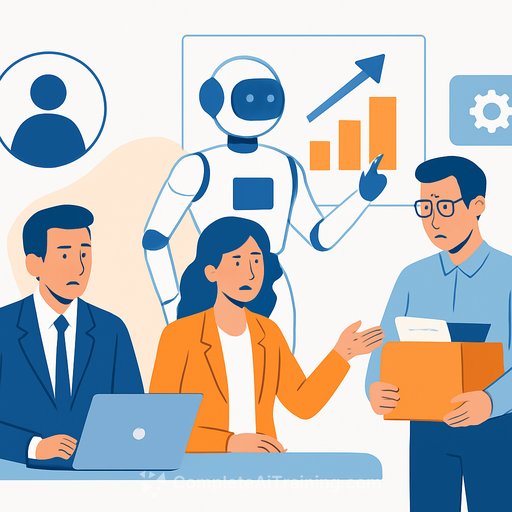
Upsales reorganises product team after AI-driven efficiency gains
Upsales (Nasdaq First North: UPSALE) announced a strategic reorganisation of its product organisation following strong efficiency gains from internal AI adoption. Over the past year, AI has accelerated how the company builds, enabling faster, more focused product development.
As a result, Upsales plans to streamline parts of the organisation, with approximately 14 positions expected to be phased out. The planned changes are subject to consultation with union representatives under Swedish labour law. For context on consultation duties, see Sweden's labour law overview from the Government Offices of Sweden here.
"This is not about reducing costs or changing our growth strategy," said Daniel Wikberg, CEO and founder of Upsales. "We have a profitable business, strong financials, aggressive product development roadmap and ambitious growth plans. And we continue to invest aggressively in strategic areas across product, sales, and marketing. But as we adopt new ways of working, it becomes clear that our future organization needs different capabilities and profiles."
Wikberg added: "The people affected are highly skilled and have made important contributions to our journey. We are deeply grateful for their work, and we will actively support them in finding new opportunities."
Why this matters for product leaders
- AI deflates coordination costs. Expect fewer handoffs, tighter squads, and more emphasis on outcomes instead of output. Shift capacity from low-leverage tasks to data quality, model evaluation, instrumentation, and UX.
- Skill mix is changing. Product managers need clear problem framing, basic prompt/testing literacy, and stronger metrics discipline. Engineers benefit from experience with automation, evaluation suites, and data pipelines. Designers should be comfortable with conversational patterns and uncertainty in model behavior.
- Quality and risk need explicit guardrails. Set acceptance criteria for AI features (quality thresholds, latency targets, failure modes, rollback plans). Treat evaluation as a first-class part of the development process.
- Team topology will evolve. Smaller, autonomous squads supported by an enablement/platform group for shared AI tooling, data access, and experimentation practices.
- Reskilling beats rehiring by default. Map roles to new capabilities, run short learning sprints, and update career ladders. If you need structured options, you can explore role-based AI upskilling resources here.
What to watch at Upsales
Upsales states the move is not a cost-cutting pivot or a change in growth strategy. The company highlights profitability, a bold product roadmap, and ongoing investment across product, sales, and marketing.
Expect role definitions and hiring profiles to evolve as workflows change with AI in the loop. The focus will be speed-to-learning, cleaner data pathways, and tighter feedback cycles between customers, product, and engineering.
Practical next steps for your org
- Audit your development flow: cycle time, review delays, context-switching, and rework. Remove steps that don't increase product learning or reliability.
- Identify tasks that AI can automate or accelerate (research synthesis, test case generation, code suggestions) and re-scope responsibilities accordingly.
- Define clear evaluation metrics for AI features: quality, safety, uptime, and regression monitoring. Make failure modes observable and fixable.
- Upskill the team where it matters most: data literacy for PMs, evaluation frameworks for QA, and AI tooling fluency for engineers.
Upsales continues to position itself as a leader in AI-driven B2B growth, with a growing product portfolio and a focus on helping executive teams make faster, smarter decisions.
Your membership also unlocks: