US and EU Regulators Align on Principles for AI Use in Pharma: What Healthcare Teams Need to Do Next
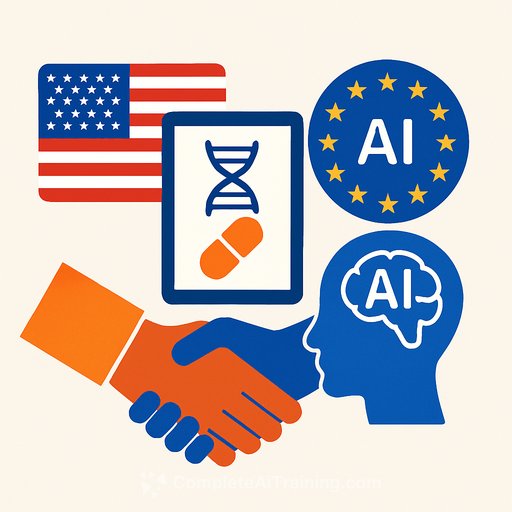
Regulators in the United States and European Union jointly released a set of agreed-upon principles to guide the use of AI across the medicines lifecycle. For healthcare and biopharma teams, this is welcome clarity. It signals convergence on expectations and a push for disciplined, documented practice-not experimentation without guardrails.
The message is simple: use AI where it helps, manage risk proportionally, and keep people accountable. Patient safety, product quality, and data integrity remain non-negotiable.
Key takeaways
- Risk-based approach: Classify AI systems by clinical and quality impact; apply controls accordingly.
- Human oversight: Keep qualified experts in the loop for high-impact decisions in development, manufacturing, and safety.
- Data governance: Provenance, bias control, privacy, and security must be documented and auditable.
- Validation and lifecycle control: Treat AI like any other GxP system-requirements, verification, change control, and revalidation when models drift.
- Transparency: Make model purpose, limits, and performance clear to users and inspectors.
- Vendor accountability: Contracts should cover training data quality, updates, security, incident response, and audit rights.
What this means for clinical, quality, and regulatory teams
Expect more questions during inspections and submissions about how AI systems are validated and monitored. If AI informs trial design, patient selection, signal detection, CMC decisions, or batch release, you'll need traceability from input to outcome.
SOPs and training must reflect these principles. "We use AI" won't fly-show the controls, measurements, and decisions behind it.
Immediate steps (next 30-90 days)
- Create an inventory of all AI-enabled tools in use or in pilot across R&D, PV, manufacturing, medical, and commercial interfaces.
- Risk-tier each use case (e.g., patient safety-critical, product quality-critical, business-only). Document the rationale.
- Define minimum validation packages per tier: datasets, acceptance criteria, performance thresholds, bias checks, and human review points.
- Update SOPs for model change control, dataset updates, drift detection, and decommissioning.
- Close gaps in data lineage: source, transformations, consent, access logs, and security controls.
Operational impacts you should plan for
- Clinical and RWE: Clear justification for feature selection, inclusion/exclusion logic, and fairness checks across subgroups.
- Pharmacovigilance: Human verification of high-signal outputs; thresholds aligned to case processing SOPs.
- CMC and manufacturing: Model performance tied to process control limits; batch-impact assessments for any update.
- IT/Compliance: Model registry, audit trails, role-based access, and defensible backup/restore for training artifacts.
Documentation regulators will expect to see
- Intended use, risk classification, and context of use.
- Training/validation datasets with provenance and bias assessment.
- Performance metrics relevant to patient safety and product quality, including limits and confidence intervals.
- Human-in-the-loop design: who reviews, when, and how disagreements are resolved.
- Change control records, versioning, drift monitoring, and triggers for revalidation.
- Vendor due diligence and ongoing oversight, including security and incident handling.
Leadership checklist
- Appoint accountable owners for AI risk, validation, and monitoring across functions.
- Stand up an AI governance forum that signs off on high-impact use cases before deployment.
- Align training plans for teams interacting with AI outputs-what to trust, what to challenge, and when to escalate.
- Plan for cross-border data issues early to avoid late-stage delays.
Why this is good news
Alignment reduces guesswork. A shared set of principles means fewer regional surprises and faster agreement on what "good" looks like.
Teams that move now-standardizing validation, documentation, and oversight-will ship safer products and face smoother reviews.
Useful references
Skill up your team
If your organization is rolling out AI across research, manufacturing, or safety, make sure your staff knows how to validate and govern it. Explore role-based learning paths such as AI Learning Path for Regulatory Affairs Specialists, the AI Learning Path for CIOs, and the AI Learning Path for Training & Development Managers.
Your membership also unlocks: