Inside the US-China AI Rivalry: Military and Educational Implications
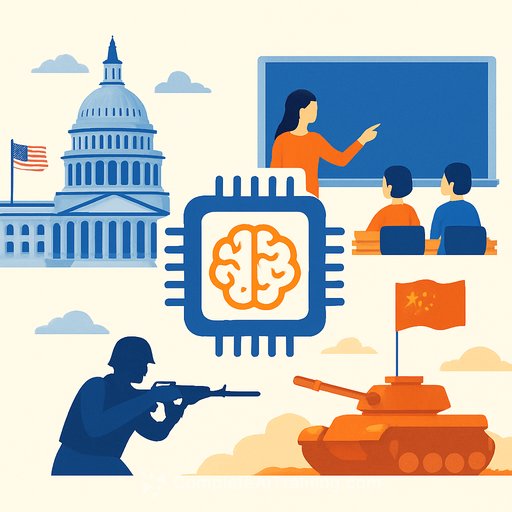
In Washington, D.C., a Senate subcommittee held a hearing titled "Countering China's Challenge to American AI Leadership." The core message was clear: AI is now a strategic asset, with direct spillover into defense and the classroom.
Industry voices, including technology entrepreneurs like Rod Martin, framed the stakes across two fronts-military capability and talent development. If you work in education, this is your lane. The choices you make on curriculum, partnerships, and policy will influence national competitiveness over the next decade.
Why this hearing matters to schools and universities
AI leadership depends on a pipeline: students, labs, compute, and data. Policy moves-export controls, research security, and funding priorities-shape which tools you can use and which collaborations make sense.
Expect tighter rules on sensitive research, more scrutiny on cross-border partnerships, and rising demand for AI fluency across every discipline. That's not a future problem. It's a scheduling and procurement problem for this academic year.
The military race: compute, data, and dual-use tech
Both countries are racing to scale compute, model training, and autonomy. Defense applications touch everything from sensor fusion and logistics to electronic warfare and swarms. Civil-military fusion on one side and stricter guardrails on the other create different paths to speed and scale.
For educators, this points to practical curriculum updates: applied machine learning, model evaluation, MLOps, edge AI, cybersecurity, and human-in-the-loop decision systems. Students don't just need theory-they need systems thinking and red-teaming skills.
Education is the new front line
China is investing heavily in STEM pathways, national AI institutes, and skills competitions. The U.S. is countering with new funding, standards, and research security frameworks. Talent-not just models-will decide who leads.
Universities and districts sit at the center: set policy, teach responsible use, and align programs with real demand. That means credible assessment practices, transparent AI policies for coursework, and faculty training that keeps pace with new tools.
What to do this semester
- Publish a clear AI use policy for students and faculty. Define "allowed," "restricted," and "prohibited" use by assignment type.
- Update assessment design: more oral defenses, process journals, versioned drafts, and applied projects that require source evidence.
- Stand up a faculty development plan: prompt-writing, evaluation, and course redesign with AI support.
- Create a data policy for AI tools: storage location, retention, deletion, and model training opt-outs.
- Launch 6-8 week, credit-bearing microprojects with local employers using real datasets and clear deliverables.
- Form an internal AI review group (IT, legal, accessibility, pedagogy) to vet tools and monitor policy changes.
Program ideas that map to national priorities
- Compute-efficient AI: small models, distillation, retrieval-augmented generation, and edge deployment.
- AI security: model red-teaming, adversarial testing, prompt-injection defenses, and audit trails.
- Data ethics and provenance: synthetic data, dataset documentation, and bias evaluation.
- Language tech: multilingual systems and domain adaptation for instruction and accessibility.
- SOC/ops meets ML: logging, monitoring, governance, and incident response for AI-infused apps.
- Semiconductor basics: architectures, memory bandwidth, and parallelism-context for the compute race.
Procurement and partnerships
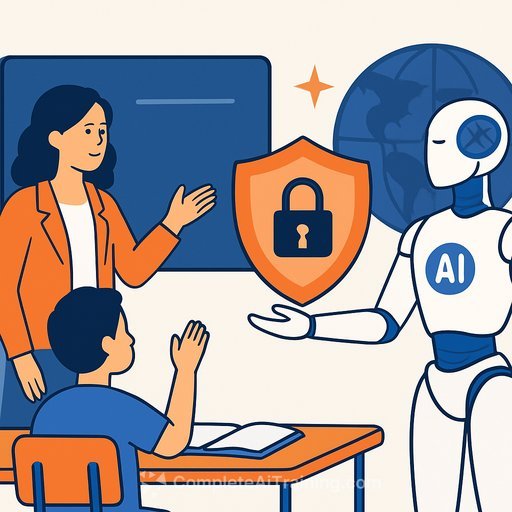
Make vendors prove they protect your community's data and your institution's reputation. Bake requirements into contracts, not just emails.
- Data handling: no training on your data without written permission; deletion on request within 30 days.
- Security: SSO, least-privilege access, audit logs, and documented FERPA-aligned practices; SOC 2 or equivalent.
- Privacy: data residency options; encryption in transit and at rest; clear subprocessors list.
- Accessibility: VPAT, screen-reader support, closed captions, and alt text workflows.
- Interoperability: LTI 1.3 for LMS, standard exports, and clear SLAs for uptime and support.
- Research compliance: export control screening and publication-friendly IP clauses.
Guardrails and ethics you can actually use
Adopt a framework and work it into syllabi and tool reviews. The NIST AI Risk Management Framework is practical for institutional risk and procurement.
For classroom policy and pedagogy, see UNESCO's guidance on generative AI in education for clarity on use, fairness, and assessment integrity: UNESCO guidance.
Funding and signals to watch
- NSF, Department of Education, and DoD calls that prioritize AI education, research security, and workforce programs.
- Export control updates that affect international collaborations, visitors, and lab access.
- CHIPS and Science Act programs tied to workforce and regional tech hubs.
- Visa policy changes for STEM students and researchers.
- Shared compute initiatives for academic research and teaching labs.
For educators who want to level up fast
If you're building courses, setting policy, or running PD, get a structured path. Start with job-specific roadmaps and current tools.
Bottom line: the AI race isn't abstract. It shows up in your syllabus, your LMS, your vendor list, and your graduates' resumes. Make decisions now that compound over the next five years.
Your membership also unlocks: