Date: January 16, 2026
Administration Policies on Advanced AI Chips Codified - What Managers Need to Know
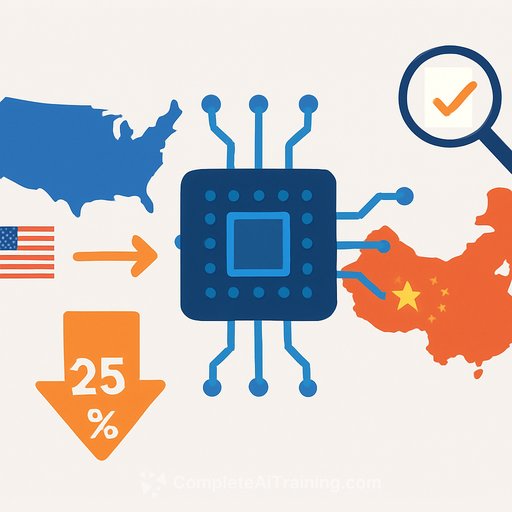
In back-to-back moves, the US government eased export licensing on certain advanced AI chips to China and imposed a 25% tariff on covered chip imports that are not for the US technology supply chain. Expect more deal-by-deal scrutiny, more paperwork, and higher costs if your supply chain touches advanced compute outside the United States.
Bottom line
- BIS shifted its review posture for NVIDIA H200- and AMD MI325X-equivalent chips (and lower) from "presumption of denial" to "case-by-case," with extensive new certifications and end-user disclosures.
- A new 25% tariff now applies to covered advanced AI chips entering the US if they are not destined for US use under defined exemptions.
- Congress is signaling tighter oversight ahead; China's willingness to buy under these terms is uncertain.
What the BIS Final Rule Does
Effective January 15, 2026, BIS formalized a more flexible but data-heavy licensing approach for H200-/MI325X-class and lesser-performing chips. The focus shifts from blanket denials to transaction-specific risk, especially around military, intelligence, surveillance, and restricted parties.
Scope
- Product: Chips at or below H200/MI325X performance using metrics tied to recent advanced computing controls.
- Geography: China remains the focus, but BIS requires disclosures on remote end users in named third countries of concern.
- Risk: Military and other sensitive uses or restricted parties remain high likelihood of denial, regardless of destination.
New License Application Requirements (What your team must be ready to certify)
- Technical metrics: Confirm operation below thresholds and provide total processing performance (TPP), total DRAM bandwidth, interconnect bandwidth, copackaged DRAM capacity, peak power at max TPP, and explanations for spec changes. Independent US third-party lab testing is required to validate performance.
- US market impact: Disclose units shipped in the US; certify with evidence that aggregate TPP exported to China/Macau is less than 50% of aggregate TPP shipped to US customers for US end use; certify sufficient US supply, no US customer delays, and no diversion of foundry capacity from US end users.
- Customer due diligence: Confirm no prohibited end uses/users and no unauthorized remote access; obtain and submit the ultimate customer's KYC procedures to prevent unauthorized remote access; identify customers' end users in Belarus, China, Cuba, Iran, Macau, North Korea, Russia, and Venezuela (including legal names, addresses, ownership, intermediaries, ultimate end users); for AI as a Service providers, verify commitments (including no undisclosed transfer of model weights and no restricted-party remote access to trained algorithms); describe physical security at the consignee.
Translation for managers: legal and compliance workloads just went up. Sales, channel, and cloud teams will need tighter KYC, deeper customer mapping, and verifiable technical documentation before deals move.
Enforcement is getting teeth
BIS is expected to ramp monitoring and validation of application claims. The FY26 budget includes at least $10 million for enforcing end-use and end-user restrictions under ECCN 3A090 and related technologies. Plan for spot checks and requests for proof.
Who Is Affected
- Chip designers and manufacturers shipping H200-class or equivalent parts
- OEMs and integrators embedding controlled chips into servers or clusters
- Cloud service providers and colocation data centers selling access to controlled compute
- Distributors and channel partners with activity in named third countries
- Multinationals deploying controlled chips for AI training or inference across borders
25% Tariff on Covered AI Chip Imports
Effective January 15, 2026, the President imposed a 25% value-based tariff on imports of covered advanced AI chips that are not for the US technology supply chain. While not China-specific, it mirrors the Administration's public stance that a portion of certain H200-class sales to China would be captured as tariffs.
Technical thresholds for covered products
- Logic ICs (or items containing them) with TPP 14,000-17,500 and DRAM bandwidth 4,500-5,000 GB/s; or
- TPP 20,800-21,100 and DRAM bandwidth 5,800-6,200 GB/s.
Exclusions (by specific tariff codes)
- Use in US data centers
- Repairs or replacements in the United States
- US-based R&D
- Use by startups
- US non-data center consumer applications
- US non-data center civil industrial applications
- US public sector applications
Note: A "US data center" is defined as a facility with more than 100 MW of new load dedicated to AI inference, training, simulation, or synthetic data generation. The Secretary of Commerce may identify additional exclusions if imports strengthen the US tech supply chain or domestic manufacturing.
If your company imports covered chips into the US before selling to foreign customers, you may trigger the 25% tariff-even if the end customer is not in China.
Congressional Pressure Is Building
During a January 14 House Foreign Affairs Committee hearing, members and witnesses voiced skepticism about permissive exports to China. Several bills would tighten oversight and prioritize US access:
- AI Overwatch Act: Congressional review and a 30-day notification period for licenses to China and other named countries.
- GAIN AI Act: Priority access for US businesses to advanced AI chips before export to countries of concern.
- STRIDE Act: Coordination with partner countries on semiconductor export controls.
- China AI Power Report Act: Annual Commerce reports to Congress on China's advanced AI capabilities.
- Divesting from Communist China's Military Act: Align Pentagon 1260H entities with Treasury lists.
- Remote Access Security Act: Expands export controls to cover cloud-based services.
China's Response
Early signs point to hesitation. Reports indicate PRC Customs temporarily halted clearance of H200 shipments, and officials urged domestic firms to avoid purchases unless necessary. Expect uneven demand and more indirect routing attempts, which will increase your KYC burden.
Action Plan for Executives (Next 30-60 Days)
- Stand up a cross-functional deal desk: Legal, export compliance, sales ops, cloud engineering, and finance to vet transactions early.
- Map your compute footprint: Identify products meeting the TPP/DRAM thresholds. Confirm which SKUs fall under the tariff and which require licenses.
- Tighten KYC and remote access controls: Collect ultimate customer KYC procedures, remote end-user identities, and physical security details. Build a repeatable checklist for AI as a Service customers.
- Lock third-party testing capacity: Pre-book qualified US lab testing and document results to avoid delays on license submissions.
- Prove US supply sufficiency: Track US unit shipments and TPP allocations. Maintain evidence that less than 50% of aggregate TPP is exported to China/Macau and that US customers face no delays.
- Protect foundry capacity: Contractually reserve capacity for US end users. Document that exports don't divert production from US demand.
- Tariff modeling: Run landed-cost scenarios for imports not qualifying for US-use exemptions. Rework pricing, margin, and incoterms accordingly.
- Channel hygiene: Audit distributors and resellers in named third countries. Add covenants and monitoring to prevent transshipment and unauthorized remote access.
- Cloud and colocation: Verify access controls, logging, and geo-fencing. Ensure no restricted parties can remotely access algorithms trained on controlled chips.
- Communications: Prepare customer letters explaining new requirements, testing steps, and expected timelines to reduce sales friction.
Helpful resources
Upskilling your team
If your managers need a fast way to get fluent on AI workflows, tools, and governance, explore curated programs by role at Complete AI Training.
What This Means for Strategy
Deal velocity will depend on your ability to certify facts with evidence, not promises. The winners will be the companies that operationalize these checks, secure testing slots, and price in tariff exposure without derailing demand.
Build the muscle now: standardize your data collection, pre-qualify customers, and document everything. That's how you keep selling advanced compute without constant fire drills.
Your membership also unlocks: