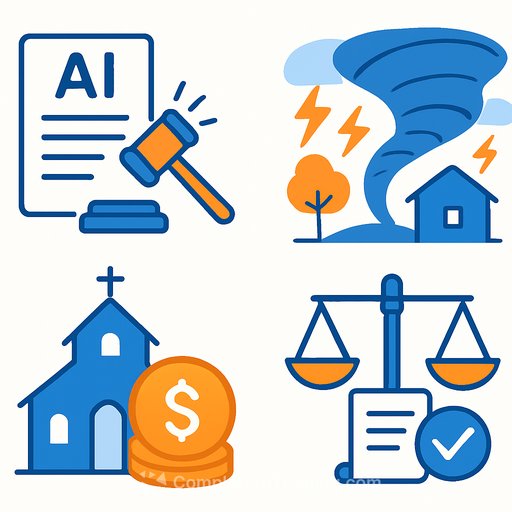
US legal roundup for insurers: AI ethics fight, tornadoes as "windstorms," and a $180M clergy-abuse settlement
Several recent rulings and filings carry real balance-sheet consequences for carriers and brokers. Highlights include an AI-ethics dispute tied to court filings, a decision affirming tornadoes as "windstorms" for coverage purposes, a $180 million clergy-abuse settlement involving the Roman Catholic Diocese of Camden and multiple insurers, plus noteworthy climate and paraquat developments.
Here's what matters, why it matters, and what to do next-so underwriting, claims, and legal teams can adjust fast.
AI-generated court filings: carrier alleges "unethical" pressure
A U.S. insurer has accused a policyholder of pressuring it to submit AI-generated court filings the carrier views as unethical. While the facts will play out in court, the risk is clear: AI misuse can trigger sanctions, prejudice a case, or complicate a carrier's duty to defend and indemnify.
Expect more policyholder, panel counsel, and TPA friction as AI tools enter litigation workflows. The exposure isn't just legal-it's operational and reputational. One sloppy brief can cost multiples in defense spend and settlement leverage.
Action checklist- Update panel-counsel guidelines to require human verification of citations, quotations, and facts in any AI-assisted filing, plus audit rights.
- Add clear protocols for disclosure of AI assistance where courts require it, and escalation paths if a party insists on risky filings.
- Train claims and legal ops on spotting AI "hallucinations" and preserving records that show reasonable diligence.
- Stress-test reserves for matters where sanction risk could inflate defense costs or force adverse procedural outcomes.
For practical guidance on AI risk management in legal workflows, see AI for Legal and for broader underwriting and claims implications, see AI for Insurance.
Tornadoes are "windstorms": deductibles, sublimits, and ACC clauses
A recent decision treated tornadoes as "windstorms" for coverage analysis. That single word can swing outcomes: windstorm deductibles vs. all-peril deductibles, the reach of anti-concurrent causation language, and which sublimits or waiting periods apply.
Expect more disputes at the margins-roof uplift, wind-driven rain, ensuing mold, and concurrent flood. Clarity on causation sequencing and evidence collection (meteorological data, engineering reports) will drive claim resolution speed.
Action checklist- Revisit windstorm definitions, deductible schedules, and sublimits across property and CAT programs; clean up conflicts between forms and endorsements.
- Standardize field investigation checklists: time-stamped photos, wind-speed data, debris patterns, and ingress points.
- Align reinsurance reporting thresholds and event-coding rules to avoid late or disputed recoveries.
Reference material for teams: NOAA's overview of tornado characteristics is useful context for claims documentation and engineering coordination. NOAA: Tornado basics
$180M clergy-abuse settlement: aggregation, towers, and bankruptcy interfaces
The Roman Catholic Diocese of Camden and several insurers agreed to pay $180 million to resolve clergy sex-abuse claims. Beyond the headline number, this raises familiar but thorny issues: multi-year trigger theories, occurrence vs. batch treatment, SIR erosion, and how towers share loss across policy periods.
Bankruptcy proceedings often dictate the playbook-proof-of-claim protocols, trust funding mechanics, and channeling injunctions. Allocation and contribution fights among carriers can stretch for years without early alignment on methodology.
Action checklist- Inventory occurrence, aggregate, and batch language across historic GL policies; map plausible allocation frameworks early (all sums vs. pro rata).
- Confirm documentation for SIR payments and erosion across years; reconcile against claim counts and settlement matrices.
- Coordinate with reinsurers on notice, event definitions, and billing cadence to reduce recovery friction.
Climate and paraquat decisions: causation and exclusion pressure points
Recent climate-related rulings continue to test causation, attribution, and public-nuisance theories that flow back into coverage battles. Even incremental shifts in how courts treat causation can change the size and timing of insured losses.
Paraquat litigation highlights product-liability exposure tied to alleged long-term health effects. Carriers face pressure on known-loss doctrines, pollution or health-hazard exclusions, batch clauses, and how to treat defense inside/outside limits.
Action checklist- For climate exposures, validate language around pollution, weather events, and ACC clauses; run scenario models against your top 50 locations by TIV.
- For paraquat and similar toxics, map venue-specific trends, expert-admissibility risks, and verdict patterns; pre-negotiate expert panels and MDL playbooks.
- Align reserving with realistic defense-spend curves; integrate social inflation and jury sentiment into severity assumptions.
Background for teams tracking toxics claims: EPA: Paraquat information and training
What carriers and brokers should do this quarter
- Wordings: Clean up windstorm definitions, ACC language, batch/occurrence provisions, and AI-related representations in engagement letters and panel guidelines.
- Playbooks: Ship an AI-in-litigation protocol to all panel firms and TPAs; add a rapid-escalation route for suspected AI misuse.
- Claims ops: Tighten event-coding and documentation standards for severe convective storms; pre-approve engineering vendors and data sources.
- Reserving: Build sanction risk, expert-exclusion risk, and venue trends into your case reserves and IBNR factors.
- Reinsurance: Confirm event definitions, notice triggers, and reporting packs for CAT and casualty towers; avoid timing disputes.
- Training: Brief underwriting and claims on the above rulings and circulate one-pagers with examples and checklists.
The takeaway: a few targeted updates-in wording, oversight, and documentation-can materially cut loss volatility. Don't wait for the next motion or storm to expose the gaps.
Your membership also unlocks: