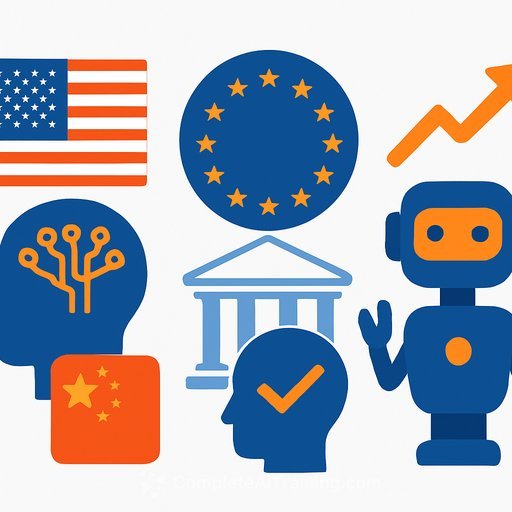
US and China race for AI dominance, but advantages are shifting
The United States leads in artificial intelligence software. China leads in robots. But neither advantage is guaranteed to last.
The competition between the two countries now spans research labs, universities, and tech startups, with trillions of dollars at stake. Each side has identified its strength: the US excels at what researchers call AI "brains"-the algorithms and language models that power chatbots-while China dominates AI "bodies," the physical robots that carry out tasks.
That division is breaking down. China has demonstrated it can build competitive language models. The US is catching up in robotics. The outcome will likely determine which country emerges more powerful from the 21st century.
America's grip on language models weakens
OpenAI's ChatGPT launch in November 2022 established American dominance in large language models (LLMs). The chatbot attracted nearly 900 million weekly users, and competitors like Google and Anthropic spent billions developing rival systems.
That dominance rested on hardware control. The US designed or manufactured most of the world's high-end microchips used to train these models. Nvidia, a California company, became the first to reach a $5 trillion valuation by supplying the chips that power LLM development.
Washington enforced export controls to prevent China from accessing these chips. The restrictions blocked Taiwan Semiconductor Manufacturing Corporation-which produces many chips for US firms-from shipping advanced processors to China. The US also prevented the Netherlands-based company ASML from selling the ultraviolet printing machines needed to manufacture high-end chips.
In January 2025, China released DeepSeek, a competing chatbot that matched American models while costing a fraction to develop. The release triggered Nvidia's largest single-day stock loss in US history-roughly $600 billion.
DeepSeek proved China could build competitive language models despite hardware restrictions. Chinese developers, forced to work with less powerful chips, developed more efficient training methods. Chinese tech firms also publish their code openly, allowing competitors to build on existing work rather than starting from scratch-a contrast to the US approach of guarding intellectual property.
"The American closed-proprietary models are probably better, but maybe just not by that much," said one researcher tracking China's AI policy. "The Chinese model, maybe it's only 90% as good, but it is 10% as expensive."
China's robot advantage faces a test
China leads in robotics. The country operates roughly two million robots-more than the rest of the world combined-thanks to government subsidies and a manufacturing base that could scale production quickly.
China has particularly excelled at humanoid robots designed to resemble humans. The country now accounts for 90% of global humanoid robot exports. One automated car factory in Chongqing operates 2,000 robots and vehicles that can assemble a new car every minute without human workers.
Beijing views robots as a solution to its aging population. By 2035, people aged 60 and above will outnumber the entire US population, creating a labor shortage in care work and manufacturing.
But robots need intelligent software to perform complex tasks. Simple repetitive work requires basic programming. Varied, complex tasks demand what researchers call agentic AI-software that acts independently, working through multi-step assignments without human input at each stage.
The US still leads in agentic AI. About 80% of a robot's value lies in its brain, not its body. Boston Dynamics' Spot robot, a dog-like machine used in US warehouses, combines advanced sensors with AI software to detect equipment failures and gas leaks, then relay findings to industrial systems for autonomous decision-making.
Ukraine has deployed similar technology on the battlefield. The Gogol-M aerial drone flies hundreds of kilometers into Russian territory, releases smaller attack drones, and those drones use AI to identify and strike targets without human control.
The finish line remains unclear
Predicting a winner assumes a clear endpoint. Victory in AI is unlikely to arrive as a single moment, like landing on the moon. Instead, advantage will accrue to whichever country most effectively deploys AI across its economy and sets global standards.
The US approach favors rapid development with minimal regulation. China's model emphasizes state oversight of research. One promises consumer capitalism at scale; the other offers state control over how AI is used.
The country that attracts more users and adopters-not necessarily the one that builds systems first-will likely prevail. With generative AI and LLMs advancing on both sides, the race remains genuinely competitive.
Your membership also unlocks: