US moves to a global licensing regime for AI chips: What government teams need to do now
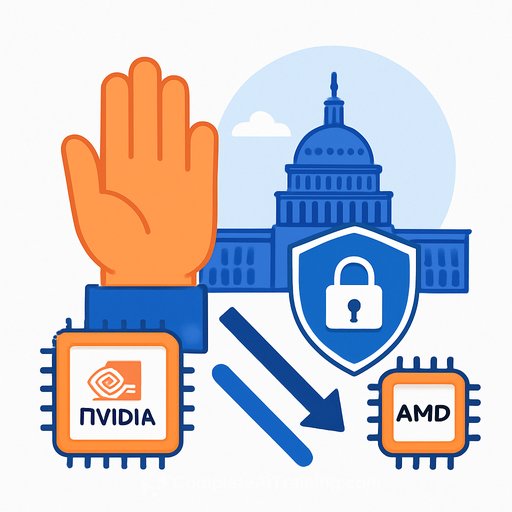
The U.S. government is drafting export rules that would give Washington authority to approve most worldwide shipments of advanced AI accelerators from American vendors like Nvidia, AMD, and Cerebras. The plan expands country-based controls into a worldwide, tiered licensing system and is described as stricter than the much-criticized AI Diffusion Rule from the Biden era. Bottom line: large-scale AI buildouts abroad could hinge on intergovernmental deals and commitments to invest in U.S. AI infrastructure.
The proposed tiers at a glance
- Small-scale: Shipments up to 1,000 Nvidia GB300 GPUs get a simplified review and may qualify for limited exemptions.
- Mid-scale: Larger deployments require "preclearance before seeking export licenses" from the U.S. Department of Commerce.
- Large-scale clusters: About 200,000 GB300 GPUs operated by a single company within one country trigger direct intergovernmental arrangements, national-security assurances, and investments in U.S. AI infrastructure as part of the approval.
Compliance could include operational transparency, disclosure of business activities, and potential on-site inspections by U.S. authorities. Existing bans to destinations such as China, Iran, North Korea, and Russia remain, while large Middle East deals already require government-to-government agreements. If enacted, similar arrangements would become common across allied nations, including in Europe.
How this hits government priorities
Strategic autonomy and digital policy: Building AWS-, Microsoft-, Oracle-, Google-, OpenAI-, or xAI-scale clusters outside the U.S. will be harder, slower, and more expensive. Expect tighter alignment between AI capacity growth and U.S. national-security assurances-compute becomes a negotiated resource, not just a purchase order.
Economic development: Large data center projects may face new friction and longer timelines. Incentives might need to offset the added licensing risk if you want hyperscale AI capacity in your jurisdiction.
Procurement and project delivery: RFPs and contracts must define who owns export-license obligations, acceptable delays, and plan B options. Cloud, colocation, or phased builds should be assessed for compliance-not used to skirt thresholds, which regulators often aggregate.
Foreign affairs and trade: Intergovernmental channels move to the critical path for mega-clusters. Early, consistent contact with U.S. Commerce (BIS) and the U.S. embassy will matter more than ever.
Immediate actions for government teams
- Map current and planned AI capacity by GPU count and categorize into small (≤1,000), mid, and large (~200,000) tiers.
- Stand up an export-controls lead and response cell across digital, procurement, legal, foreign affairs, and national security.
- Engage early with BIS on preclearance for mid- and large-scale proposals. See the Export Administration Regulations (EAR) and advanced computing controls: BIS advanced computing controls and EAR.
- Update procurement templates to include: license-responsibility clauses, licensing timelines as milestones, termination rights for denials, and verified compliance reporting.
- Prepare for inspections and transparency: document operational controls, tenant policies, and data-handling boundaries in advance.
- Run denial/delay scenarios with alternatives: different chip mixes, U.S.-hosted capacity, sovereign cloud arrangements, or staged deployments.
What remains unclear (watch these)
- How "single company within one country" is defined for clusters, including joint ventures and cloud multitenancy.
- Whether equivalence thresholds will apply across different vendors and accelerator types.
- Processing-time targets for licenses and preclearance, especially for allied governments.
- Potential exemptions for research institutions or public-interest projects.
Policy and procurement implications
For policy makers: Expect more U.S. leverage over where and how large AI infrastructure is built. Plan for interagency coordination and diplomatic engagement before committing to mega-scale timelines.
For procurement leads: Treat export approval like a critical dependency, not an afterthought. Budget time for licensing; write in penalties and remedies tied to approvals; validate vendor compliance systems upfront.
For regulators and security teams: Build inspection-ready documentation and access protocols now. The faster you can satisfy transparency requests, the less risk to schedule.
The practical takeaway
This is not a blanket ban. It is a powerful throttle on global AI capacity growth outside the U.S., especially at hyperscale. Small projects will move with extra paperwork; mega-clusters will hinge on diplomacy and investment concessions.
If you're a government stakeholder, line up your cross-functional team, categorize your projects by GPU scale, and open talks with Commerce early. That preparation is the difference between a year lost to red tape and a project that actually ships.
If you need a structured overview of policy levers and governance options for AI, see the AI Learning Path for Policy Makers.
Your membership also unlocks: