
AI news ·
U.S. promotes AI exports to Asia as China leads with cheaper models
The U.S. AI export program drew just 78 applications as China pushes cheaper models in Asia. Washington's low APEC profile highlights its struggle against Beijing.
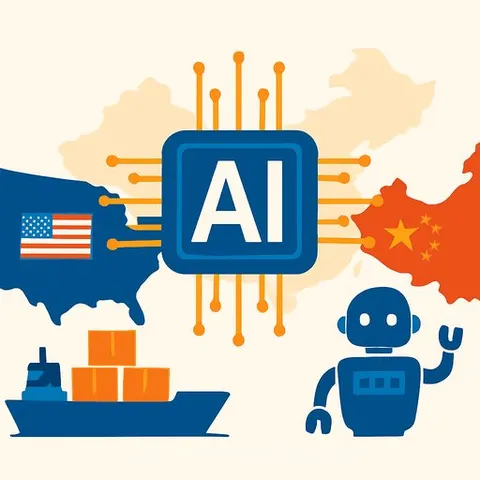
The U.S. left few public traces at the Asia-Pacific Economic Cooperation "Digital Weeks" in Chengdu, China, this month, even as Chinese companies promoted AI models that rival American capabilities at lower prices. The subdued presence marks a shift in the AI competition across Asia, where Beijing is aggressively pushing its technology while Washington's flagship export program struggles to build momentum.
"The American strategy is to stop China from becoming the leading AI supplier for the rest of Asia ... and frankly the whole world," said Gary Dvorchak, managing director at The Blueshirt Group. While China's alternatives are cheaper, he said the U.S. currently offers a more complete solution from chips to AI models.
Export program sees low uptake
The American AI Exports Program, designed to let buyers acquire a full U.S. tech stack or select components, has drawn just 78 applications, Politico reported this month citing three former officials. An International Trade Administration spokesperson said the volume "exceeded our expectations," but the figure falls short of the program's early ambitions.
At the Chengdu forum, Bill Guidera, deputy under secretary for innovation and engagement at the U.S. Department of Commerce, still pitched the initiative. He called broadly for Asia-Pacific partnerships and described the program as "the brilliant design that shows the strength, security and capability of U.S. AI." The low-key event contrasted with the first APEC AI meeting in South Korea last summer, where Michael Kratsios, President Donald Trump's chief science and technology policy advisor, had prominently promoted the exports program and the U.S. AI Action Plan.
Chinese alternatives gain ground
Chinese firms have launched new AI models with capabilities similar to American counterparts for far less money. Meanwhile, Anthropic delayed its Fable model release after abrupt U.S. policy changes, and Google and Meta were the only U.S. companies with booths at the Chengdu event. They focused on molecular AI system AlphaFold and AI applications for small businesses, steering clear of large language models. Google's vice president of government affairs, Wilson L. White, made only passing references to Gemini in his speech, while Tencent's vice president Cai Guangzh took a more visible role.
For professionals working in AI for Government, the lukewarm response to the export program signals that policy frameworks alone may not secure adoption in fast-moving Asian markets. The developments also hold immediate implications for AI for IT & Development: the rise of cheaper Chinese models is reshaping cost-benefit calculations for AI deployments across the region, and the limited U.S. commercial presence at a major APEC forum suggests that procurement and partnership strategies may need to adjust quickly.