US Moves to Control AI Standards as Systems Begin Negotiating With Each Other
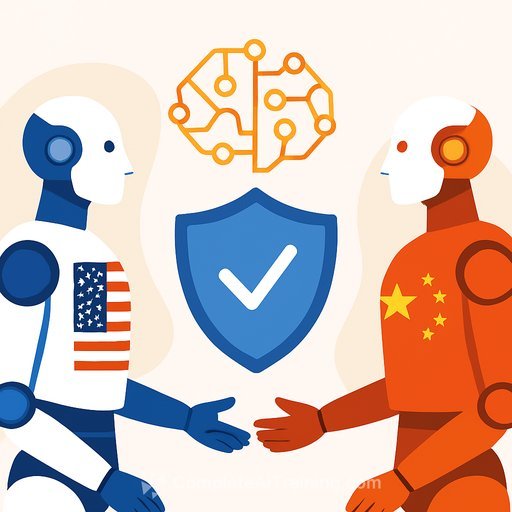
The U.S. government and major technology companies are racing to establish global standards for how AI systems communicate with each other, a move that mirrors the internet standardization battles of the 1990s and carries significant implications for which countries control the AI economy.
The urgency stems from a practical shift: AI systems are now autonomous agents that negotiate directly with each other to complete tasks. In a Las Vegas startup office, an employee typed a single instruction to book a business trip. Within five seconds, the user's personal AI haggled with an airline's booking system, then a hotel AI, then a payment system-all in real time, each making independent decisions to find the best deal.
"This isn't simple automation," an engineer explained. "It's a structure where AIs make their own judgments and negotiate trade-offs. It's only possible because AIs from different services can talk to each other in the same language."
That shared language is what the U.S. is now trying to define. The National Institute of Standards and Technology launched an "AI Agent Standardization Initiative" in February. Anthropic released the Model Context Protocol as a proposed standard for AI-to-AI communication. OpenAI and others formed the Agentic AI Foundation under the Linux Foundation to promote technology sharing.
The stakes are enormous. History offers a precedent. When the U.S. established TCP/IP as the global internet standard in the 1990s, American companies-Google, Amazon-emerged as platform giants. Capital, data, and technological leadership flowed to the country that wrote the rules.
"Once a standard is locked in, it becomes a powerful moat that rivals struggle to cross," according to industry analysts. Apple's iOS and Google's Android in smartphones show how standards become ecosystem gatekeepers. Developers worldwide ultimately have little choice but to follow the rules and fee structures set by whoever controls the standard.
Security concerns add another layer. Rhea Siskind, a researcher at the Foundation for Defense of Democracies, warned that agent-style AI spreading without common security rules could leave systems defenseless against backdoor attacks or data poisoning. "Standards for verifying data provenance and model history are the minimum safety net for filtering out dangerous AI," Siskind said.
The U.S. push reflects anxiety about China's technological progress. According to Stanford University's Human-Centered Artificial Intelligence institute, the U.S. still leads in AI model count and investment scale, but the gap is narrowing quickly.
Gate Rogino, a senior fellow at Georgetown University's Center for Security and Emerging Technology, noted the stakes plainly: "Depending on who designs the standards for AI agents, the way the global AI ecosystem operates could look completely different."
For now, no single global standard exists. Each company connects its AI systems differently. Lee Seung-yoon, head of the Standards Research Division at South Korea's Electronics and Telecommunications Research Institute, said, "Those who create the AI standards will sit at the center of the ecosystem, steering the flow and capturing the profits. It is highly likely that other companies and countries will end up operating on top of that framework."
The U.S. strategy centers on embedding its companies' technical approaches across the entire industry. On the surface, these efforts emphasize openness. But many analysts see them as moves to establish American dominance before competitors catch up.
For government officials, understanding these standards matters directly. Decisions made now about which protocols become global norms will determine whether your country's agencies can integrate with international AI systems, or whether they'll operate on terms dictated by whoever controls the standard. Learn more about AI for Government and the technical foundations of Generative AI and LLM systems.
Your membership also unlocks: