USAi is becoming shared code development across federal agencies
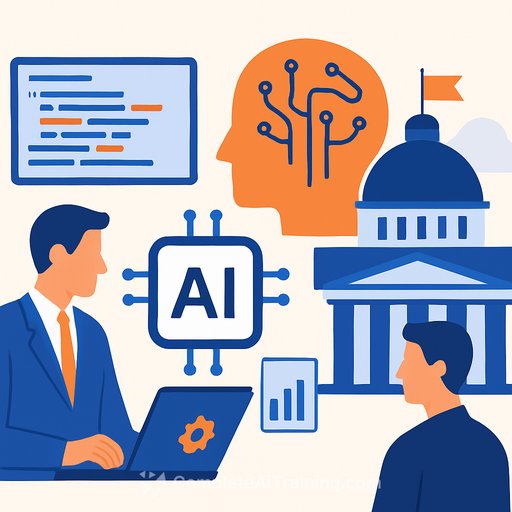
Three months in, GSA's USAi isn't just another test bench. It's turning into a shared build space where agencies co-develop how AI gets used, governed, and improved across government.
GSA's chief AI and data officer, Zach Whitman, said the suite has shifted from a single-agency project to a multi-agency effort where teams compare notes, shape features, and align on repeatable patterns. His point was simple: "We're all learning from each other."
What USAi actually does
- Gives agencies a single place to evaluate multiple foundation models (Anthropic, OpenAI, Google, Meta, now Amazon and Microsoft).
- Collects hands-on usage data and human ratings to see what works across real workflows.
- Adds controls for access, auditing, data handling, and org-level usage policies.
- Lets teams prototype against several models, then buy the right one with evidence, not hype.
Why this matters for IT and development teams
Procurement gets faster and smarter when you can prove which model handles a specific job. You stop guessing and start benchmarking.
Engineering decisions improve when human feedback is tied to task types. You find the right model for acquisition questions versus facilities or tech, and you plan integrations accordingly.
Security, compliance, and usage guardrails get baked in early. That reduces "shadow AI" and avoids dead-end experiments that burn time and budget.
What GSA is seeing in the data
- Users rate response quality; those signals are tracked over time.
- Models can be ranked by how well they handle different domains (acquisition, facilities, technology).
- Insights feed back into the platform and inform which providers fit which use cases.
How USAi plugs into real work
Whitman noted that business processes vary across agencies, so the suite is built to meet those differences without forcing one pattern. The emphasis is on clear controls, observable outcomes, and quick iteration.
The result: fewer blind corners, more repeatable wins, and a growing playbook other agencies can adopt without starting from scratch.
Current footprint
- Model access includes Anthropic, OpenAI, Google, Meta, Amazon, and Microsoft.
- GSA says it's actively partnering with 15+ agencies to deploy and expand the suite.
Practical steps you can apply now
- Stand up a lightweight evaluation framework: consistent prompts, tasks, and scoring across models.
- Capture human ratings tied to task types; track drift and quality over time.
- Instrument usage analytics (tokens, cost, latency, escalation paths).
- Define policy by team and use case: access tiers, logging, redaction, retention.
- Map findings to procurement checklists so buys reflect real performance, not vendor claims.
What to watch next
- More models and modalities entering the suite.
- Deeper policy controls that reflect evolving federal guidance.
- Stronger signals connecting task complexity to model selection and prompt patterns.
If you're building similar capabilities, the federal AI portal offers helpful context on initiatives and guardrails: ai.gov. For a quick scan of model ecosystems by provider, this overview can help you map skills and training to specific stacks: AI courses by leading companies.
Your membership also unlocks: