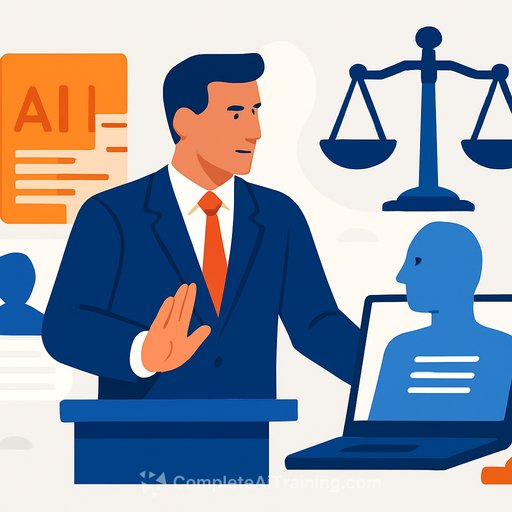
USDOT Plans to Use AI to Draft Federal Transportation Rules in 30 Days
The U.S. Department of Transportation plans to use Google's Gemini to generate federal transportation regulations. The stated goal: reduce the time from idea to an OIRA-ready draft to just 30 days.
In a recent meeting, the agency's general counsel, Gregory Zerzan, said, "We don't need the perfect rule on XYZ. We don't even need a very good rule on XYZ," emphasizing "good enough" rules at scale.
That stance has raised internal concerns. These rules govern aviation safety, gas pipelines, and freight trains carrying hazardous materials-areas where mistakes carry real risk. As one expert put it, "Just because these tools can produce a lot of words doesn't mean that those words add up to a high-quality government decision," said Ohio State University professor Bridget Dooling.
What this means for writers
Speed is about to outpace tradition. Policy drafts may come fast, but they'll need rigorous human review, source checks, and plain-language cleanup.
If you write for regulated industries, your value shifts from first-draft creation to direction, verification, and accountability. Think prompts, checklists, and audit trails. See Practical prompt engineering guides for examples on structured prompts, prompt verification, and maintaining audit trails.
How to work with AI on high-stakes policy content
- Write structured prompts like a policy brief: define scope, legal basis, definitions, enforcement, timelines, stakeholders, and safety considerations.
- Force source mapping: require citations to statutes and regulations (U.S.C., C.F.R.) next to each major clause.
- Use a review checklist: clarity, enforceability, conflicts with existing rules, measurable outcomes, and ambiguity removal.
- Red-team the draft: test edge cases, failure modes, and unintended incentives; flag any fabricated citations.
- Keep an audit trail: prompt versions, model settings, date/time, reviewers, and change logs.
- Enforce style: plain language, short sentences, defined terms, consistent section structure.
- Pair with SMEs and legal counsel early to catch domain-specific gaps.
Quality risks to watch
- Invented or misapplied legal citations.
- Vague or circular definitions that weaken enforcement.
- Conflicts with existing statutes or agency rules.
- Overbroad provisions that create costly compliance without safety benefits.
- Undercoverage of critical scenarios and safety edge cases.
Opportunities for writers
- Prompt architect: translate policy intent into structured prompts with legal hooks.
- Editorial lead: convert AI drafts into clear, enforceable language with consistent definitions.
- Fact-check and citation audit: verify every reference and crosswalk to source law.
- Workflow builder: templates, checklists, and QA systems that reduce errors and rework.
Context and resources
The agency aims to move drafts to the Office of Information and Regulatory Affairs in about a month. If you work near the federal process, it helps to know OIRA's role in regulatory review.
Skill up for AI-assisted policy writing
If your work touches policy, compliance, or technical standards, sharpen your prompt and audit skills. A useful place to start:
Bottom line: volume is going up. Your edge is making sure speed doesn't replace judgment.
Your membership also unlocks: