UTA opens AI-driven Smart Agriculture Research Center to forecast ag threats and train talent
Tuesday, Feb 10, 2026
Bird flu tore through flocks last year and sent egg prices up. The pattern was clear: food systems are exposed, and we need better prediction and faster response.
The U.S. Department of Agriculture's Agricultural Research Service (USDA-ARS) partnered with The University of Texas at Arlington to answer that need. Their new Smart Agriculture Research Center (SARC), opened in August 2025, applies artificial intelligence and data science to real agricultural problems across plant, animal and environmental systems.
What the center does
- Provide AI capacity and data discovery tools for agriculture research projects.
- Serve as a campus hub for faculty doing agriculture-related research.
- Secure major USDA and external training and center grants.
- Act as UTA's gateway for external partners focused on sustainability and global environmental impact.
Co-directed by Jianzhong Su (mathematics) and Gautam Das (computer science and engineering), the center connects more than 20 faculty across science and engineering. On Feb. 9, SARC hosted its grand opening with UTA and USDA leaders. Researchers can also consult AI Research Courses for research-focused training and resources.
"Agriculture is essential to society, yet it has historically seen less AI integration than other industries," said Su. "UTA's strengths in technology and data science position us to help modernize agriculture in Texas and beyond."
"The work done by SARC will turn interdisciplinary research into practical solutions that strengthen our region and drive progress worldwide," said Kate Miller, vice president for research and innovation. "It reflects our 130-year legacy and points to a bold future."
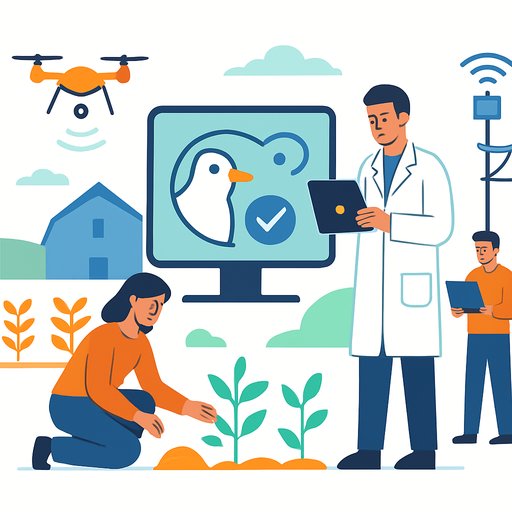
Backed by growing federal investment, SARC teams pair UTA researchers, students and USDA-ARS scientists to tackle projects like plant disease prediction, soil health modeling and near-term forecasts for highly pathogenic avian influenza (HPAI). "This center is UTA's direct response to the national call for climate-smart agriculture and resilient food systems," said Scott Miller, associate vice president for research and innovation. "We are here to ensure that the innovations born in Arlington scale to support the entire nation."
Students at the core
A USDA-supported summer program powers much of the center's work. Each year, 20-25 undergraduate and graduate students from mathematics, computer science, engineering and science join an eight- to 10-week research experience.
Small teams pair each student group with a UTA faculty mentor and a USDA-ARS scientist. The brief is simple: work with real agricultural datasets, apply AI and machine learning, and deliver tools producers can use.
- Predicting plant diseases under shifting weather patterns.
- Modeling crop resilience and the effects of fertilizers and pesticides on the environment.
- Developing data-driven tools for livestock and poultry health monitoring.
- Forecasting HPAI outbreaks using automated ingestion of publicly reported data to produce short-term risk estimates and recommended actions.
Students collaborate remotely with USDA scientists across the country and join site visits to see research operations firsthand. The result: practical training and a pipeline of talent ready for AI-enabled agriculture.
Forecasting HPAI: from data to action
One active track focuses on bird flu. Teams are building models that automatically collect publicly reported outbreak data and generate short-term forecasts that producers and agencies can act on. Outputs are built to inform choices like tightening biosecurity, stepping up sanitation or adjusting facility management to lower transmission risk.
For national HPAI context and data, see USDA APHIS resources at APHIS: Avian Influenza. To learn more about USDA-ARS research priorities, visit USDA-ARS.
Building national capacity
Beyond student training, collaborative USDA projects linked to UTA faculty and ARS partners total more than $5.5 million in external investment. The goal is straightforward: grow national research capacity in AI-driven agriculture, strengthen food and environmental resilience and help producers respond faster to biological and climate threats.
Why this matters to researchers
- Campus-wide AI infrastructure and data discovery reduce startup friction for new ag projects.
- Interdisciplinary teams (math, CS, engineering, science) accelerate model development and validation.
- Direct USDA-ARS collaboration anchors work to priority problems with field relevance.
- Focus areas include plant disease risk, soil processes, livestock and poultry health-each demanding spatiotemporal modeling, data fusion and careful uncertainty quantification.
- Training builds a workforce fluent in ML, data pipelines and domain constraints that actually matter on farms and in labs.
Level up your AI skill set
If you're building applied AI skills for ag and life-science research, explore curated, practical coursework such as the AI Learning Path for Data Scientists and the AI Learning Path for Software Engineers.
About The University of Texas at Arlington (UTA)
The University of Texas at Arlington is a growing public research university in the heart of Dallas-Fort Worth. With more than 42,700 students, UTA is the second-largest institution in the University of Texas System and offers over 180 undergraduate and graduate programs.
Recognized as a Carnegie R-1 university, UTA ranks among the top 5% of institutions for research activity. UTA and its 280,000 alumni generate an annual economic impact of $28.8 billion for the state.
The University holds the Innovation and Economic Prosperity designation from the Association of Public and Land Grant Universities and is recognized for its focus on student access and success-key drivers of economic growth and social progress for North Texas and beyond.
Your membership also unlocks: