UTulsa lands four federal awards to accelerate energy resilience, extreme materials and secure physical AI
February 23, 2026
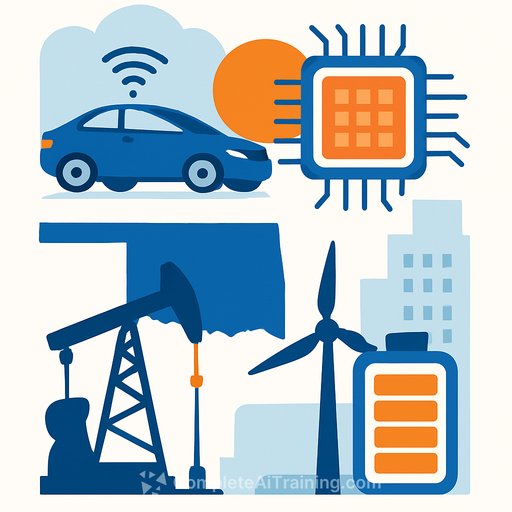
The University of Tulsa secured four FY26 federal appropriations to scale pilot research, deepen industry partnerships and build a stronger talent pipeline across energy systems, materials science, autonomy and cybersecurity. The awards expand North Campus pilot facilities and position Oklahoma as a testbed for practical, high-impact R&D.
"From providing novel energy systems to securing physical artificial intelligence systems, these investments reaffirm UTulsa's role as a national leader in applied research that delivers real-world impact," said Rose Gamble, vice president for research and government relations.
- Expand pilot-scale research facilities and fabrication capabilities
- Grow Oklahoma's workforce through faculty-led research, student participation and industry collaboration
- Support manufacturers and energy firms with prototyping, testing and data-driven insights
"UTulsa's partnerships with industry and community stakeholders ensure these breakthroughs translate into economic and societal benefits," said Interim President Rick Dickson. He thanked U.S. Sen. Markwayne Mullin and Oklahoma's congressional delegation for helping secure the appropriations.
Advanced, low-cost, grid-scale energy storage - Department of Energy (FY26: $3.2M)
UTulsa will develop pilot-scale zinc-sulfur (ZnS) batteries as a safer, lower-cost alternative to lithium-ion for utility-scale storage. The effort integrates new battery manufacturing, industrial-grade characterization, grid-simulation hardware and GPU-based AI/ML modeling to evaluate performance, safety and reliability under real grid conditions.
This builds on UTulsa's battery research track record while addressing domestic supply, safety and cost constraints that limit large-scale deployment. For context on national priorities, see the U.S. Department of Energy's work in energy storage here.
Resilient and safe energy transportation - Department of Energy (FY26: $3.2M)
Researchers will leverage UTulsa's pilot pipeline assets to study multifuel flow behavior, corrosion mechanisms and leak-detection challenges. The team will combine distributed sensor networks with machine-learning models to improve anomaly detection, risk assessment and code development.
Outcomes will inform best practices and future design standards while strengthening U.S. energy security and Oklahoma's energy economy. Industry partners can engage in data sharing, sensor validation and pilot-scale testing.
Extreme materials - Department of Energy (FY26: $3.2M)
This project targets materials that operate in extreme environments: temperatures above 600 degrees, corrosive conditions and high-velocity flows relevant to deep-well drilling, hypersonics and spacecraft reentry. UTulsa is among the few U.S. universities that can manufacture carbon-carbon composites via chemical vapor infiltration and test them at pilot scale.
The research stack includes thermomechanical characterization, porosity analysis, micro-CT imaging and AI/ML-driven materials discovery. The aim is faster iteration from formulation to performance proof under realistic loads.
Cooperative and secure physical AI systems - NIST STRS (FY26: $3.0M)
UTulsa will advance autonomous robots that interact with the physical world through real-time sensing, adaptation and decision-making. The initiative integrates robotics, AI/ML, kinesiology, user-experience research and cybersecurity for assistive robotics that support people who may need home services and care.
The Institute for Robotics & Autonomy and the Oklahoma Cyber Innovation Institute will combine physical AI development with cyber vulnerability detection and mitigation. Learn more about NIST's Scientific and Technical Research and Services program here.
Why this matters for researchers and industry
- Pilot-to-field bridge: Access to pilot-scale lines, grid simulators, pipeline testbeds and composite manufacturing cuts time from concept to validated prototype.
- Data-rich workflows: Distributed sensing, micro-CT, GPU modeling and AI/ML pipelines enable faster learning cycles and higher confidence in scale-up decisions.
- Standards and safety: Results are structured to inform codes, best practices and certification paths-key for adoption in energy and aerospace.
- Workforce growth: Students gain experience on industrial-grade systems, building a talent pipeline ready for energy storage, materials, autonomy and cybersecurity roles.
Opportunities to engage
- Co-develop prototypes: Leverage fabrication and test facilities for ZnS cells, pipeline sensing, or extreme-materials components.
- Validate models: Contribute real-world datasets for corrosion, leak detection, grid stability or robot-human interaction; benchmark AI/ML models against operational KPIs.
- Student and faculty collaboration: Sponsor projects, host internships, and align capstones with pilot experiments and field trials.
- Security by design: Pair autonomy development with vulnerability assessment to de-risk deployments early.
Skills and tools that accelerate this work
- GPU-accelerated ML for battery degradation, multiphase flow analytics and microstructure-property prediction
- Physics-informed modeling and uncertainty quantification across grid, pipeline and materials domains
- Sensor fusion, real-time controls and safety cases for physical AI systems
For practitioners building these capabilities, see the AI Learning Path for Research Scientists and broader applications in AI for Science & Research.
Your membership also unlocks: