UW Ph.D. Student Builds AI Model to Predict Heart Failure Risk in Cattle
January 10, 2026 | Media Release
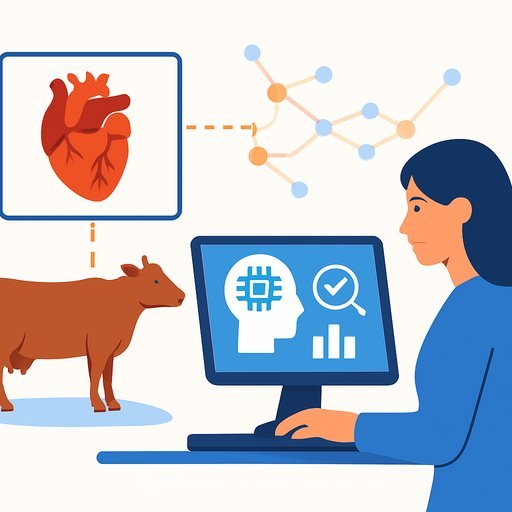
Chase Markel, a University of Wyoming Ph.D. student from Wheatland, is using AI to help animal scientists study risk factors for congestive heart failure in cattle. His image-based model estimates risk from photos of the heart-a project the team describes as a first of its kind for this problem space-and contributes to ongoing Research into image-driven model development and validation. The goal is straightforward: give researchers and industry a faster, consistent way to flag risk in individual animals and reduce preventable losses.
Markel earned his undergraduate and master's degrees in UW's Department of Animal Science and is now pursuing a doctorate with advisers Hannah Cunningham-Hollinger and Cody Gifford. He came to this project from studies in pulmonary hypertension (also called high-altitude or brisket disease) and later joined the UW School of Computing as a fellow to push the computer vision side forward. "I'm not a computer scientist," he says. "I'm someone who is studying heart failure [in cattle] and just happened to have the right conversation and made the connection in order to build something that I think can be useful."
Why this matters to researchers and producers
Subclinical pulmonary hypertension may cost more than the obvious losses from animals that die before harvest. The size and shape of the right ventricle are key indicators: as pressure builds, the wall thickens and the chamber distorts, increasing risk of heart failure. For background on high-altitude (brisket) disease, see this overview from Colorado State University Extension: CSU Extension: High-Altitude/Brisket Disease.
If abnormalities can be detected consistently-even when subtle-they can inform traceability and management decisions earlier in the production cycle. As Markel puts it, anything that improves individual animal identification and trace-back is a net benefit for the industry.
How the model works
As a School of Computing fellow, Markel built a supervised image classification model trained on thousands of heart photos collected in commercial processing plants in Nebraska and Colorado. Each image was labeled using a 1-5 scoring system developed by Tim Holt, a collaborator and professor at Colorado State University. The dataset now includes nearly 7,000 images, all scored by hand before training.
On images it has never seen, the model assigns the correct score 92% of the time. That level of performance provides a clear proof of concept for image-driven risk assessment at the individual animal level. In parallel, Markel is developing a similar model for liver images to assess the presence and severity of liver abscesses, another common feedlot concern.
Applications and next steps
Today, the approach fits best inside processing plants, where standardized imaging is already practical. Future iterations could move upstream-helping producers and veterinarians make earlier, better-informed decisions. "As researchers, we need to start incorporating these tools into our research and build that technology so producers and people out in the industry can actually utilize those tools and help improve their bottom line," Markel says.
"Chase Markel's research exemplifies our college's commitment to conducting Wyoming-relevant research, which integrates emerging technologies, producer experiences and UW faculty expertise to address some of Wyoming agriculture's most vexing challenges," says Kelly Crane, Farm Credit Services of America dean in the College of Agriculture, Life Sciences and Natural Resources.
Markel has submitted a provisional patent application through UW and is pursuing full protection in 2026. For an overview of provisional filings, see the U.S. Patent and Trademark Office: USPTO: Provisional Application.
Key details for researchers
- Problem focus: congestive heart failure risk linked to pulmonary hypertension; right ventricle morphology as a core signal.
- Data: ~7,000 heart images from commercial plants in Nebraska and Colorado; all images hand-scored using a 1-5 system (Tim Holt, CSU).
- Method: supervised image classification calibrated on Holt's scoring rubric.
- Performance: 92% accuracy on previously unseen images.
- Additional work: a companion model for detecting and grading liver abscesses.
- Collaboration: Cunningham-Hollinger lab, Gifford lab, UW Meat Lab, and Colorado State University.
- Deployment context: currently most practical at processing plants; future iterations aim to support on-ranch decisions.
- IP status: provisional patent filed in 2025; full patent targeted for 2026.
- Contact: cmarkel1@uwyo.edu
If you're expanding your lab's AI capabilities for imaging, model validation, or workflow design, you may find these resources helpful: curated AI courses. For guidance on system and interface Design that supports deployable research tools, those resources can be a useful starting point.
Your membership also unlocks: