AI Model Flags Heart Failure Risk in Cattle Using Plant-Scale Heart Images
Published January 08, 2026
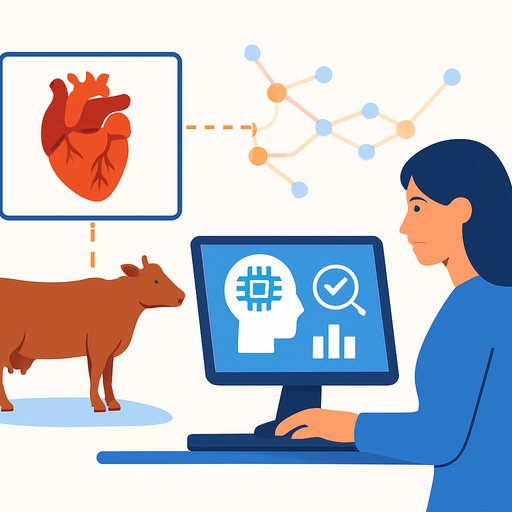
Chase Markel, a University of Wyoming Ph.D. student from Wheatland, built an image-based AI model that predicts the risk of congestive heart failure in cattle. Trained on thousands of post-harvest heart images, the model scores right-ventricle morphology and reaches 92% accuracy on unseen images. It's a first for this specific application and points to a practical path for phenotyping health risks at scale.
Members of the Cunningham-Hollinger lab, Gifford lab, and UW Meat Lab supported image collection and scoring. The effort started with Markel's long-running work on pulmonary hypertension (high-altitude disease or brisket disease) and its link to heart failure in feedlot cattle.
Why this matters for researchers and industry
Subclinical pulmonary hypertension can quietly erode profitability through performance loss, trim, and treatment costs-often more than direct losses from mortalities. Congestive heart failure is closely tied to changes in the right ventricle's size and shape; as pressure builds, the ventricle thickens and distorts, increasing risk.
Markel's goal is simple: make those risk signals visible and quantifiable. As he puts it, "I'm not a computer scientist. I'm someone who is studying heart failure in cattle and just happened to have the right conversation and made the connection to build something useful." For background on brisket disease, see the Merck Veterinary Manual's overview of high-altitude disease in cattle: Merck Vet Manual.
What Markel built
- Task: Image classification of the heart's right ventricle to estimate risk of congestive heart failure.
- Data: Nearly 7,000 labeled images collected in commercial processing plants in Nebraska and Colorado.
- Labels: A 1-5 right-ventricle score developed by Tim Holt (Colorado State University) served as the ground truth.
- Performance: 92% top-1 accuracy on images the model had not seen before.
- Intended setting: Processing plants, where high-throughput data capture and traceability can feed insights back to producers.
- Next build: A similar model for liver images to detect and grade liver abscesses, another costly issue in feedlot cattle.
Study design notes for science and research professionals
The labeling protocol followed Holt's 1-5 score, focusing on right-ventricle morphology tied to pulmonary hypertension and heart failure risk. Each image was hand-scored prior to training, which helped standardize the target and reduce noisy supervision.
To strengthen generalization, additional work will focus on cross-plant validation (lighting, angles, equipment), inter-rater reliability for the 1-5 score, calibration curves to align predicted probabilities with risk thresholds, and cost-sensitive decision points. Breed, elevation history, and management factors should be modeled as covariates where available. External replication across more plants and seasons will help confirm stability. For related methodological resources, see Research.
Practical applications across the pipeline
- Processors: Automated scoring at the line for QC, triage, and structured data capture, enabling consistent feedback to suppliers.
- Producers: Individual-animal risk signals tied back to management and environment, informing breeding, nutrition, and housing choices.
- Veterinarians and researchers: Scalable phenotyping for studies on cardiopulmonary health, GWAS, and intervention trials.
- Data teams: A template for building applied computer vision systems where ground-truth labels are accessible post-harvest.
From graduate research to plant-scale tooling
Markel finished his undergraduate and master's degrees in the UW Department of Animal Science and is now a Ph.D. candidate advised by Hannah Cunningham-Hollinger and Cody Gifford. As a School of Computing fellow, he shifted from physiology-focused research to building a computer vision workflow that animal scientists and industry partners can use.
He emphasizes the point: "As researchers, we need to start incorporating these tools into our research and build that technology so producers and people out in the industry can actually utilize those tools and help improve their bottom line."
IP, collaboration, and next steps
Markel submitted a provisional patent application through UW in 2025 and hopes to secure full patent protection in 2026. For general info on provisional filings, see the USPTO guidance.
The work connects the Cunningham-Hollinger lab, Gifford lab, UW Meat Lab, and collaborators such as CSU's Tim Holt. If you're interested in data sharing, validation studies, or pilot deployments, contact Markel at cmarkel1@uwyo.edu.
For researchers building similar tools
If you're scoping image-based classifiers for livestock or biomed, structured courses can speed up prototyping and evaluation. Explore role-focused options here: AI courses by job. For applied model and workflow resources, see Design.
About the UW College of Agriculture, Life Sciences and Natural Resources
The University of Wyoming College of Agriculture, Life Sciences and Natural Resources serves students and communities through scholarship, research, and outreach. Guided by land-grant principles of discovery and experiential learning, the college creates opportunities in the classroom, laboratory, and community.
Programs span agricultural and applied economics; animal science; botany; ecosystem science and management; family and consumer sciences; molecular biology; plant sciences; veterinary sciences; and zoology and physiology. The college also offers programs in agricultural communications, microbiology, and ranch management and agricultural leadership.
Your membership also unlocks: