Verizon Business powers Kodiak AI's push into driverless trucking
Verizon Business has signed a commercial deal to provide connectivity and IoT services for Kodiak AI's driverless trucking operations. For operations leaders, this is a signal: the reliability of your autonomy program will live or die on your network, telemetry, and update pipeline.
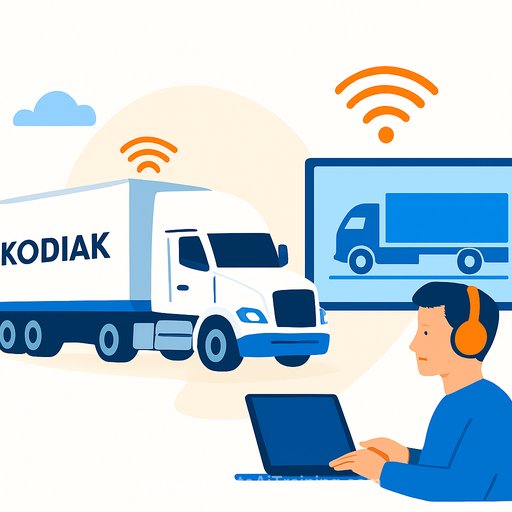
The agreement covers 5G and LTE telematics plus Verizon's ThingSpace IoT management platform, enabling near real-time communication between trucks and remote command centers, over-the-air software updates, and fleet management. Verizon says the network will support low-latency transmission of camera and sensor data, even on remote routes, with custom data plans sized for autonomy-grade traffic. ThingSpace details.
How the stack works on the road
Kodiak runs its AI-driven virtual driver, the Kodiak Driver, for around-the-clock operation. In specific, low-speed, or tightly defined scenarios, trucks can request human support through Assisted Autonomy, which uses remote driving technology from Vay. Kodiak's CEO describes the system as "physical AI" designed for continuous, driverless operations-connectivity is the backbone of that promise. Learn more about the company's approach at Kodiak AI.
What this means for operations
- Coverage-first routing: Map lanes to 5G/LTE strength, dead zones, and handoff behavior. Define fallbacks (LTE, store-and-forward) and test them under load.
- Uptime and SLAs: Set clear network SLAs with escalation paths. Track p95/p99 latency and packet loss that affect remote assist and perception.
- Data budgets: Model per-truck data flows by sensor suite and duty cycle. Plan compression, edge filtering, and retention to control cellular and cloud costs.
- Remote operations: Staff and schedule remote operators; set assist criteria, handover thresholds, and runbooks for interventions and recovery.
- Safety and compliance: Define fail-safe behaviors, black box logging, and video retention. Monitor state-level rules and federal guidance (see NHTSA automated vehicle resources).
- Software change control: Standardize OTA windows, version pinning, staged rollouts, and rollback procedures. Treat each update like a production change.
- Systems integration: Connect autonomy events to TMS/WMS, ELD/telematics, and dispatch systems. Push exceptions to your existing incident workflow.
- Security: Lock down SIM provisioning, private APNs, device identity, and least-privilege access. Automate patching for edge devices and gateways.
Practical rollout playbook
- Start corridor pilots on lanes with known coverage, then extend to more challenging routes as data proves out reliability.
- Negotiate custom data plans with QoS for safety-critical traffic and caps for noncritical uploads. Budget by mile and by hour.
- Set stage gates: disengagements per 1,000 miles, remote assist rate, OTA success rate, on-time performance, and cost per mile.
- Build a 24/7 ops model: NOC/ROC staffing, escalation tiers, incident postmortems, and clear accountability across autonomy, network, and fleet teams.
Why this deal matters
Autonomous trucking runs on predictable connectivity, disciplined software updates, and tight human-in-the-loop operations. Verizon's 5G/LTE plus ThingSpace gives Kodiak a single provider for telemetry, remote assist, and fleet control-key ingredients for scaling day-and-night hauling with industrial customers and long-haul partners. For ops teams, the win is fewer unknowns between the truck, the cloud, and the control room.
KPIs to track from day one
- Network: p95 latency, session drop rate, coverage gaps per lane.
- Safety: disengagements per 1,000 miles, remote assist frequency, time-to-handover.
- Reliability: OTA success/rollback rates, MTTR for comms incidents, fleet availability.
- Performance: on-time delivery %, asset utilization, cost per mile including data and compute.
If you're formalizing AI skills across ops, training your team pays off fast. See curated AI courses by job function built for hands-on execution.
Your membership also unlocks: