Vibe Prototyping: How AI Is Changing Product Development
Generative AI has lowered the effort needed to turn ideas into working software. The result: teams are shifting from long product requirement docs to quick, testable prototypes that speak for themselves.
Vibe prototyping is that shift. It favors "build-first" collaboration-use a functional demo to align, debate and decide. PRDs still matter for privacy, security and scale, but the center of gravity is moving to code you can click.
What Is Vibe Prototyping?
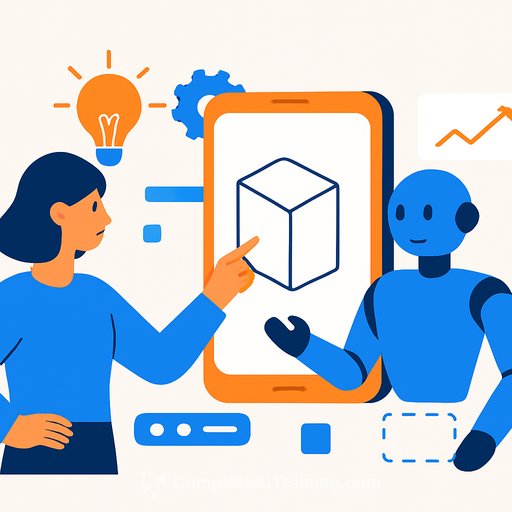
It's the practice of describing an idea in plain language, generating a functional prototype with AI, and iterating fast with real feedback. Instead of arguing over paragraphs, you refine the thing users will touch.
This doesn't replace guardrails. It pulls learning earlier. Documentation evolves from speculative to specific, capturing the risks and decisions that survive prototype testing.
Why It's Taking Off: Four Market Shifts
- 1) Feasibility for everyone. You no longer need deep syntax skills to try an idea. PMs and Design teams can build working demos from prompts, while engineers focus on hard problems and production quality.
- 2) From "tell" to "show." The loop is build → test → iterate. Because a prototype can spin up in minutes, requirements writing and implementation start to overlap. PRDs don't vanish-they codify privacy, security and rollout plans.
- 3) Specialized tools, fragmented choices. Fast, low-fidelity tools are great for exploration but weak at versioning and sharing. Mid-tier tools add structure but may lack back-end or mobile depth. Full-stack environments give you control and scalability-but add complexity. Pick speed or control based on the decision you need to make.
- 4) A real gap remains. AI prototypes are great for communication, not turnkey production. Scale, maintainability and security still require engineering rigor.
Mind The Gap: Common Failure Modes (And Fixes)
- Over-eager AI. LLMs "do what you asked," not always what you meant.
Fix: Add acceptance criteria, edge cases and UI constraints to your prompts. Use small, realistic test scenarios and a quick manual QA checklist per demo. - Integration pain. Recreating internal systems or unsupported frameworks is tricky.
Fix: Mock APIs with well-typed contracts. Gatekeep production credentials. Treat integration as an engineering task, not a prototype deliverable. - Mock data ≠ real life. Synthetic data hides messy patterns.
Fix: Maintain anonymized, production-shaped datasets. Define quality bars (e.g., pagination, long-tail inputs, accessibility) before green-lighting a concept.
Choosing Your Tool Level
- Low-fidelity chat interfaces: Fastest idea exploration; limited versioning and sharing. Use for early "is this worth it?" signals.
- Mid-tier AI builders: Better file management and collaboration; limited back-end/mobile depth. Use for cross-team demos and usability tests.
- Full-stack with AI coding assistants: Full control, versioning and local dev; higher setup cost. Use when you're pressure-testing architecture or moving to prod. For practices around deployment and engineering workflows, see AI for IT & Development. For more on AI-assisted development workflows and prototyping, see Coding.
A Simple Operating Rhythm For Product Teams
- Week 0: Outcome and constraints. Define the decision to make, the user, and the non-negotiables (privacy, latency, platforms, compliance).
- Week 1: Prototype the core loop. Prompt for a working slice (one user, one job, one path). Add acceptance criteria and sample data in the prompt.
- Week 2: Test with 5-10 users. Capture friction, missing states and must-haves. Translate feedback into concrete test cases and prompt updates.
- Week 3: Decide. Kill, pivot, or commit. If "commit," switch to engineering workflow: tickets, architecture, telemetry, security review.
Prompt Patterns That Save Time
- Role + objective: "You are a front-end engineer building a mobile-first onboarding flow to reduce time-to-value."
- Constraints: Tech stack, accessibility, performance, platforms, and banned libraries.
- Interface contract: Example API schema, types, and error states.
- Data + edge cases: Realistic payloads, long strings, nulls, rate limits.
- Definition of done: User can complete X in Y steps; handles A/B/C errors; passes the provided test cases.
Governance Without Slowing Down
- Sandbox by default: No prod data or secrets in prototypes. Use mock services and throwaway environments.
- Version everything: Save prompts, outputs and test runs. It makes iteration, sharing and compliance easier.
- Security gates: Before any prototype moves forward, run dependency checks, threat modeling and basic performance budgets.
How To Measure Value
- Time to first clickable demo (hours, not days).
- Demo-to-decision time (reduce meetings; increase clarity).
- Rework delta (bugs/design changes caught in prototype vs. after build).
- User comprehension (can a new user complete the task without help?).
What's Next
Expect tighter loops: user feedback summarized and turned into prompt updates, UI variants generated on demand and lightweight AB tests before a single sprint begins. The near-term win is speed and shared understanding. Make decisions with a demo, not a memo.
Want To Level Up Your Team's AI Skills?
If you're formalizing this practice across roles, browse hands-on resources by job function here: Complete AI Training - Courses by Job.
Your membership also unlocks: