
AI news ·
Victoria Albrecht warns that existing legal systems cannot handle liability for autonomous AI decisions
Autonomous AI is creating legal gaps where no human can be held responsible, leaving courts without clear answers on liability. Current contracts, warranties, and indemnities are nowhere near sufficient for systems that make probabilistic decisions across multiple jurisdictions.
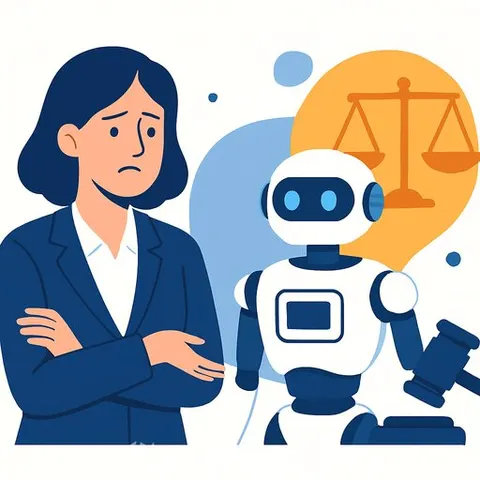
Autonomous AI systems are creating a gap in legal accountability that existing frameworks cannot bridge, according to Victoria Albrecht, Director of AI Acceleration at Cleary Gottlieb Steen & Hamilton. Speaking at Legal Tech Talk 2026, Albrecht outlined how AI-driven decisions now occur without any identifiable human decision-maker, leaving courts and companies without clear answers on who bears responsibility when things go wrong.
Albrecht opened with a scenario many professionals recognize: accepting a GPS route without questioning how the algorithm arrived at its recommendation. She then escalated the stakes. An AI-driven banking process delays a critical payment during a medical emergency abroad, causing long-term health damage. "Who do you sue? Who do you hold accountable?" she asked. The bank might point to a California startup's algorithm, which relied on an open-source model modified across multiple jurisdictions. No human made the decision. The outcome was produced entirely through autonomous systems and agents.
"Existing legal systems are not equipped for what is to come," Albrecht said. But she stressed the discussion was not only about identifying the problem. It was about what organizations can do now.
Three legal frameworks that break down
Albrecht identified three areas where current law fails when applied to autonomous AI: personhood, liability, and governance.
Personhood concerns identifying a legal entity that can be sued or held accountable. A legal person-an individual or a company-possesses both rights and duties. Distributed agentic systems create agency without legal identity. Without a legal entity, there may be no one to sue. Liability problems operate on two levels. First, intent becomes difficult to attribute. Second, AI challenges traditional notions of foreseeability because probabilistic systems are not explicitly programmed to make any particular decision. "The result is causation without culpability," Albrecht said.
Governance challenges emerge when AI models are developed, refined, and deployed across different jurisdictions. Albrecht described this as "jurisdiction without borders."
Contracting around AI is not enough
Organizations often protect themselves through warranties, indemnities, and limitations of liability. Albrecht called these approaches "a good start" but said they are nowhere near sufficient for the challenges ahead. Clients increasingly ask not only for the correct legal answer but also how that answer was reached, especially when legal technology tools process large volumes of information.
She pointed to recruitment as an example. Large corporations already use AI to sift through job applications. No human instructs the AI precisely which candidates to select. The systems operate probabilistically, not deterministically. "Organizations are presently contracting around AI without truly governing or questioning it," Albrecht said. It is extremely difficult to hold a probabilistic system to account in the same way as a deterministic one.
The illusion of the human in the loop
Albrecht outlined four models of human-AI interaction. The simplest preserves full human accountability: a human decides what should be done and AI carries out those instructions. Many law firms regard themselves as operating in a model where AI makes suggestions and the human accepts or rejects them.
Decision augmentation represents what Albrecht called "a danger zone." AI acts but a human must approve the outcome. The person serving as the human in the loop may become the individual held accountable because legal systems lack mechanisms for handling these situations. Courts may increasingly question whether a single individual can genuinely understand the decisions being made, appreciate the full dataset, and fairly be held solely responsible. Albrecht urged organizations to ask whether distinctions made by AI agents are explainable and whether those decisions could be defended in court.
She repeated a line she encountered at a recent Gartner Data & Analytics AI Conference: "If the human cannot interrogate the recommendation, augmentation is automation with a signature attached." Where a person cannot properly question or understand an AI recommendation, the appearance of human oversight simply masks an automated process.
Decision automation-where AI acts and humans review outcomes only after decisions are made-is already in use at many organizations. Large retailers use agents to handle customer complaints. Autonomous vehicles involve human intervention only when an issue arises. Albrecht said this is where the largest regulatory gap currently exists.
A new duty of competence for lawyers
The legal profession may need to develop new standards for what lawyers should know about AI. Albrecht observed that the debate has shifted. The profession once asked whether it was ethical to use AI in legal work. Now, an increasing number of people ask whether it remains ethical not to use AI in certain aspects of practice. New associates entering law firms have never experienced a world without AI. They regard it as a normal part of legal practice.
Legal education and professional development must help lawyers understand AI for Legal explainability and accountability. Albrecht described this as part of a new duty of competence and a broader commitment to AI literacy.
Three areas for change
Albrecht identified three areas requiring development. The first is attribution frameworks. Organizations need to identify who was in control when a decision was made and understand the chain of decision-making. She drew an analogy with product liability law, where defective products can be traced through every stage of production to particular suppliers and production batches. AI decision-making requires similar traceability.
The second area is regulatory sandboxes. Innovation moves so quickly that rules created today may soon become outdated. Regulatory approaches should provide space for learning, testing, and adaptation. Lawyers are closely involved with the practical effects of emerging technologies through client work. "If lawyers do not take a proactive role in shaping the law, they risk leaving those decisions entirely to regulators," Albrecht said.
The third area returns to a new duty of competence: establishing expectations regarding AI literacy, AI competency, and AI explainability for both current and future generations of lawyers.
Why this matters for legal professionals
Albrecht closed with a direct challenge to the audience: ask whether your organization can explain how AI-assisted decisions are made, where the effects of those decisions extend, and how those decisions can be traced. The legal profession will continue to face new technologies and new challenges. Increasing AI Agents & Automation literacy helps practitioners respond practically rather than reactively.
"Shape it or catch up to it," she said.