Vietnam's AI Law: Strategic Moves and Legal Implications
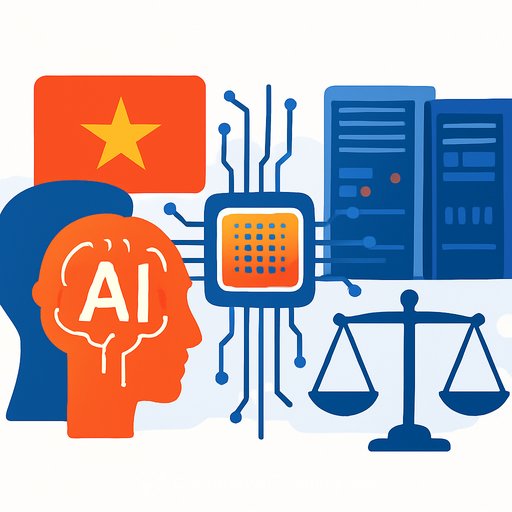
Vietnam is making deliberate moves to lead in AI-across law, compute, funding, and talent. As one official put it, Vietnam won't be a follower. The aim is mastery, autonomy, and digital sovereignty.
The legislative pillar is clear: a dedicated AI law built on risk management. If passed this session, Vietnam would join the EU, South Korea, and Japan as an early mover. The intent isn't to clamp down, but to create an open, safe legal corridor that drives innovation.
Legislation: A Risk-Based Approach With Teeth
The core spirit of the proposed AI law is "open yet safe." It favors innovation while setting guardrails based on risk levels. For legal teams, this is where definitions and scope will matter most.
- Scope: Watch how "AI system," "high-risk," and "prohibited" uses are defined. Precision here sets the compliance burden.
- Risk tiers: Expect obligations to scale with risk. Look for transparency, human oversight, and incident reporting thresholds.
- Governance: Monitor institutional roles-who regulates, who audits, and how market surveillance operates.
- Enforcement: Track penalties, remediation timelines, and potential sandboxes for pilots.
- Cross-border: Note any extraterritorial reach, data flows, and interoperability with foreign regimes.
Reference points include the EU's risk-based framework. See the EU AI Act for directional alignment, especially on high-risk categories and conformity assessment.
Compute Sovereignty: Policy Meets Procurement
The State is moving to build large-scale high-performance computing centers and reduce reliance on any single vendor or country. The push includes "Make in Vietnam" chips and Vietnamese-led design, packaging, and testing.
Legal workstreams will follow quickly:
- Public procurement: Clauses on security, uptime, incident response, and sovereign control.
- Data and security: Residency, classification, and lawful access in shared compute environments.
- Export controls and sanctions: Supplier screening and technology transfer reviews.
- IP and standards: Ownership of designs, joint development terms, and compliance with technical standards.
- Resilience: Multi-vendor strategies to avoid single points of failure.
Funding: New Incentives, New Compliance
Alongside NAFOSTED and NATIF, Vietnam is developing a National AI Development Fund and an "AI Voucher" scheme to stimulate adoption. Expect strong public-private collaboration and clear performance metrics.
- Grant and voucher compliance: Eligibility, reporting, clawback triggers.
- State aid and competition: Fair allocation, anti-favoritism controls, and IP obligations.
- Tax and accounting: Treatment of incentives, R&D capitalization, and subsidy disclosures.
Talent: Dual-Skilled Teams, Clear IP
Vietnam is backing "dual-skilled" talent-experts in both semiconductor hardware and advanced AI algorithms. This is framed as the country's most valuable asset for long-term sovereignty.
- Contracts: Clean IP assignment, moral rights, and background IP carve-outs.
- Mobility: Non-solicit and trade secrets stewardship that can survive M&A.
- Training data: Licensing for datasets, model weights, and third-party code.
State as Conductor-and Largest Client
The government will connect the three pillars: government, academia, and industry. It also plans to be the largest client-issuing grand, hard problems to pull in businesses and research institutions.
- Challenge-based procurement: Clear IP terms, liability allocation, and audit rights.
- Safety and testing: Pre-deployment evaluation, post-market monitoring, and recall processes.
- Confidentiality and national interest: Security clearances and controlled information handling.
Why This Matters Now
AI is central to Vietnam's shift from traditional manufacturing to a knowledge-driven economy, as stressed by leadership at the National Innovation Center under the Ministry of Finance. The State has named AI a top priority through 2030 with a long view to 2045, and placed it at the top of its Strategic Technologies and Products list.
Global context supports the bet. The OECD notes AI's outsized economic impact by 2030, and in semiconductors, AI boosts productivity, precision, and resilience across supply chains.
Practical Checklist for In-House Counsel
- Map AI use cases and assign risk tiers; build a register of systems, datasets, and vendors.
- Draft baseline AI clauses: transparency, human oversight, incident reporting, and audit rights.
- Prepare for conformity assessments and technical documentation requirements.
- Review procurement playbooks for HPC and chip-related projects; add sovereignty and data controls.
- Stand up a grants and incentives desk for the National AI Fund and AI Voucher compliance.
- Tighten IP and secrecy in talent contracts; address model training assets and derivative works.
- Establish a board-level AI risk policy with clear accountability lines and KPIs.
The Bottom Line
"AI and semiconductors are two sides of the same coin-the twin wings of Vietnam's economic takeoff," as Thang put it. For legal teams, the window is now: codify risk-based governance, secure procurement and IP positions, and get audit-ready before obligations kick in.
Your membership also unlocks: