Vietnam's AI Labeling Law: What Legal Teams Need in Place by March 1, 2026
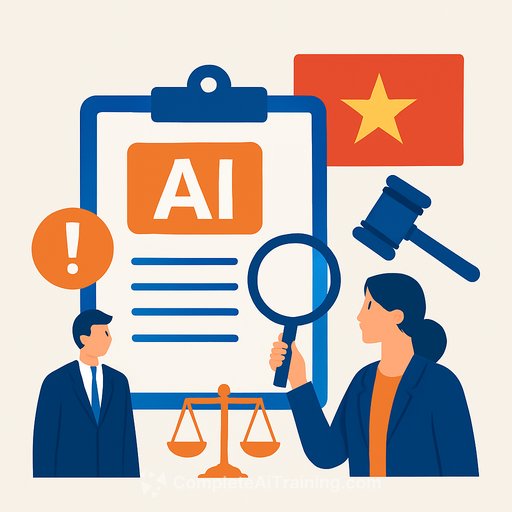
Vietnam's Law on Artificial Intelligence takes effect on March 1, 2026. It requires AI service providers to tell users when they're interacting with AI. Failing to disclose can trigger criminal proceedings or administrative fines. The Ministry of Science and Technology (MOST) is drafting a decree to clarify labeling rules.
If your organization builds, deploys, or distributes AI content in Vietnam, treat disclosure as a product requirement, not a marketing preference. The risk sits squarely with the provider and the content user who publishes or distributes the output.
Core disclosure duties
- AI systems that interact directly with humans must inform users they are engaging with AI.
- AI-generated content must carry appropriate labels.
- Content that simulates a real person's appearance or voice, or recreates real events, must include clear and distinguishable labeling.
Recognized exceptions
- Internal use within closed ecosystems (B2B, B2E) without public access.
- Experiences in controlled environments.
- Imaginative works where the audience clearly understands the content is fictional.
- AI-enhanced content (e.g., image, sound, appearance, or text improvements) that does not alter the intended message.
Format-specific labeling rules
- News: Show a clear notice on-screen or directly beneath the headline so it's unmissable.
- Short videos: Place labels in screen corners or use platform captions.
- Audio: Provide a spoken notice at the beginning.
- Images: Include watermarking and, where applicable, embed metadata as part of the label.
Platform and provider responsibilities
- AI service providers and content users must not remove or interfere with labels.
- Social platforms must support users in labeling but are not required to proactively review content, except for violations or when authorities formally request action.
Practical compliance checklist for counsel
- Scope your exposure: Inventory AI systems and AI-assisted workflows touching Vietnam. Flag direct human interaction and any content that simulates real people or events.
- Design for disclosure: Build UI/UX notices for chatbots and assistants. Ensure labels are visible, persistent where needed, and recorded in logs.
- Set content pipelines: For images, embed watermarking and metadata at creation and on export. Consider open standards like C2PA for provenance and label integrity.
- Meet format rules: Add pre-roll voice notices for audio; corner overlays or platform captions for short video; on-screen or under-headline labels for news.
- Lock labeling protections: Use technical controls to prevent label stripping. Monitor transformations (re-encoding, cropping, compression) that could remove labels.
- Define exceptions policy: Document when internal-use, controlled-environment, fictional, and enhancement-only exceptions apply. Require approvals and evidence.
- Contractual coverage: Push labeling obligations and no-removal clauses into vendor and creator agreements. Allocate liability and incident response duties.
- Records and audits: Keep evidence of disclosures, label insertion logs, QA checks, and user notices. Prepare for regulator or platform inquiries.
- Enforcement readiness: Stand up a takedown and correction process for mislabeling. Train moderators and comms teams.
- Track the decree: MOST's implementing decree will refine scope, formats, and enforcement mechanics. Assign a policy owner to monitor updates and align templates.
What to watch for in the forthcoming decree
- Definitions and thresholds for "simulates a real person" and "recreates real events."
- Any standardized label text, icons, or placement rules by medium and screen size.
- Technical requirements for watermarking/metadata and cross-platform preservation.
- Recordkeeping duration, audit expectations, and penalty ranges.
- Treatment of cross-border content and responsibility allocation across the stack.
Action now, before March 2026
- Map AI interactions and content flows.
- Implement labeling at the point of generation and at publishing.
- Update policies, contracts, and user notices.
- Pilot label durability across your full toolchain.
- Schedule a legal/engineering review when the decree lands.
If your team needs structured training on disclosure, provenance, and AI compliance workflows, see AI for Legal.
Get Daily AI News
Your membership also unlocks:
700+ AI Courses
700+ Certifications
Personalized AI Learning Plan
6500+ AI Tools (no Ads)
Daily AI News by job industry (no Ads)