AI-Generated "Carrier Strike" Clips Surge in China: A PR Playbook for High-Velocity Misinformation
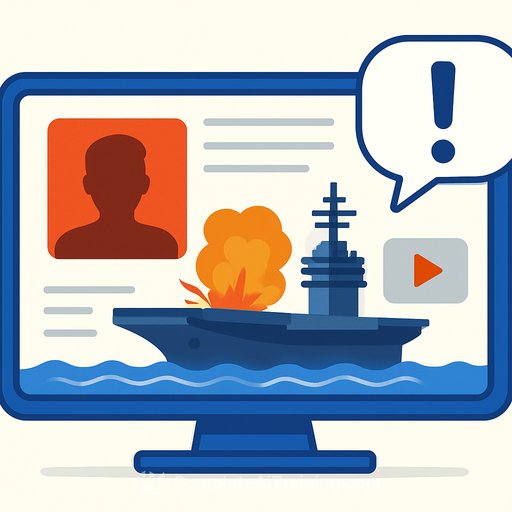
AI-made videos claiming Iranian missiles hit the USS Abraham Lincoln spread across Chinese platforms this week, pushed in part by a report from state broadcaster CCTV echoing statements from Iran's Islamic Revolutionary Guard Corps. U.S. Central Command denied any U.S. carrier was struck, calling the narrative part of "the Iranian regime's false messaging machine."
On Weibo and Douyin, the topic climbed into the top 10, pulling tens of millions of views. Several clips impersonated a CCTV host and showed hyper-realistic explosions, jets falling overboard, and claims of casualties. Reactions ranged from celebration to doubt that a supercarrier could be disabled so easily.
The broader backdrop: the Abraham Lincoln and Gerald R. Ford are involved in ongoing strikes on Iran; Beijing has criticized the U.S. and Israel and urged an immediate halt to fighting. Chinese officials warned about spillover risks, while Washington advised Americans to leave multiple countries as Iran expanded its strikes. President Donald Trump said operations are ahead of schedule and could last about four weeks.
Why this matters for PR and communications
This is a case study in how AI video, state media amplification, and user-generated content converge to create a fast-moving narrative loop. It crosses languages and platforms in hours, puts pressure on official channels to respond, and forces brands and institutions to verify at speed without amplifying falsehoods.
As a communicator, you need a repeatable playbook that blends OSINT-style verification, multilingual messaging, and pre-approved assets. Treat synthetic media crises as a when, not if.
Immediate response checklist (first 60 minutes)
- Spin up your virtual war room: comms lead, social lead, security/ops liaison, legal, and a decision-maker who can approve statements fast.
- Establish source truth: contact the relevant operations center or press desk. For U.S. military updates, monitor U.S. Central Command for official statements.
- Triage platform spread: log URLs, hashtags, repost velocity, and key accounts fueling reach (state media, influencers, bot-like clusters).
- Decide posture: no-comment (buy time), limited rebuttal with receipts, or full thread with media forensics-based on confirmation level and risk to life, markets, or public safety.
Verification workflow (fast OSINT for comms)
- Visual forensics: look for model artifacts (warped text, misaligned shadows), recycled B-roll, inconsistent ship markings, and physics that don't track.
- Audio/narration: check lip-sync, cloned anchor voices, and repeated cadence glitches common in AI dubbing.
- Temporal checks: compare alleged strike time with flight ops logs, AIS-derived location context, weather/sea state, and known deck cycle patterns.
- Cross-affirmation: align with official operations channels; do not quote unverified third-party media as proof.
Messaging that limits amplification
- Holding line: "We're aware of synthetic media circulating online. We have no evidence supporting these claims and are verifying with relevant authorities."
- Confirmed false: "Reports of damage to [asset] are false. Here are today's operations and images time-stamped at [UTC]."
- Safety first: if the content could trigger panic, lead with clear, short facts before adding context; avoid technical jargon.
Channel and market nuance (China-focused)
- Weibo moves via trending topics; Douyin via creator-driven remix. Address each with native assets: subtitled vertical clips for Douyin, concise image cards for Weibo.
- Localize simply in Simplified Chinese; avoid idioms that can be misread. Expect state media narratives to set early frames-respond with verifiable evidence, not emotion.
- Use respected third-party validators where possible (subject-matter experts, partner institutions). Brief them privately before they post.
Pre-approved asset kit (prepare before you need it)
- Fresh, time-stamped photos/video with consistent EXIF practices and on-screen UTC clocks when appropriate.
- Template overlays: "Verified Footage," date/time/location, and a QR code to your live updates page.
- Short explainer on AI-generated video tells (visual + audio) to educate media and the public without sounding defensive.
Monitoring signals and search patterns
- Core queries: "Abraham Lincoln carrier hit," "林肯号 航母 被击中," "航母 导弹 视频," "IRGC cruise missiles carrier."
- Indicators of coordination: identical captions across accounts, sudden language switching, and re-uploads with minor edits to evade moderation.
Governance and escalation
- Define red lines: misinformation that risks lives, markets, or diplomatic fallout triggers immediate level-up to legal and executive leadership.
- Keep a one-pager of who approves what within 5 minutes, 30 minutes, and 2 hours. No guesswork under pressure.
Quotes driving the narrative
"Chinese media first amplify questionable or unverified reports from Iranian state media, and then people start creating all kinds of videos about it using AI tools," said one China affairs commentator. China's Foreign Ministry stated the strikes lack UN authorization and urged all parties to stop military operations.
What to watch next
- More AI battle footage spoofing anchors and military comms, designed to erode trust and stretch verification teams thin.
- State-aligned amplification cycles across languages timed to major operational updates or diplomatic moments.
- Official advisories and timelines from national authorities as the conflict window evolves over the coming weeks.
Skills and tools to level up your response
- AI for PR & Communications - strategies for detection, rapid response, and reputation defense.
- Generative Video - how these clips are made, what to look for, and counter-messaging tactics.
Bottom line: speed without proof is noise. Build a verification muscle, keep your asset kit current, and communicate facts with receipts-brief, visual, and multilingual. That's how you contain synthetic narratives before they set.
Your membership also unlocks: