Virginia bill to add AI risk education in schools advances to Senate
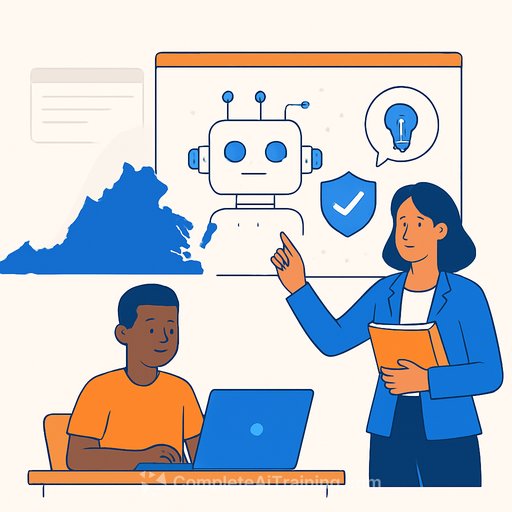
Virginia's House of Delegates advanced a measure to strengthen internet safety education by adding instruction on AI risks, scams, and misinformation. House Bill 171, carried by Del. Alex Askew of Virginia Beach, updates division internet use policies and pushes for explicit teaching on AI-generated content.
The proposal builds on current requirements that all divisions include internet safety in their instructional program and restrict illegal online content. It also aligns with the state's recent focus on responsible AI use in education referenced in Executive Order 30 from 2024.
What the bill would change
- Require schools to teach students how to spot AI-generated content, online scams, and misinformation.
- Clarify and strengthen existing internet safety policies already required in division curricula.
- Encourage age-appropriate instruction and practical skills students can use immediately.
Askew underscored the urgency: students are increasingly running into AI scams and cyberbullying. "With these emerging threats, we need to continue to teach our kids to be safe online from harm and the more specific these algorithms get, the more potential harm they can face."
Education groups backed the bill in a K-12 subcommittee hearing. VEA's Meg Gruber cautioned that trust signals are breaking down online: "Unless you take the time to really do some deep dives, you can't… necessarily trust that it's accurate, that it isn't AI-generated." She noted many students can't tell if a video or clip is AI-made-yet.
UVA neuroscientist Meghan Puglia added a developmental lens. Students learn by struggling through challenge. If AI removes that friction, it can affect cognitive development, creativity, and how students problem-solve. Her advice: start the conversations early and keep them age-appropriate.
Why this matters for educators
- AI tools can fabricate text, images, audio, and video that feel convincing-students need fast, simple checks.
- Scams and impersonations are getting more specific and personal, amplifying risk to minors.
- Over-reliance on AI can short-circuit learning if schools don't set boundaries and teach process integrity.
Action steps you can start now
- Policy tune-up: Add explicit language on deepfakes, voice clones, LLM chatbots, data privacy, and reporting procedures to your Acceptable Use and academic integrity policies.
- Verification drills: Teach lateral reading, reverse image search, and frame-by-frame video checks. Tools to practice: Google Lens, InVID, and basic metadata review.
- Classroom norms: Define what "AI assistance" means in your courses (idea generation, outlines, code suggestions). Require citation of tool use and prompt logs where applicable.
- Assessment design: Use process artifacts (drafts, version history, annotations), quick oral defenses, and in-class writing to reduce overreliance on AI.
- Scam awareness: Train students to spot phishing, deepfake voice requests, and social engineering. Reinforce: never share personal data or login credentials.
- Cyberbullying protocols: Update workflows to include AI-altered media. Save evidence, verify sources, and route incidents through counseling and admin promptly.
- Staff PD: Run short, recurring sessions on AI basics, detection strategies, and ethical use. Pair early adopters with peers for classroom pilots.
- Scope and sequence: K-2 (tricky pictures/voices), Grades 3-5 (credibility checks), Middle (algorithmic bias and claims vs. evidence), High School (model limits, IP, citation rules).
- Family communication: Share monthly tips in newsletters and host a short webinar on recognizing AI-generated content at home.
What's next
The bill passed the House with bipartisan support and now heads to the Senate Education and Health Committee for further consideration. District leaders may want to monitor the committee calendar and begin drafting updates to curricula and policies so implementation can move quickly if the bill becomes law.
Helpful resource
For practical PD and course options on AI literacy and classroom implementation, explore the AI Learning Path for Primary School Teachers.
Your membership also unlocks: