
AI news ·
Virtual reality and AI help nervous students progress from silence to confident speaking
VR-AI boosted speaking confidence in over 70% of UK language students in a trial. It lets them practise real-world scenarios like ordering food without peer pressure.
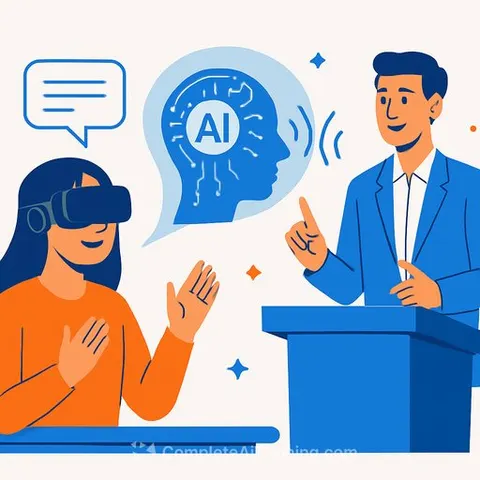
Students entering UK language degrees often arrive with fragile foundations and low speaking confidence, a consequence of a system where foreign language study is not compulsory past age 14. Virtual reality combined with AI can provide an emotionally safe rehearsal space that moves learners from silence to confident participation, according to a senior teaching associate at Lancaster University.
Immersive technologies, when used with clear pedagogical intent, offer rehearsal spaces free from high-stakes classroom pressure. The combination of VR and AI - VR-AI - helps develop that missing confidence, a topic explored in AI for Education resources. A typical scenario might place a student in a 3D restaurant where they speak Spanish with an AI waiter, without worrying about mistakes in front of peers or teachers.
Why immersion matters
VR-AI can create culturally grounded scenarios where students practise real-world communication at their own pace. Each scenario, built in Unity, features AI-driven characters programmed with specific role conditions and linguistic goals. This allows both beginners and advanced learners to immerse themselves in another language without travelling abroad.
The Lancaster system combines three technologies: OpenAI Whisper for speech-to-text recognition, GPT-4o for dialogue generation and CEFR-aligned feedback, and Amazon Polly to produce natural-sounding speech for the AI characters. Students wear a VR headset and interact verbally with avatars in a simulated environment, where their speech is recognised and responded to in real time.
Students can also rehearse each scenario through a web-based version before the immersive session. This flipped-learning approach frees classroom time and gives learners more control. The web version also increases contact hours with the language, reducing reliance on staff-intensive one-to-one practice outside teaching sessions.
What language students gain
Students described the VR-AI experience as less pressured and more enjoyable compared with traditional speaking tasks. They characterised it as "immersive", "interactive", "realistic" and "a great way to practise speaking in real-life scenarios". Over 70 per cent of participants reported a positive impact on their learning, with speaking confidence and listening comprehension identified as the most improved skills.
The technology offers a psychologically safe space where students can speak freely and make mistakes without judgment, encouraging greater linguistic risk-taking. Beginners responded strongly to the novelty and felt less inhibited, while more advanced learners focused on how naturally the AI could sustain a conversation.
Because the VR interaction is projected onto a screen, peers can follow and support the dialogue in real time. This transforms an individual task into a collaborative learning experience, with students exchanging vocabulary and strategies in a supportive environment.
Challenges for institutions
Setting up VR headsets requires technical support and training, and developing scenarios demands ongoing investment. However, costs can be offset through external research funding and partnerships with other institutions.
Environmental and ethical concerns around AI-generated platforms remain an issue for some students and educators, and pedagogical development of immersive learning can add to staff workloads. As AI systems improve, the approach will become more scalable and feasible for sustained integration.
Why this matters for Education
For educators, VR-AI tools are not a replacement for teachers. They rest on the expertise of instructors who shape meaningful pedagogical experiences, prepare materials, and guide students through tasks. The technology provides a low-stakes environment where anxious students can build speaking confidence at their own pace.
Schools and universities facing barriers to traditional year-abroad programmes can use these tools to offer accessible, real-world practice. Start with web-based versions and explore partnerships to manage costs. For a structured approach, the AI Learning Path for Teachers offers practical guidance on integrating immersive AI into the classroom.