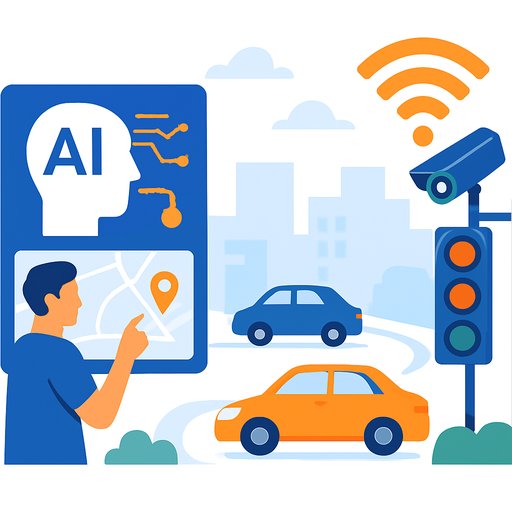
SARTHI: Vizag's AI-Managed Traffic Plan, Built for Results
Visakhapatnam is moving from fixed timers to AI-managed signals under SARTHI (Systematic Augmented Radial Traffic and Hoop Induction). By April 2026, the city targets AI-driven surveillance and control across 56 corridors and 102 junctions, backed by ₹60-65 crore in funding. Over 2,000 high-end cameras will feed live data to automate flow, cut delays, and tighten enforcement.
GVMC Commissioner Ketan Garg said the goal is simple: reduce waiting time at red lights and make roads safer. A city team will study best practices in Trivandrum, Kochi, Bengaluru, Ahmedabad, and Hyderabad to inform the rollout.
What SARTHI Includes
- Adaptive Traffic Control (ATCS): Installed at 102 junctions. Sensors detect real-time traffic density and extend or shorten greens to clear queues faster.
- Integrated Traffic Management System (ITMS): Monitoring 90+ junctions with Automatic Number Plate Recognition (ANPR), Red Light Violation Detection (RLVD), and automatic e-challans. Backbone: ~2,000 cameras across priority corridors like RK Beach Road.
"With SARTHI, AI manages rush hour headaches, speeds up travel, and holds violators accountable in real time," said Mr. Garg, calling the program a gold standard for smart-city traffic.
Why This Matters for City and Operations Leaders
- Throughput first: Shorter cycle delays and smoother progression mean higher corridor capacity without new lanes.
- Lower fuel burn: Less idling cuts emissions and citizen costs-good policy and good optics.
- Fair, consistent enforcement: ANPR and RLVD apply rules evenly, reducing disputes and manual workload.
- Better planning data: Heatmaps of demand by hour, junction, and approach support capital planning and signal policy.
Execution Highlights
The city will benchmark systems in Trivandrum, Kochi, Bengaluru, Ahmedabad, and Hyderabad to refine design and SOPs. Chennai's adaptive signals backed by Japanese cooperation offer a clear reference for governance and vendor coordination. Trivandrum's model adds facial recognition to its traffic stack-useful for understanding integration boundaries and privacy controls.
What Managers Should Watch
- KPIs that matter: average delay per vehicle, queue lengths, corridor travel time reliability, violation rate, incident clearance time. Capture baselines before any switch-on.
- Interoperability: Open APIs, ONVIF-compliant video, standard data schemas. Avoid proprietary lock-in for controllers, sensors, and VMS.
- Data governance: Clear retention windows, audit trails, role-based access, and compliance with India's data protection norms. Separate enforcement data from planning data.
- Procurement model: CapEx vs. SaaS. Model 7-10 year total cost of ownership (hardware refresh, licenses, connectivity, spares).
- Uptime & SLAs: Define targets for camera/controller uptime, detection accuracy, and mean time to repair. Tie payments to verified performance.
- Cybersecurity: Network segmentation, encrypted streams, patch cadence, red-team testing, and incident response runbooks.
- People and process: Signal engineers, analysts, and a 24/7 ops cell. Codify playbooks for adaptive plans, incidents, and roadwork overrides.
- Public trust: Transparent signage, grievance redressal for e-challans, and periodic third-party audits of ANPR and RLVD accuracy.
90-Day Playbook to De-Risk Rollout
- Day 0-15: Stand up a joint PMO with police, transport, and IT; lock KPIs and data policy; pick 3 pilot corridors.
- Day 16-45: Baseline studies; network surveys; evaluate vendors against live pilots; verify API openness and migration paths.
- Day 46-75: Integrate with enforcement backends for e-challans; stress-test dashboards; run citizen communication dry runs.
- Day 76-90: Go-live on pilots with shadow monitoring; weekly KPI reviews; fix false positives in RLVD/ANPR; finalize citywide schedule.
Budget and ROI Snapshot
At ₹60-65 crore, leadership should evaluate payback beyond fines. The primary return is time saved per commuter, reduced fuel burn, and fewer incidents. A simple model: value of minutes saved × peak-hour volume × working days. Add maintenance offsets from fewer manual deployments and targeted enforcement.
Benchmarks to Learn From
- Bengaluru: ATCS at scale-good lessons on calibration and corridor coordination.
- Chennai: Adaptive signals supported by Japanese cooperation; strong governance and vendor alignment. JICA documentation can inform contracting and QA.
- Trivandrum: Advanced integration including FRS; helpful to define boundaries for public safety vs. mobility use cases.
Next Steps for Decision-Makers
- Appoint a single accountable owner (CMO-level or Commissioner-level) with a weekly KPI review rhythm.
- Publish a public dashboard with corridor travel times and signal performance to keep momentum and trust.
- Run a Privacy Impact Assessment; engage civil society early; document exceptions and data retention in plain language.
- Negotiate vendor terms on accuracy guarantees, uptime, and penalties tied to measurable outcomes.
- Plan for training: controllers, analysts, and enforcement staff; simulate incident scenarios before scale-up.
If you lead transport operations or city services and want a structured path to skill up on systems like ATCS, ITMS, ANPR, and enforcement analytics, explore AI for Transportation Managers.
Your membership also unlocks: