Computer Science Departments Face a Reckoning as AI Changes What Coding Skills Matter
Computer science educators are caught between two opposing forces. Artificial intelligence can now generate working code in seconds, making traditional programming instruction feel obsolete. At the same time, AI's arrival creates demand for a different kind of programmer-one who understands how to direct these tools rather than write every line by hand.
Sanjay Srivastava, CEO of Vocareum, an educational platform for hands-on coding practice, frames the moment as one of "extreme euphoria and extreme panic." The shift reflects a broader change in what counts as literacy. Education moved from teaching everyone to code, then to making graduates data-literate. Now comes AI literacy.
The Conductor, Not the Musician
Srivastava uses an orchestra analogy to explain the new role. Programmers are no longer individual players performing their instruments. They are conductors, orchestrating multiple technologies and systems.
He tested this himself recently, spending a few hours building AI agents to scrape emails for leads and research customers in Slack. He touched eight or nine different technologies in a single afternoon. The experience revealed an immediate need: proper controls and guardrails around what these systems do.
This shift requires different teaching. The skill is no longer syntax. It is orchestration-knowing which tools to use, how to combine them, and how to manage their outputs responsibly.
Why Most AI Tutors Fail in Classrooms
Many schools have added AI tutors or chatbots as optional supplements to existing courses. Srivastava calls this the "5% problem." When AI tools sit on the periphery, only about 5 percent of students use them-typically high performers who need help least.
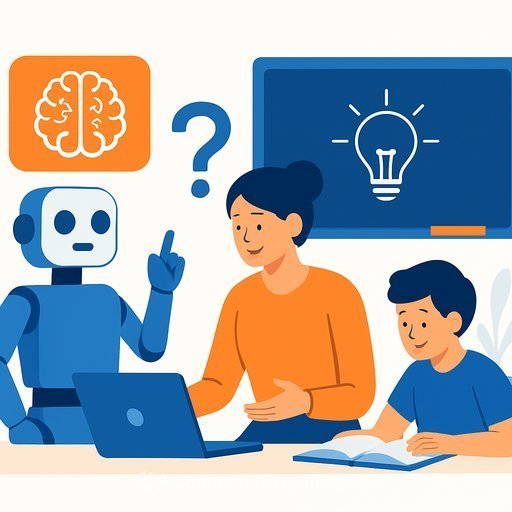
Integration matters more than availability. AI must be woven directly into the teaching environment, appearing exactly when a student gets stuck on a specific problem. The difference is between an assistant and what Srivastava calls a "digital twin"-a system that knows precisely what a student understands and where they are struggling.
The evidence is concrete. Vocareum and UC San Diego partnered on a pre-calculus project where an AI tutor was embedded directly into coursework. The failure rate dropped 70 percent. Students who previously feared asking questions in a lecture hall of 1,400 people now had access to immediate help.
How Assessment Must Change
Old testing methods are becoming unreliable. AI agents can take quizzes. Tools can provide answers from a screenshot. Some schools are responding by returning to monitored, locked-down testing facilities for high-stakes exams.
The more meaningful shift happens in formative assessment-the feedback students get while learning. Instead of grading only the final output of a coding project, educators can use AI to probe understanding. A student might submit working code, but the AI asks them to explain different sections of their logic. If they cannot articulate why the code works, they have not achieved mastery.
This approach pushes toward authentic assessment-measuring whether students understand the concepts deeply enough to manage AI effectively, not whether they can produce a functioning program.
Personalization at Scale Becomes Possible
Education's perennial goal is personalization. The barrier has always been cost. One-on-one instruction works, but it does not scale.
AI changes the equation. Teachers can now deliver individualized attention to hundreds of students simultaneously. AI handles routine explanations and initial obstacles. Teachers move through the room, working with small groups on real-world projects.
Srivastava compares this to the calculator moment in mathematics education, not the Model T moment. Calculators did not end math. They removed drudgery and freed teachers to focus on concepts and problem-solving. AI can do the same for coding and other technical subjects.
The Unfinished Question
As more work gets outsourced to machines, education must ensure something does not get outsourced: ethics and judgment. The goal is to produce graduates who understand what AI cannot do-who can conduct these tools with wisdom and purpose.
That requires rethinking what computer science education teaches, how it measures success, and what role teachers play. The work is technical, but the stakes are human.
For more on how AI is reshaping education, explore resources on AI for Education and AI Coding Courses.
Your membership also unlocks: