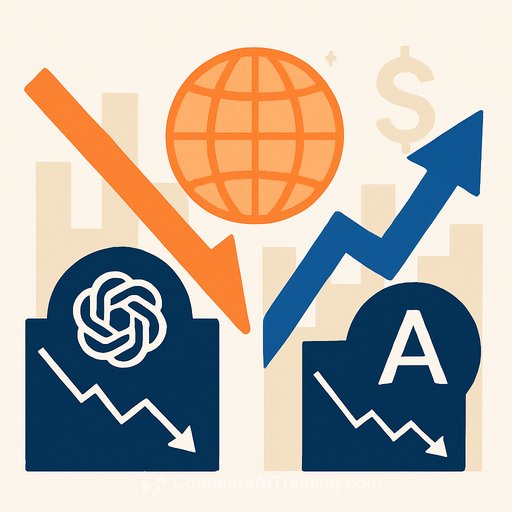
AI trade flips: OpenAI turns from catalyst to drag as Alphabet gathers strength
Wall Street has re-priced the AI trade. OpenAI is losing its shine while Alphabet looks like the safer, better-capitalized compounder across the stack.
For portfolios tied to AI, this isn't a headline - it's a repricing of risk and cash flow. The spread is showing up in returns, supply chains, and the cost of capital.
What triggered the pivot
- Mixed reception to OpenAI's GPT-5 vs. strong reviews for Alphabet's latest Gemini model, which reset expectations for product quality.
- OpenAI's "code red" to improve ChatGPT, putting other efforts on hold - signaling execution pressure.
- Scrutiny of financing structures, circular deal-making, and debt exposure around OpenAI's buildout.
- Alphabet's scale advantages: cash, distribution, Google Cloud, semiconductor efforts (TPUs), and mature businesses like YouTube and Waymo.
As one strategist put it, OpenAI went from being the market's "golden child" to a name investors treat with more caution.
Scoreboard, 2025 to date
- OpenAI-connected basket: +74%
- Alphabet-exposed basket: +146%
- Nasdaq 100: +22%
The spread has been fast and wide - and it's forcing position reviews across tech, semis, and cloud.
Second-order effects up and down the stack
- Pressure on OpenAI-linked exposures: Oracle (cloud capacity), CoreWeave (infrastructure), AMD (accelerators), plus knock-on selling in Microsoft, Nvidia, and SoftBank (owns 11% of OpenAI).
- Momentum for Alphabet's partners: Broadcom (TPUs), Lumentum (optical components), Celestica (hardware), TTM Technologies (PCB and electronics).
If users tilt toward Gemini, ChatGPT growth slows, which pinches OpenAI's ability to fund cloud and chip commitments. That risk funnels straight into suppliers' backlog quality and utilization.
The funding math spooking investors
- HSBC pegs the gap between OpenAI's revenue and spending plans through 2033 at roughly $207 billion.
- Revenue is expected to exceed $12 billion in 2025 - but compute costs remain heavy, and returns across the "interlaced AI chain" are under a microscope.
Comments from leadership added fuel. The CFO's remarks about potential government backstops (later clarified) and the CEO's sharp response on a podcast to questions about funding commitments both hit sentiment.
Why Alphabet looks "complete" to investors
- Scale: top-tier market cap, large cash position, and a wide distribution footprint.
- Vertical integration: model development, TPUs, and data center buildout via a mature partner network.
- Multiple monetization rails: Search, YouTube, Cloud, and emerging units like Waymo.
There's a growing view that Alphabet has the pieces to set the pace on model quality and unit economics. Whether it keeps that edge is the key debate.
What to watch next (practical checkpoints)
- Product quality and usage: user growth and retention for ChatGPT vs. Gemini, developer adoption, enterprise pilots turning into paid seats. See Alphabet's updates on Gemini here: Google AI: Gemini.
- Unit economics: inference costs, cloud discounts, gross margin per token/inference, and capex intensity for model upgrades.
- Supplier prints: bookings, backlog, and capacity utilization at Broadcom, Lumentum, Celestica, TTM; any order pushouts from OpenAI-linked partners (Oracle, AMD, CoreWeave).
- Financing signals: debt issuance, structured deals, or capital injections to bridge compute and data center commitments.
- PR and regulatory noise: anything that increases the risk premium on OpenAI's cash burn and governance.
Scenario map to frame positions
- Two-leader base case: Alphabet and OpenAI both ship improvements; spread narrows modestly; suppliers with diversified demand outperform single-customer names.
- Alphabet out-executes: Gemini leads on quality and cost; Alphabet suppliers re-rate; OpenAI-linked capacity gets repriced or deferred.
- OpenAI comeback: Material step-up in ChatGPT quality and monetization; Oracle and AMD sentiment recovers; short interest in OpenAI-adjacent names squeezes.
- Macro/capex shock: Broad AI spend slows; picks-and-shovels with broad customer bases defend better than single-counterparty exposure.
Portfolio ideas to evaluate
- Favor diversified "picks-and-shovels" over single-customer suppliers tied to one model's growth curve.
- Size positions by balance sheet strength and visibility into backlog conversion, not headlines.
- Use pairs or baskets to express relative views (Alphabet supplier basket vs. OpenAI-linked basket) to reduce market beta.
- Define risk with options where uncertainty on model quality and funding is highest.
- Track dispersion and be willing to rebalance - this is still a factor-driven tape with sudden rotations.
Earnings-season checklist
- Alphabet: Cloud AI backlog, TPU ramp, capex guide, and commentary on Gemini adoption.
- Oracle: GenAI bookings tied to OpenAI, timing of deployments, and margin impact from AI workloads.
- AMD: MI-series shipments mix by customer; any exposure concentration to OpenAI.
- Broadcom/Lumentum/Celestica/TTM: order quality, lead times, cancellations/pushouts, and capacity plans.
- Microsoft/Nvidia/SoftBank: color on OpenAI exposure, contract structures, and risk-sharing terms.
The market is telling you something simple: cash flow clarity beats promise. Alphabet currently has it. OpenAI needs to prove it. Trade accordingly, and keep your eyes on unit economics over narratives.
Resources
- Model quality updates: Google AI: Gemini
- Practical tools for finance teams tracking AI vendors: AI Tools for Finance
Your membership also unlocks: