
AI news ·
Walmart embeds AI across operations and launches companywide reskilling programs for its workforce
Walmart is rolling out AI across its stores, supply chain, and HR operations, per its latest annual report. Workers who complete AI certifications gain access to higher-paid roles in driving, management, and software development.
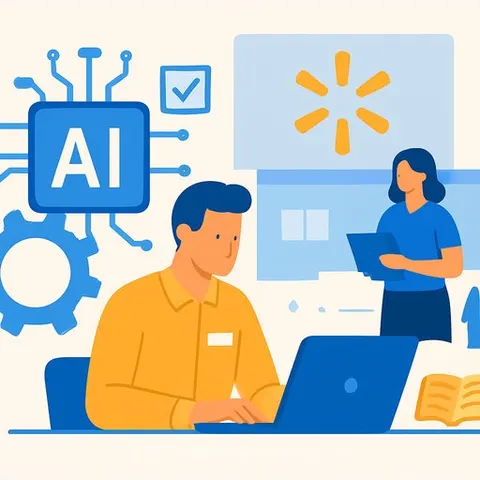
Walmart Scales AI Across Operations and Workforce
Walmart is embedding artificial intelligence across customer-facing services, supply chain management, and staffing operations, according to its latest annual report. The retailer frames the move as central to becoming customers' primary shopping destination while simultaneously reskilling its workforce into higher-paid technical and management roles.
The deployment spans personalization tools for shoppers, frontline systems that reduce repetitive work for store associates, and backend automation for inventory and fulfillment. Walmart is pairing these technical rollouts with formal training programs and certifications that certify workers as AI proficient and create pathways to roles in commercial driving, management, and internal software development using its vibe coding platform.
What Walmart is Actually Doing
The company is not announcing a single model or product. Instead, it is operationalizing AI across five areas: customer experience, associate productivity, supply chain, operations management, and talent recruitment and development.
On the customer side, Walmart is using AI for personalization and in-store experience enhancements. For associates, the company has built tools that accelerate decision-making and automate routine tasks-reducing friction in daily work.
The workforce element is the strategic differentiator. Walmart is offering companywide learning pathways, certifications, and programs that let workers move into driver roles, supervisory positions, and technical jobs. This creates an internal labor market where AI proficiency unlocks career advancement.
Why This Matters to Executives
Large retailers have moved beyond pilot projects. Walmart's approach signals how enterprise AI adoption now requires three pieces working together: model deployment, operational process change, and workforce reskilling budgets.
For executives building AI strategy, the pattern is clear: treating AI as an end-to-end capability-not just a personalization feature-means thinking about inference, human-in-the-loop workflows, and skills certification as a single system.
Walmart is also using AI as a retention and advancement tool. Associates who gain AI certifications can move into higher-paying roles, which addresses labor market pressure in retail while building internal technical capacity.
What to Watch Next
The real test is measurement. Walmart will need to show ROI through labor productivity metrics, inventory turnover, fulfillment speed, and associate career outcomes. If training investments translate to durable competitive advantage, other large retailers will follow the same model.
Future disclosures may reveal vendor partnerships, in-house model stacks, and data governance practices-details that will show whether Walmart is building proprietary AI infrastructure or relying on third-party tools.
For practitioners, this is a notable large-scale deployment worth monitoring. It is strategic and operationally significant, but not a frontier research breakthrough. The value lies in seeing how a major enterprise executes AI adoption across multiple business functions simultaneously.
Learn more about AI for Executives & Strategy and AI for Human Resources to understand how to design similar organizational transformations.