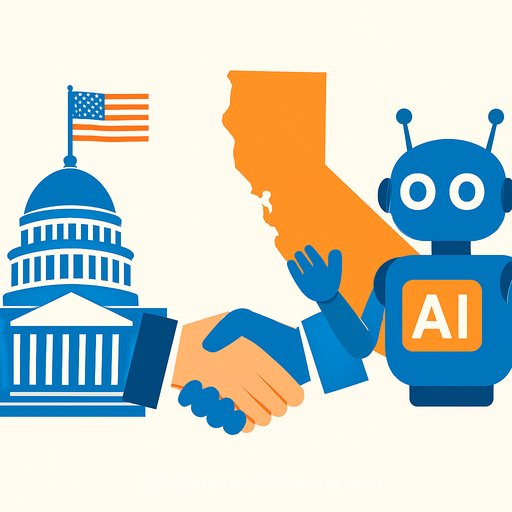
The Federal Government Is Becoming an Agent of AI Chaos
Reports indicate that federal officials, backed by a few Silicon Valley executives, are pushing to block states from regulating AI. Pre-emption language was reportedly floated for the National Defense Authorization Act, even as members of the House heard testimony about AI chatbots harming children. The White House is also said to be exploring an executive order that would curb state-level action. Even if one attempt fails, the message is clear: more will follow.
What this means for people in government
If federal pre-emption moves forward, states could lose key tools to address real harms, move faster than federal agencies, and run tailored pilots. It would shift decisions that affect local schools, health systems, and public safety to Washington. That slows response time and limits practical oversight where it actually happens-on the ground.
Why pre-emption matters
- State experimentation drives early detection of risks and workable guardrails.
- Attorneys general and consumer protection teams are often first to see complaints and patterns of harm.
- Procurement and grants are leverage points that help shape safer AI use in schools, health, labor, and public safety.
Action checklist for state and local officials (do this now)
- Adopt procurement guardrails: incident reporting, audit access, training requirements, red-teaming results, and kill-switch terms for harmful behavior.
- Require data and privacy controls: data minimization, prompt/response logging with safeguards, clear deletion timelines, and vendor attestations on training data sources.
- Set use-case rules: ban AI for eligibility or discipline decisions without human review; separate pilot environments from production; mandate human-in-the-loop for high-risk uses.
- Protect minors: restrict AI chatbots in K-12 without age gating, educator oversight, and content filtering; require vendor safety test results before deployment.
- Stand up an AI risk registry: inventory systems, classify risk, track incidents, and publish summary dashboards for transparency.
- Create an interagency AI working group: CIO, CISO, AG's office, education, health, labor, child safety, and procurement at one table with a 90-day action plan.
- Use existing laws: consumer protection, unfair/deceptive acts, civil rights, data breach, and education records can cover a lot-pre-emption or not.
If you're in a federal agency
- Adopt the NIST AI Risk Management Framework and require vendors to map controls to it.
- Standardize vendor disclosures: model lineage, training data sources, evaluation results, known failure modes, and fine-tuning limits.
- Gate high-risk pilots: documented expected benefits, risk owner, sandbox constraints, and clear exit criteria.
- Coordinate with child safety and health teams on AI and youth exposure before agency-wide rollout.
What likely still remains even under broad pre-emption
- Contract law and procurement terms (testing, audit rights, security baselines, and service levels).
- General consumer protection and anti-discrimination statutes.
- Data security and breach notification requirements.
- Education, health, and labor standards tied to funding and accreditation.
Prepare for fast-moving federal moves
- Scenario-plan three paths: strong pre-emption, narrow pre-emption, or no pre-emption. Draft playbooks for each.
- Keep model policy text ready for procurement, data protection, and child safety you can plug in within days.
- Track legislative vehicles and executive actions; assign a single point of contact to push updates to program leads.
- Invest in staff training so teams can evaluate vendor claims, read eval reports, and spot high-risk use cases early.
Practical resources
- NIST AI Risk Management Framework - a common starting point for controls and vendor requirements.
- NDAA tracker on Congress.gov - monitor amendments and report language that could include pre-emption.
Build internal capacity
Policy is only part of it. Your teams need the skills to evaluate systems, write enforceable contracts, and run safe pilots. If you're standing up training programs for non-technical staff, this catalog can help you map courses to roles and functions.
Federal action may narrow what states can do. It doesn't stop you from using the tools you already have, raising your standards through procurement, or protecting the public with clear, enforceable rules. Move now, document everything, and be ready to switch lanes as the legal picture changes.
Your membership also unlocks: