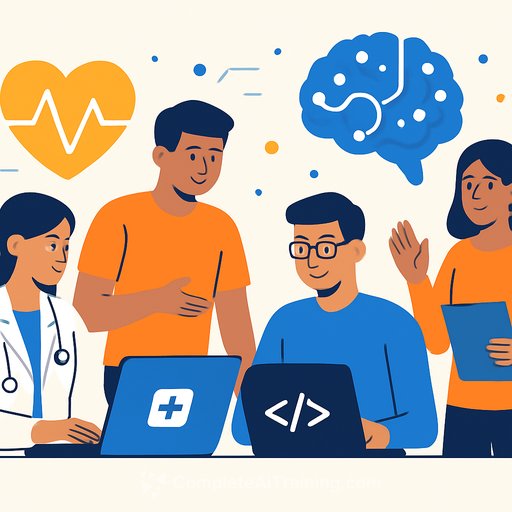
WCM-Q Hackathon Drives AI Innovation in Healthcare
Artificial intelligence is moving from theory to bedside problems. At Weill Cornell Medicine-Qatar's first AI Hackathon, medical and computer science students teamed up to build early models for clinical prediction and workflow automation.
Over one weekend in October (10-11), six interdisciplinary teams worked on real problems clinicians care about: earlier detection, better triage, and clearer decisions at the point of care.
Inside the "MedAI Hack Collaborative"
Hosted by WCM-Q and co-sponsored by WCM-Q Dean Dr. Javaid Sheikh and Cornell's Global Chief Information Officer Dr. Curtis Cole, the hackathon brought students together from WCM-Q, Cornell University, and Cornell Tech.
- Clinical risk prediction using federated learning (multi-site modeling without centralizing patient data)
- Simulating clinical trials with real-world data to inform protocol design
- Predicting breast cancer tumor subtypes from available clinical and imaging signals
- Automating polycystic ovarian morphology classification from imaging
- Early prediction of postpartum depression
- Using wearable data for proactive health insights
Mentors from biomedical research, radiology, and data science guided teams on feasibility, data quality, and evaluation. Organizers noted how smoothly students in the U.S. and Qatar worked together-different backgrounds, shared clinical goals.
Why this matters for clinicians and health leaders
- Better risk stratification: Techniques like federated learning enable institutions to learn from distributed data while keeping PHI local, strengthening privacy and generalizability. See overview
- Trial simulation with real-world data can reduce avoidable protocol amendments and improve site selection before the first patient is enrolled.
- Imaging automation (e.g., PCOM classification) can trim manual workload and improve consistency across readers and sites.
- Wearables and passive monitoring can surface earlier warning signals for timely intervention-especially in outpatient and postpartum settings.
What participants learned
Medical students sharpened the skill of framing precise clinical questions and defining meaningful endpoints. Computer science students gained exposure to clinical constraints: missingness, shift, bias, and workflow fit.
With hands-on mentorship, teams iterated quickly on problem scoping, baseline models, and validation plans. As organizer Ayham Boucher noted, the standout outcome was how fast cross-disciplinary teams moved once they aligned on a clear clinical target.
How to apply this approach in your organization
- Run a focused 48-hour sprint: 1 clinician, 1 data scientist, 1 engineer. Pick one narrow question (e.g., "Which postpartum patients need a 2-week check-in?"). Define success metrics upfront.
- Adopt privacy-first methods: start with de-identified, synthetic, or federated data pilots. Engage compliance early; document IRB pathways and data use agreements.
- Prototype on open benchmarks, then shift to local validation. Track calibration, subgroup performance, and drift over time.
- Design for workflow: where does the prediction show up, who sees it, what action follows, and what happens if it's ignored?
- Plan MLOps from day one: monitoring, human-in-the-loop review, feedback capture, retraining cadence, and fail-safes.
What's next
Expect more collaboration between WCM-Q, Cornell University, and Cornell Tech as teams refine prototypes and pursue clinical validation. The bigger signal: health systems can create similar sprints to test ideas safely, cheaply, and fast-before full-scale investment.
If you're looking to upskill clinicians, data teams, or program managers on practical AI for care delivery, explore curated training by role here: AI Courses by Job.
Bottom line: Aim small, move fast, measure honestly. Interdisciplinary, time-boxed work sprints can turn AI from a buzzword into bedside value.
Your membership also unlocks: