Weathernews Launches Conversational AI for Ship Captains: What Operations Teams Need to Know
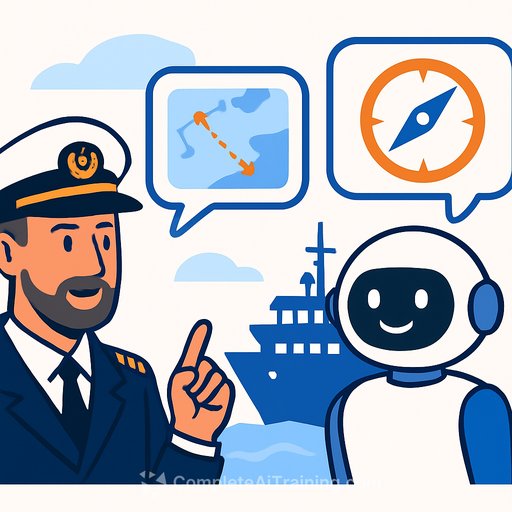
Weathernews Inc. (Chiba, Japan; President: Tomohiro Ishibashi) has launched SeaNavigator for Master, a next-generation onboard platform that lets captains query an AI Agent for voyage-critical data in plain language. The company describes it as the world's first commercial conversational AI Agent for captains, built on improved maritime connectivity and a long track record of marine weather services.
For operations leaders, the value is clear: faster approvals, less back-and-forth via email, better fuel and time outcomes, and tighter alignment between bridge and shore-using the same live data.
Why it matters for Operations
- Closes the information gap between ship and shore with high-resolution, real-time forecasts on the bridge.
- Speeds route approvals via chat while both sides view the same screen and data.
- Quantifies trade-offs (time, distance, fuel) across multiple route options to support consistent decisions.
- Adds grounding risk checks (NAR: Navigation Assessment & Routing) into the standard workflow.
What SeaNavigator for Master Does
Conversational AI for voyage decisions
Captains can ask the AI questions like "Summarize weather risks along the planned route," or "Wind speed and wave height for Osaka in 48 hours." The AI pulls from Weathernews marine and operational datasets and replies in chat, 24/7. It also covers fuel consumption and speed trends based on historical routing track records.
Weathernews plans to expand the AI to handle complex consultations that usually require expert input, providing faster guidance while leaving final authority with the captain and operations.
High-resolution weather on the bridge
Historically, onboard bandwidth limited updates to once per day and lower-resolution data. Now, vessels can view global, high-resolution wind, wave, current, and tropical cyclone track forecasts overlaid on a chart-style display. This places the same level of detail used by shore teams directly in front of the captain.
Voyage Route Simulation (multi-option planning)
Captains enter departure/arrival ports, schedule, and a reference wave-height threshold. The system generates multiple route options ranked by weather-related risk, refined by threats such as tropical cyclones and low-pressure systems, plus ship reports. Each option shows estimated time, distance, and fuel consumption.
Simulations can be re-run from the vessel's current position after departure, enabling updates mid-voyage as conditions shift.
Sea-shore approvals via chat (beyond email)
Route selection and approvals move from email to a shared chat workspace, accelerating decisions while improving clarity and auditability. Both onboard and shore-side personnel can validate grounding risks using the same NAR data, alongside weather and operational constraints.
Track Record and Infrastructure
Weathernews has supported marine operations for nearly 40 years and launched the first offline onboard system in 1994. With recent maritime network improvements, the company has renewed its onboard systems for the first time since 2012 and is drawing on experience across a cumulative one million voyages to improve the AI Agent and simulations.
Suggested Operations Playbook
- Pre-departure: Run simulations with agreed wave thresholds; review options and rationale in chat; log the final approval. Ops teams handling pre-departure planning and communications can follow the AI Learning Path for Administrative Assistants to standardize those processes.
- En route: Set check-in times; ask the AI for 48-72 hour risk changes; re-run simulations when systems intensify or tracks shift.
- Fuel policy: Compare route options by fuel burn per nautical mile vs ETA risk; document chosen trade-offs.
- Safety: Use NAR to flag shallow or congested areas during planning and revisions; verify mitigations in the chat thread.
- Post-voyage: Compare forecasts vs actuals; capture deviations, lessons learned, and AI queries that added value.
KPIs to Monitor
- Approval cycle time (email chains vs chat-based decisions)
- Fuel consumption per nautical mile vs baseline for similar voyages
- Weather-related deviations and off-hire hours
- Grounding near-miss events and NAR alert engagement
- Volume of emails replaced by shared chat threads (auditability)
Governance and Change Management
- Define decision rights: AI informs, captains and operations decide.
- Adopt a standard prompt set for common queries (route risk summary, port conditions in 48-72 hours, fuel/time trade-offs).
- Set fallbacks for degraded connectivity and document final decisions with rationale.
- Train bridge and shore teams on interpreting ranked route options and NAR outputs.
Compliance Notes
Use the platform to support required passage planning while keeping human oversight central. For reference, see the International Maritime Organization's guidance on voyage planning: IMO Voyage Planning.
What's Next
Weathernews plans to expand the AI Agent's scope and improve the accuracy of Voyage Route Simulation. The goal: deliver expert-level guidance instantly, 24/7, while maintaining captain authority and transparent sea-shore collaboration.
For Ops Leaders Building AI Skills
If you're formalizing AI literacy for decision support, this curated track can help: AI Learning Path for Business Unit Managers.
Disclaimer: This article is for general information. Verify details with the provider and assess suitability for your fleet and policies. Any reliance is at your own risk.
Your membership also unlocks: