Patients Are Uploading PHI to Chatbots. Healthcare Needs a Playbook.
Patients are pasting blood tests, doctor's notes, and surgical reports into AI chatbots. They want speed, clarity, and reassurance, and they're not waiting for appointment slots or portal replies. That shift isn't theoretical anymore - it's already shaping clinical decisions, for better and for worse.
Three cases tell the story. A 26-year-old, Mollie Kerr, fed her hormone panel into a chatbot and got "most likely" pituitary tumor. Her MRI was clean. A 63-year-old, Elliot Royce, uploaded years of cardiac records; the model urged him to push for catheterization - a stent fixed an 85% blockage. An 88-year-old, Robert Gebhardt, asked if monthly disorientation meant dementia; the bot gave a broad differential and advised seeing a doctor. Accuracy was mixed. The behavior - uploading PHI to consumer AI - was constant.
Why patients are doing this
- Instant synthesis of fragmented records and jargon-heavy reports.
- Second opinions without friction, cost, or judgment.
- Emotional regulation: a quick "what does this mean?" before anxiety spirals.
The clinical risk: confident, wrong, and persuasive
LLMs explain patterns well, but they don't own outcomes. They miss context, over-index on salient features, and present probabilities with conviction. That combo can push a healthy patient into unnecessary scans - or lull a high-risk patient into waiting when speed matters.
In Kerr's case, the model anchored on hormone ratios and jumped to a tumor. In Royce's case, the model recognized a reproducible exertional pattern aligned with ischemia. Same tool, opposite directions. Your team will see both.
The compliance risk: PHI is leaving your safety net
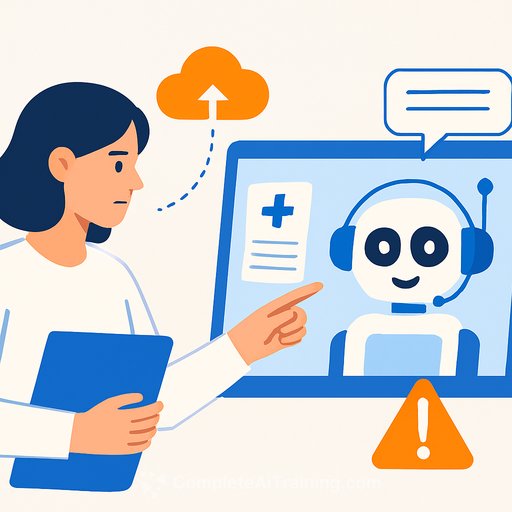
Consumer chatbots may log prompts, retain data, or route it through third-party processors outside your control. Without a Business Associate Agreement (BAA), uploading PHI is a compliance exposure. Even "anonymized" uploads can be re-identifiable when labs, timelines, and rare conditions line up.
- Assume prompts and files could be stored, analyzed, or shared per vendor terms.
- Screenshots, email forwards, and cloud backups multiply the footprint.
- Cross-border processing complicates HIPAA and GDPR alignment.
A Practical Playbook for Healthcare Teams
Frontline conversations: set expectations fast
- Thank the patient for bringing context. Then anchor: "AI can summarize; it can't examine you or weigh risk the way we do."
- Separate signal from speculation. Keep the timeline, meds, and symptom pattern; drop the model's ranked diagnoses.
- Triage on your criteria, not the bot's. If a model pushed for an invasive test, tie your decision to guidelines, vitals, and risk scores.
- Document the AI input as patient-supplied info, not clinical evidence.
Clinical triage heuristics (use your protocols)
- Reproducible exertional symptoms in known CAD or high ASCVD risk: treat as clinically significant until proven otherwise.
- Single abnormal lab without symptoms: confirm, trend, correlate; avoid anchoring on AI differentials.
- Neurologic concerns (new disorientation, focal deficits, anticoagulation): time-sensitive pathways first, explanations later.
Operational guardrails: keep PHI safe
- Publish a clear policy: no PHI into consumer AI. Use approved, BAA-covered tools only.
- Offer a safe alternative: an enterprise chatbot with logging, data retention controls, and zero training on customer data.
- De-identification standards: remove names, dates, MRNs, exact locations, rare disease flags; minimize to the question at hand.
- Configure controls: turn off chat history, restrict file uploads, and mask identifiers in pre-processing.
- Run vendor risk assessments: data flow maps, model hosting location, retention defaults, subcontractors, breach terms.
Documentation and liability
- Record that AI outputs were patient-provided and reviewed, not relied upon.
- Note your clinical reasoning, decision thresholds, and what changed management.
- If AI contributed, treat it like any external source: cite, contextualize, and verify.
Patient education: simple scripts your staff can use
- "AI explains reports; it doesn't know your full picture. We'll use it as a tool, not a verdict."
- "Please don't upload PHI to public chatbots. If you want help summarizing, we can do that safely here."
- "Bring the exact phrases that worried you. We'll translate and decide next steps together."
If you're building or buying AI
- Demand a BAA, clear data retention limits, and the option to purge logs.
- Prefer on-prem or virtual private cloud; avoid co-mingled training.
- Human-in-the-loop by design: summaries and differentials are drafts until a clinician signs off.
- Guardrails: cite sources, show uncertainty bands, and flag "do not decide" zones (e.g., chest pain, neuro deficits, pediatric red flags).
- Monitor: sample outputs, track near-misses, and update prompts/policies monthly.
What This Means for Care
Your patients will keep using AI. The move is to channel that behavior into safer tools and tighter workflows. Meet them where they are, filter the signal, and keep decisions anchored to your standards.
Resources
Upskilling your team
If you need structured training on safe, practical AI use for clinical and operations teams, see courses by job at Complete AI Training.
Your membership also unlocks: