WGS 2026: Nobel Laureates press governments to fund basic research and keep humans at the creative core
At the World Governments Summit 2026 in Dubai, Nobel Prize-winning scientists delivered a clear message: science gives us the tools, but progress depends on political will, scientific literacy, and steady funding for basic research. The session, "Can Science Save the Earth?", focused on energy security, human health, and climate change-and what it takes to turn breakthroughs into real outcomes.
Omar Sultan AlOlama, UAE Minister of State for Artificial Intelligence, led the discussion with Prof. Steven Chu (Physics, 1997), Prof. Roger Kornberg (Chemistry, 2006), and Prof. Serge Haroche (Physics, 2012). Their collective view: if governments want stability and long-term competitiveness, they must back fundamental science at home and bring scientists into the rooms where decisions are made.
Science as a stabilizer
Steven Chu framed science as a foundation for social stability. New technologies often carry high early costs, which means policy has to bridge the gap until scale and efficiency catch up.
He also flagged aging populations as a growing pressure point for health systems worldwide. That demographic shift calls for higher investment in research across biology, medicine, and data-driven health.
Human creativity versus AI
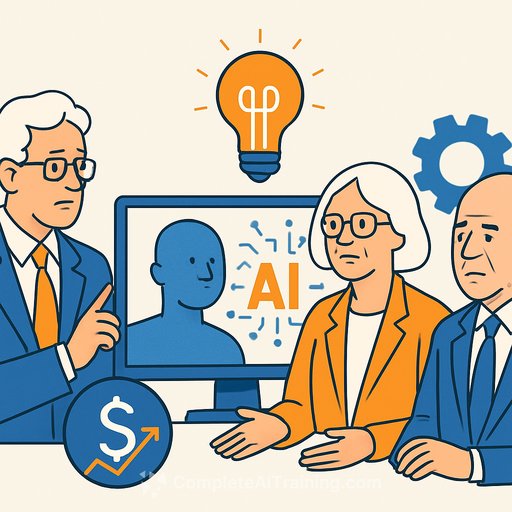
The panel debated whether AI can replicate scientific creativity. Chu urged humility about machine progress and argued for a collaborative model-AI as a force multiplier for human researchers, not a replacement.
Serge Haroche countered that genuine creativity is rooted in emotion, ambition, and passion-human chemistry that hardware can't reproduce. Roger Kornberg added that many breakthroughs come from challenging prevailing assumptions, something systems trained on existing data may struggle to do. Haroche also pointed to a physicist's "sense of beauty" and natural symmetry as a quiet compass for discovery.
From lab insight to public policy
Chu was blunt: scientists need seats at the main decision-making table to translate knowledge into policy. He cited his own tenure as the first scientist to serve in a cabinet-level role in the United States as proof that technical expertise can guide national strategy.
Kornberg urged small and mid-sized nations to invest in homegrown basic research instead of importing solutions. Retaining top talent requires funding, labs that work, and a clear path to impact-because researchers are "the most valuable natural resources of all."
The panel agreed that curiosity-driven work is the wellspring of major advances. Because this work carries long horizons and risk profiles the private sector rarely absorbs, funding it is a sovereign responsibility; for further reading on research policy and leadership, see Research.
Practical takeaways for research leaders
- Build policy fluency: designate PI or center liaisons for government engagement, publish concise briefs, and quantify outcomes policymakers care about (cost, health, emissions, jobs).
- Treat AI as a collaborator: run controlled workflow tests, keep humans in the loop on design and interpretation, and standardize bias and reproducibility checks.
- Defend basic research: structure funding portfolios that cover exploratory work and translational pipelines, with milestones that track learning progress as well as outputs.
- Retain talent: create stable early-career tracks, modernize core facilities, use targeted seed grants, and reward data/code sharing that accelerates collective progress.
- Plan for aging populations: back cross-disciplinary programs that connect biology, data science, and social policy to reduce system-wide costs.
The summit drew more than 60 heads of state and deputies, over 500 ministers, and delegates from upward of 150 governments and 80 international organizations-over 6,250 attendees in total. That level of participation signals broad interest in moving science from intent to implementation.
Event context and background can be found at the World Governments Summit. For laureate profiles and prize histories, see the Nobel Prize.
If your lab or institute is upgrading AI fluency for research teams, explore curated AI courses that focus on practical skills and credible tools.
Your membership also unlocks: