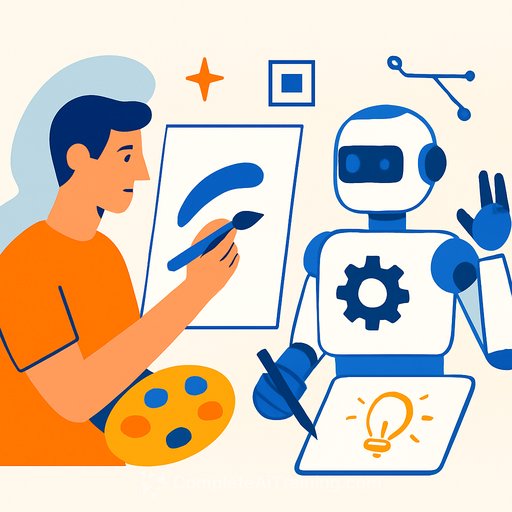
AI: The new skills creatives are learning to keep their edge in 2026
It doesn't matter how many awards you've got. In 2026, every creative feels the pressure. AI is shipping concepts, images, and copy at blistering speed. The question isn't if it affects your work. It already does. The real question: what are you going to do about it?
This isn't a zero-sum fight. The creatives who are thriving aren't ignoring AI or battling it. They're doubling down on skills AI can't fake: judgment, taste, context, and story. With the right approach, AI becomes a force multiplier - and ironically, it can make you more valuable.
Editing and curation
Jessica Walsh is blunt: "AI can generate infinite options. What it can't do is decide what's good, what's wrong, what's culturally off, or what will age badly." The win isn't being the fastest maker. It's being the sharpest editor, curator, and thinker.
Lainey Holland sees the same shift. "The edge has moved from hands-on creation to thoughtful curation," she says. AI creates abundance. Your job is to know what matters - why some ideas move people and others vanish. That judgment comes from studying emotion, story, and culture.
- Build a personal "taste OS": a swipe file with weekly scoring (1-5) and notes on why pieces work.
- Run option sprints: generate 30 variations, shortlist 3, rewrite 1 in your voice, ship 1.
- Create a kill list: label what's cliché, time-bound, or off-culture - and stop it early.
Critical thinking over instant answers
Harry Ead warns about the real risk: efficiency. "Accepting the first thing that lands, delivering in an instant, and moving on." The winding process - writing, sketching, talking, thousands of micro-decisions - sharpens judgment and uncovers the unexpected.
His point: originality won't come from the tools. It comes from how you think - curiosity, context, and pushing past the first answer.
- 3x3 rule: for any brief, produce three distinct directions; for each, three reasons it won't work. Then fix them.
- Counterfactuals: ask "What if the opposite were true?" to break template thinking.
- Timebox exploration: 45 minutes of messy thinking before any polishing.
- Decision journal: log choices, assumptions, and outcomes. Review weekly.
Storytelling and conceptual depth
Léa Berger puts it simply: storytelling is where human minds excel. Setting the scene, shaping meaning, and building emotional connection are the foundation for work that sticks. Designers who frame better questions and systems will matter more.
Lucas Luz is doubling down on conceptual thinking, taste-making, and creative direction. He's also deepening storytelling, editing, and presenting. The real value: curating and connecting ideas into a clear point of view - not just pushing pixels.
- Story first: write a one-page narrative before any design. Who, what tension, what change?
- Metaphor bank: collect 50 metaphors and visual analogies; use them to spark concepts.
- User heartbeat: describe the emotional beat at each step of your experience or campaign.
Human taste and craft still matter
Marina Bonet doesn't see AI as a threat to her job. "AI is not human," she says. "These tools create images that are just 'not human enough.' The machine language is stronger than the feeling you want to communicate." Her answer: make the renders - with real 3D tools - even better.
Use AI for exploration, sure. But the decision-making, the nuance, the feel - that's on you.
- No-first-draft rule: sketch or block by hand or in your core tool before any AI pass.
- Artifact hunt: train your eye to spot AI tells (hands, signage, perspective, lighting logic).
- Craft sprints: weekly deep work to upskill in your core software or medium.
Be tool-agnostic, not tool-phobic
Craig Dobie is pragmatic: AI is a tool. The real threat is refusing to use it. It can speed up research, summarising, ideation, rough prototypes, iteration, rewriting, and proofreading. The two meta-skills: stay open-minded and stay curious.
- Experiment log: test one AI workflow per week; note time saved and quality hits.
- Guardrails: define where AI is helpful (options, drafts) and where it isn't (final taste calls).
The skills that age well
- Judgment and taste
- Cultural awareness and nuance
- Emotional intelligence
- Question design (better prompts start with better thinking)
- Critical thinking and systems thinking
- Curation and editing
- Storytelling and presentation
- Creative direction and synthesis
- Ethical sense and bias checks
Speed and execution are becoming commodities. In a world where everyone has the same tools, originality comes from how you think, what you know, what you've lived, and the choices you make with the options in front of you - not prompt tricks.
A simple weekly training plan (30-60 minutes a day)
- Mon: Build your swipe file and score 10 pieces. Write one paragraph on what you'd change.
- Tue: Generate 20 options with AI. Shortlist 3. Rewrite 1 in your voice. Ship a draft.
- Wed: Story day. Outline the narrative arc for one project or storyboard 6 frames.
- Thu: Crit with peers. Defend your choices. Update your decision journal.
- Fri: Craft deep work. No AI. Push your core tool skills or material quality.
- Weekend: Culture refill. Galleries, films, books, conversations. Capture 5 notes.
Useful resources
- Generative Art Courses for faster exploration without losing your taste.
- How to collaborate with AI (practical guidance on pairing human judgment with AI speed).
Bottom line
The creatives who win in the late 2020s won't be the ones with the flashiest prompt hacks. They'll be the ones who think deeper, edit harder, and communicate stories that people feel. Focus on the skills that make you human - and make your brand unmistakable.
If you want structured ways to uplevel your AI workflows without losing your voice, explore AI Design Courses and AI Research Courses.
Your membership also unlocks: