How Reddit and TikTok - with AI - Are Changing Substance Use Research
Most people with substance use disorder never show up in clinics. Only a small fraction pursue formal treatment. Yet millions talk openly about drugs online - offering candid, real-time stories that traditional studies rarely capture.
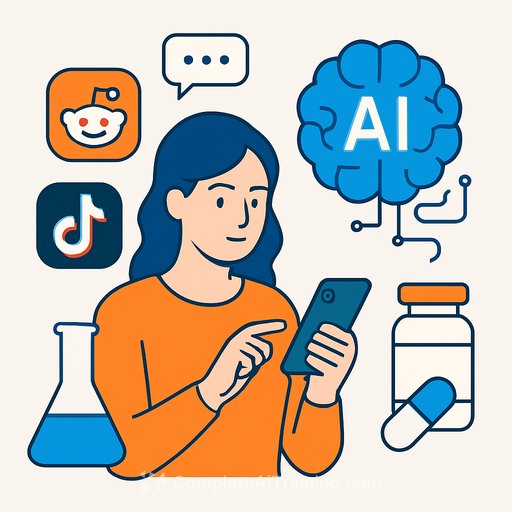
Social platforms like Reddit and TikTok now function as living archives of experience: raw, unfiltered, and timely. With modern AI, researchers can analyze these conversations at scale and spot patterns that surveys and sporadic interviews typically miss.
The "hidden" 95% is speaking - online
Many people manage substance use informally - leaning on friends, family, communities or simply coping alone. A subset posts in public forums with honesty that's hard to elicit in a clinical setting.
On Reddit, there are well over a hundred interconnected communities focused on drugs: chemistry and pharmacology, harm reduction, recovery, and even lifestyle spaces like book clubs and festival threads. Analyses of these forums show users often asking for practical safety details, sharing warnings, and checking in on each other after losses.
TikTok shows a similar pattern. In one review of more than 350 videos from substance-related communities, recovery advocacy was the most common theme. Only a small share displayed active use; safety and care featured prominently.
What these spaces actually do
- Surface real-time questions: dosing concerns, interactions, signs of trouble.
- Circulate peer-to-peer safety tips and harm reduction practices.
- Build informal support systems that respond quickly - sometimes in minutes.
- Process grief after overdoses and renew community safety efforts.
AI makes large-scale analysis feasible
Keyword matching misses nuance. Slang, sarcasm, coded talk, and emotion are common in substance-related posts. Modern large language models can read context: tone, implied intent, and shifting meaning - crucial for sensitive topics like stigma, safety, and recovery.
At scale, these models help researchers:
- Detect emerging trends and language shifts across thousands of posts and videos.
- Complement surveys with near-real-time signals from public conversations.
- Improve forecasting when official data lags. For example, incorporating Reddit signals has been shown to enhance predictions of opioid-related overdoses, while official counts often trail by months. See provisional overdose tracking at the CDC.
Bringing stigma into focus
Stigma is personal, often hidden, and hard to capture in snapshots. It erodes self-worth, worsens mental health, and keeps people from seeking help. On social media, people talk about it in their own words - describing judgments from clinicians, shame about use, or strained relationships.
Language models can flag signals tied to stigma theory: shame, guilt, hopelessness, resistance, or reframing identity in recovery. Recent work shows that what people share online maps closely to established stigma constructs. That alignment matters: it means researchers and clinicians can read day-to-day expressions of stigma and design more precise interventions.
Practical takeaways for researchers
- Treat social platforms as complementary data - not replacements - for surveys and clinical studies.
- Start with a clear taxonomy: safety questions, pharmacology, recovery, grief, stigma. Label a small, high-quality sample to train models.
- Use a mixed pipeline: rules for obvious cases, language models for nuance, and human review for sensitive classifications.
- Monitor early signals (e.g., spikes in adverse effects, new slang for substances) to inform outreach and resource allocation.
- Validate findings against ground truth: community feedback, local public health data, and clinician input.
Practical takeaways for clinicians and public health teams
- Assume online communities often function as harm reduction hubs. Engage them, don't dismiss them.
- Use social insights to refine patient education: interactions to avoid, overdose signs, and safer-use guidance.
- Expect stigma to be a barrier. Listen for language that signals shame or isolation, and counter it directly in care plans.
- Create rapid-response content addressing common questions you see online, then measure what resonates.
- Keep helplines visible. The SAMHSA National Helpline can be a low-friction first step.
Ethics and guardrails
- Privacy and consent: prioritize public data, minimize re-identification risk, and avoid quoting unique posts verbatim.
- Context matters: slang and sarcasm can flip meaning; include human review for ambiguous content.
- Bias control: audit models for demographic and linguistic bias; document limitations.
- Do no harm: avoid amplifying risky content and share safety resources where appropriate.
- Community respect: when possible, collaborate with moderators and community members before publishing findings.
Bottom line
Social platforms give researchers, clinicians, and public health teams a clearer view of substance use as it is lived - messy, candid, and deeply human. With careful methods, AI can turn those conversations into timely insight on safety, stigma, and recovery. The result: better questions, faster signals, and more effective support.
Level up your AI workflow
If you're building research or clinical analytics with language models, explore practical courses by role at Complete AI Training.
Your membership also unlocks: