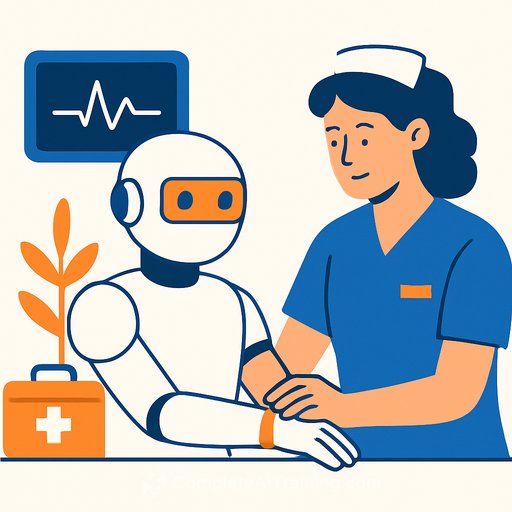
AI in healthcare: efficient where it fits, human where it matters
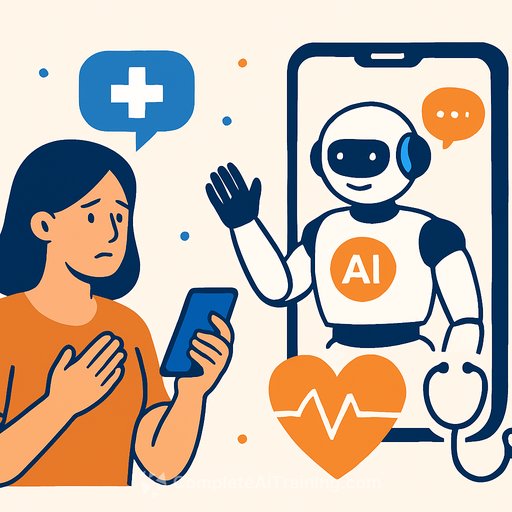
Hospitals are testing AI to remove friction from care - from ambient documentation to robots that can draw blood. The promise is clear: fewer clicks, fewer delays. But nurses and researchers keep pointing to the same truth: many moments in care still demand human judgment and empathy.
Blood draws are a useful test case. Systems in the U.S. and abroad are piloting robotic phlebotomists that identify veins with imaging, apply a tourniquet, and insert a needle automatically. In one 2024 clinical trial, a device reported about a 95% success rate for locating a vein and collecting a sample. Impressive numbers, but numbers don't calm a patient's nerves.
"A robot may be able to find a vein, but it can't calm a nervous patient down or explain what is happening and it may even mess up," said Meghan Connolly, a junior nursing student. "I am scared of needles and I know a lot of people who are. I think human reassurance is part of the job, and that can't be done by a robot, you need a human."
Robots can assist - they don't replace the human touch
Dr. Sandeep Reddy, a professor of healthcare management, notes that AI has shown value in social contexts - think companion robots for the elderly or conversational agents. He also points out the gap: these tools can mimic connection, but they still fall short of the full human presence patients rely on, especially in stressful clinical moments.
Reddy is clear about the current state: most blood-drawing robots are in trials or limited hospital pilots, operating under human supervision. These systems depend on AI models that can produce incorrect outputs. "It is early days to have completely automated robots," he said. "There is a risk of hallucination, and in healthcare those errors can have serious consequences. We need a rigorous scientific evaluation process - teams should study validation methods in AI Research Courses before introducing any fully automated, AI-enabled system."
Documentation AI: helpful, but not hands-off
AI note-taking and summarization tools can reduce clicks, but they are not set-and-forget. Annika Marie Schoene, a research scientist and assistant professor who studies AI in healthcare, emphasizes that even well-performing systems miss context, misinterpret details, or generate incomplete notes - all of which require clinician oversight.
The efficiency story is mixed. In the past six to nine months, many clinicians have had to return to correct AI-generated notes or fill gaps, which can add to workload. And clinical interactions aren't call centers; the frustration of a bot that "doesn't get it" becomes a safety risk when patients need reassurance or nuanced explanations.
Practical guidance for clinical teams
- Start with low-risk tasks: draft documentation, visit summaries, patient instructions, or coding suggestions - always with human review and sign-off.
- Keep humans in the loop: require clear verification steps, and make it obvious in the workflow who is accountable for final content or actions.
- Protect patients: explain when automation is used (especially with robotics), and have a staff member present to support anxious patients.
- Define safety triggers: set thresholds for when to stop the robot and switch to a clinician (e.g., failed attempts, patient distress, abnormal conditions).
- Audit quality: routinely sample AI outputs for errors, omissions, and bias. Track corrections to see where the system helps or hurts.
- Secure data: limit PHI exposure, use HIPAA-aligned configurations, and ensure vendor BAAs and access controls are in place.
- Pilot before scaling: run small, supervised trials; measure patient experience, success rates, time saved, and downstream impacts on care.
- Train the team: simulate edge cases, set escalation paths, and make it easy to report AI-related issues or near-misses.
What to watch next
Near-term progress will likely look like this: better vein detection, steadier robotics under supervision, and ambient scribes that save time in specific, well-scoped scenarios. Expect more guidance from regulators as hospitals evaluate outcomes and risk.
For policy and device oversight, see the U.S. Food and Drug Administration's resources on AI/ML in medical devices: FDA: AI/ML-Enabled Medical Devices.
The takeaway is straightforward: use AI where it reduces low-risk busywork, but keep people front and center for patient-facing care. As Connolly put it, learning to calm patients, read reactions, and respond with empathy is the core of nursing - and that's not something a machine can replace.
Build your team's AI literacy
If your unit is exploring documentation tools or supervised automation, structured training helps. Engineers building integrations should consider AI Coding Courses. Explore role-based options here: Complete AI Training: Courses by Job.
Your membership also unlocks: