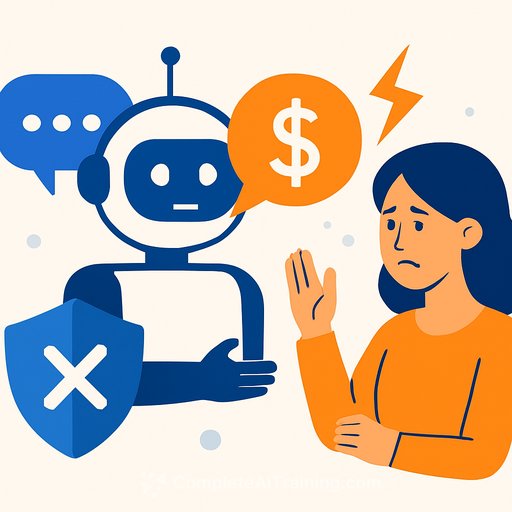
Advertising in AI is a trust experiment marketers can't ignore
The biggest ad moment this year wasn't the flashiest Super Bowl spot. It was a simple line: "Ads are coming to AI. But not to Claude." It landed because it poked a nerve - what happens when the place we go for help starts selling our attention?
OpenAI has tested sponsored placements below chat responses for free users. They're labeled and, according to the company, don't influence outputs. On paper, fine. In practice, AI isn't a billboard - it's a conversation. That context raises the stakes.
The Facebook echo
We've seen how ad incentives can quietly reshape products and, in turn, behavior. Facebook promised strong data controls early on. As ad revenue scaled, those commitments softened and trust eroded bit by bit. Even if ads never touch the core answer in AI, the economic gravity still pulls on the product over time.
That's the risk here. Once ads get a foothold in a conversational interface, they don't just take space - they alter expectations. And expectations are hard to reset.
Trust isn't just privacy - it's the emotional contract
Users don't open an AI chat to be entertained by brands. They open it to be understood. That creates an unspoken contract: help me first, sell me never - or at least, not here.
In search or social, ads live on the edges. We compartmentalize them. In AI chat, the edges dissolve. It's like talking to a therapist with a side hustle. If people start feeling that their personal prompts underwrite someone else's revenue, they share less. And once honesty drops, everything downstream gets worse.
The business case for restraint
Yes, GPUs are expensive. Free tiers need support. Ads scale. All true.
But if monetizing attention inside AI reduces candor, the model starves. You'll see shorter prompts, thinner context, fewer "edge case" questions - the exact inputs that make AI useful and the brand insights advertisers crave. Short-term lift, long-term loss.
What this means for marketers
- If you build or monetize AI products
- Separate church and state: no ads inside or interleaved with answers. If you must, isolate below the fold with clear labels and an immediate opt-out.
- Set a hard "sensitivity wall": no ads attached to health, legal, finance, relationships, or crisis queries. Default to human dignity over CPMs.
- Create an incentive firewall: ad revenue can't influence product rankings, retrieval, or model tuning.
- Publish an ad transparency log: what ran, on which surfaces, against what guardrails.
- Cap ad load per session and per day. Preserve the feel of help, not a feed.
- If you buy media in AI environments
- Buy by intent with explicit permission, not by vulnerability inferred from prompts.
- Favor utility formats: "save for later," "compare options," or "book a demo" only after the user signals they want it.
- Ban adjacency to sensitive categories. Add finance, dating, medical, and legal to your exclusion list out of the gate.
- Measure trust, not just CTR: complaint rates, session abandonment, NPS change, and "would recommend" deltas.
- If you run brand and comms
- Codify an "assistance first" doctrine: solve first, then earn the right to sell outside the chat.
- Publish your stance on AI ads and data use in plain language. Make it easy to link to and easy to audit.
- Prepare a fast path to paid, ad-free experiences. Price it simply. Explain the trade-off clearly.
- What to track weekly
- Prompt honesty signals: average prompt length, percent of sessions with sensitive topics, repeat-session depth.
- Trust proxies: satisfaction after exposure to ads, unsubscribe/opt-out rates, complaint velocity within 24 hours.
- Brand health: aided/unaided trust, "helps people like me" score, share of positive vs. skeptical mentions.
A better path for brands: be findable, not forceful
Let people discover you through the model's objective help, not through paid placement inside the help. That means sharpening clarity, utility, and proof.
- Structure your content so AI can cite it: clear FAQs, specs, transparent pricing, comparison pages with sources.
- Ship helpful tools and data endpoints that AIs can reference: calculators, checkers, open documentation.
- Partner on problem-solving, not pitches: co-create guides that answer real questions without a sales push.
- Ask for the sale outside the chat - email follow-up, lightweight signup, or a clean landing page - after explicit consent.
If you want hands-on training to operationalize this, see the AI Learning Path for Brand Managers.
The counterargument - and how to test it
Yes, norms change. People once hesitated to pay online, then it became second nature. It's possible that clearly labeled, low-friction ads below AI responses become acceptable.
Test for cultural fit before you scale. Run controlled experiments with and without ads. Hold out cohorts. Track honesty signals, trust deltas, and downstream revenue. If trust drops while CTR rises, you're eating seed corn.
The real experiment
Advertising inside AI isn't inherently wrong. It might even be necessary in spots. But this is a trust experiment with limited retries.
If users start to feel their vulnerability is being mined, the cost won't be a quarter of churn - it will be a years-long drag on belief. And belief is the engine. Treat trust like infrastructure. Sell the ground beneath it and you don't get it back.
Your membership also unlocks: