
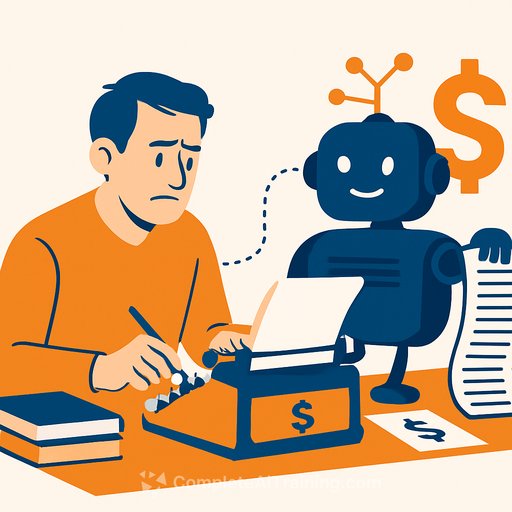
The Impact of AI on Authors and Their Work
Jane Rosenzweig directs the Harvard College Writing Center. Two decades ago, when her mother passed away at 62, she left behind a family unprepared for the loss—and two academic history books published by NYU Press. Academic books typically reach a niche audience, so it was surprising to find one of her mother’s books on LibGen, a pirated document database used to train AI tools like Meta’s Llama and OpenAI’s ChatGPT.
While it remains unclear which books were directly used in Meta’s AI training, court documents from a lawsuit involving authors like Sarah Silverman and Ta-Nehesi Coates reveal that Meta initially sought to buy rights to books. When that proved slow, the company turned to LibGen’s collection to quickly gather “as much long form writing as possible in the next 4-6 weeks.”
Writing a book, however, takes years. Linda Rosenzweig, Jane’s mother, spent several years researching and honing her expertise before publishing her first book at 51. Her journey began long before she started writing.
A Personal Story of Persistence and Passion
Born in the 1940s, Linda grew up in an era when women were expected to marry rather than pursue academic careers. She loved history and dreamed of attending prestigious schools like Vassar or Radcliffe. Yet, her family prioritized sending her brother to college.
Like many women of her generation, she married soon after graduating from a local college and became a teacher. After having children, she pursued a PhD and eventually taught at the same women’s college she attended. It wasn’t until her daughter was in college that Linda finally embarked on writing a book about the mother-daughter relationship.
Her research involved applying for grants and spending weeks at the Schlesinger Library at Radcliffe. Though not a student there, she walked the Cambridge streets she had long admired. Her daughter accompanied her on some research trips and reviewed drafts, witnessing firsthand the effort and care involved in writing and revising the work.
Writing was a challenge for Linda, as it is for most authors. She overcame gaps in training and confidence to eventually hold her published book in hand.
Legal Battles Over AI Training and Copyright
The lawsuits against Meta and OpenAI focus on whether authors should be compensated for their work used in training large language models (LLMs) and if such use qualifies as fair use under copyright law. OpenAI argues that training AI with copyrighted works is fair use, comparing it to human education, where exposure to diverse information helps solve new problems.
But AI doesn’t “read” or learn like humans. Instead, books are converted into numerical data representing word relationships, enabling the AI to predict the next word in a sequence. This training requires millions of pages authored by humans, yet the AI lacks the lived experience and insight that went into those words.
Meta’s lawyers claim individual works hold no economic value as training data, suggesting authors shouldn’t be compensated. However, without authors and their books, there would be no training data to feed these models.
What This Means for Writers
Finding her mother’s book on LibGen using a tool from The Atlantic highlights a broader issue. Many books you’ve read could be part of these unauthorized collections.
Using books without permission to train AI doesn’t just borrow words; it diminishes the countless hours authors spend researching, drafting, and revising. It disregards the dedication required to bring a book to life.
The courts will decide if AI training on copyrighted works is fair use, but they won’t determine how this shapes the future of reading and writing. Society must decide whether books remain valued as crafted works or are treated merely as data to feed machines.
For writers interested in understanding AI’s growing role and its effects on their craft, exploring resources on AI tools and courses can provide useful insights. Platforms like Complete AI Training offer courses tailored for writers navigating this evolving landscape.