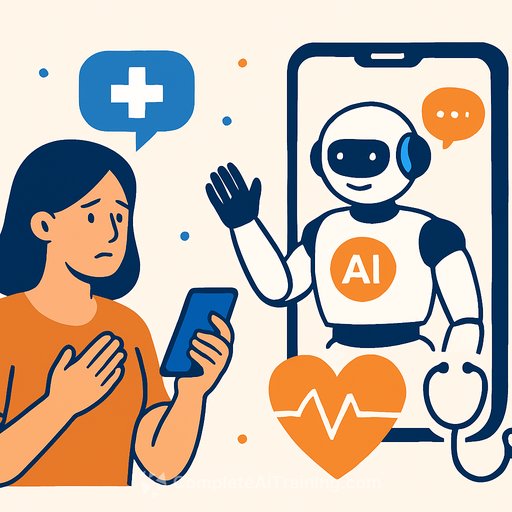
AI errors are here to stay. In healthcare, that changes the rules
Over the past decade, AI got good enough to earn trust in everyday tasks - even as it still makes obvious mistakes. Voice assistants mishear. Chatbots invent facts. Mapping apps have sent drivers off paved roads. People tolerate this because the cost of failure is low and the time savings are real.
Healthcare is different. There's growing pressure to let AI take on higher-stakes work, including prescribing with limited human oversight. A proposal in early 2025 even floated autonomous AI prescribing. For practical guidance on clinical safety, validation, and governance, see AI for Healthcare.
Why AI mistakes don't vanish with more data
Alan Turing put it bluntly: "If a machine is expected to be infallible, it cannot also be intelligent." Learning requires trial and error. In many datasets, some level of error is baked in because categories overlap.
Think in practical terms. If a model sees only age, weight, and height, it can easily tell a Chihuahua from a Great Dane. But it may confuse an Alaskan malamute with a Doberman - different breeds can share those same numbers. The features overlap, so the best model still misclassifies some cases. That's a limit of the data, not just the algorithm.
Real life adds more noise. In one large academic dataset, even the best models stalled around 80% accuracy when predicting who would graduate on time. Many students looked identical on paper - same grades, age, socioeconomic status - yet some finished on time and others didn't because of unrecorded events after enrollment. More data helped a bit, then hit diminishing returns.
Healthcare data shares these traits. Different diseases can look the same. The same disease can look different across patients. That overlap limits how cleanly any system can separate "A" from "B" without errors.
Prediction has a horizon - and it's shorter in messy systems
In a city, you can predict where a car will be in two minutes. Ten minutes out, interactions with other drivers make the forecast fuzzy. Complex systems behave like that. Interactions you can't see ahead of time change the outcome.
Clinical practice sits right in that zone. Comorbidities, meds, environment, genetics, access - each one interacts. That's why models that look sharp in a paper can stumble at the bedside. It's not a failure of math; it's a property of the system.
Prescribing without a human in the loop is a legal and clinical risk
Humans make errors too, but accountability is defined. With AI, responsibility is murky. If an AI misprescribes and harms a patient, who's liable? The vendor, the health system, the developer, the insurer, the pharmacy?
Given irreducible error and unclear liability, fully autonomous prescribing is a bad bet. A better pattern is "centaur" practice - clinicians plus machines. Let AI surface options, spot interactions, and personalize suggestions. Let clinicians decide.
Practical guardrails for hospitals, clinics, and prescribers
- Keep a clinician in the loop. No final orders without human sign-off.
- Define out-of-scope rules. If the model sees uncertainty, conflicting signals, or rare conditions, it must defer.
- Use clinically meaningful metrics. Look at calibration, PPV/NPV by subgroup, and decision-curve analysis - not just AUROC.
- Probe for overlap. Stress-test on look-alike presentations and common confounders; quantify how often classes collide.
- Set conservative thresholds. Prioritize sensitivity or specificity based on clinical risk, and document why.
- Lock dose bounds and interaction checks. Enforce hard stops tied to vetted guidelines and local formularies.
- Track provenance and context. Log inputs, versions, prompts, and outputs for every recommendation; follow an explicit MCP (Model Context Protocol) for provenance and context practices.
- Monitor in production. Drift detection, bias audits, error reporting, and a clear incident-response playbook.
- Get informed consent right. Patients should know when AI contributes and how oversight works.
- Align with regulators. Follow guidance for AI/ML-enabled medical tools and prepare for audits.
Helpful references:
Where AI adds real value today
- Drafting differentials and surfacing overlooked diagnoses for review.
- Flagging drug-drug and drug-condition interactions before order entry.
- Summarizing charts and extracting key trends for faster clinical review.
- Risk stratification to prioritize outreach, always with clinician judgment.
Used this way, AI saves time and reduces misses without handing it the pen.
A quick preflight checklist before any AI influences prescribing
- Clear use case, risk assessment, and documented clinical owner.
- External validation on your population; subgroup results reviewed.
- Human factors testing in the actual workflow (EHR, alerts, handoffs).
- Fail-safes: uncertainty detection, escalation paths, and hard stops.
- Governance: versioning, change control, and sunset criteria.
- Continuous monitoring with measurable safety and utility targets.
Bottom line: some AI errors are unavoidable, and healthcare carries the cost. Keep humans accountable, keep models humble, and keep the guardrails tight.
If your team needs structured upskilling to evaluate and govern clinical AI, explore job-focused programs here: Complete AI Training - Courses by Job.
Your membership also unlocks: