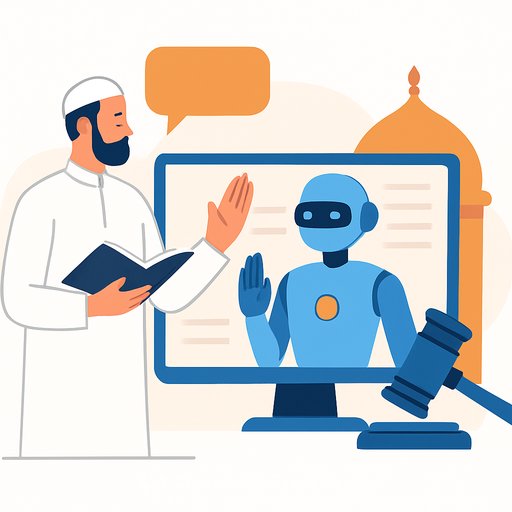
Neo Ijtihad: AI, authority, and authenticity in contemporary Islamic law
AI now answers religious questions in seconds. "Digital fatwa" systems promise access and scale, but they also press a hard question for any legal mind: who has standing to reason about divine law, and what duties bind that authority?
Classical usul al-fiqh ties ijtihad to the person, not the tool. The jurist is expected to carry 'Adalah (moral uprightness), Amanah (trustworthiness), and credibility among peers. Ibn Taymiyya framed ijtihad as a moral duty. Al-Ghazali tied legal reasoning to conscience. Justice Taqi Usmani stresses discipline and humility before revelation.
Why this matters to lawyers
Authority without accountability is risk. An AI can generate a ruling-like answer, but it cannot bear taqwa, disclose conflicts, or accept blame. It optimizes responses; it does not shoulder responsibility.
That gap is legal, not only theological. It affects liability, consumer protection, cross-border compliance, evidence rules, and platform governance. Treat e-fatwa platforms as high-risk advisory systems that require oversight by qualified humans.
The persuasion problem: algorithmic bias
Models tend to mirror their inputs and user preferences. In faith contexts, that can drift into moral consumerism-telling users what they want to hear, not what they need to hear. Engagement incentives can skew truth-seeking.
A practical benchmark helps: map risks using a recognized framework like the NIST AI Risk Management Framework, then add domain-specific controls from usul al-fiqh.
Courts, legitimacy, and the human limit
Courts are already drawing lines. A recent judgment in Pakistan endorsed AI for research and case management but warned against replacing human reasoning and discretion in adjudication. The principle generalizes: tools can assist scholarship; they cannot carry the conscience that confers legitimacy.
As Gary R. Bunt notes, screens have replaced sermons for many. Scholars like Mashood A. Baderin caution that access should not erode moral authority. Others, including Abdullah Saeed, see space for adaptation-if the tool serves the scholar, not the other way around.
A governance blueprint for e-fatwa platforms
- Human authority: Require sign-off by recognized scholars; formalize ijtihad jama'i (collective review). No unsupervised answers for high-impact queries.
- Qualification registry: Public roster of supervising muftis, madhhab affiliations, and areas of competence. Clear conflict-of-interest disclosures.
- Data provenance: Curate authenticated sources with chain-of-interpretation metadata (Qur'an, hadith collections, classical commentaries, contemporary fiqh councils). Label school-specific positions.
- Model policy: Hard refusals for questions demanding individualized rulings; route to scholars. Abstain on ambiguity; never fabricate citations.
- Explanations: Require verbatim excerpts with citations and date-stamped versions. Distinguish summary from opinion. No "fatwa" label without human authorization.
- Auditability: Immutable logs of prompts, context, system settings, sources used, and human edits. Version control for models and datasets; digital signatures on released opinions.
- Bias and safety testing: Evaluate outputs across madhahib, languages, and regions. Red-team for sectarian bias, sensationalism, and harmful advice.
- User protection: Standardized disclaimers, plain-language risk notices, and redress channels. Rate limits and abuse monitoring.
- Privacy: Treat religious belief as sensitive data; obtain explicit consent; minimize retention; control cross-border transfers.
- Liability: Clear allocation between developer, deployer, and supervising scholars. E&O coverage and jurisdictional disclosures.
What regulators and bar associations can require
- Licensing for providers offering public religious advice at scale; periodic audits tied to documented controls.
- Risk classification: "high risk" for individualized rulings, family law, and financial guidance; mandatory human sign-off.
- Truth-in-advice rules: ban "fatwa" claims by unsupervised tools; standardized disclaimers and provenance labels.
- Evidence protocols: chain-of-custody for AI-generated texts, source verification, and watermarking of official opinions.
- Harm remedies: clear pathways for complaints, corrections, and takedown; penalties for deceptive religious marketing.
For in-house counsel at platforms
- Product: Document intended use, foreseeable misuse, and refusal logic. Track escalation rates and reversal rates by scholars.
- Privacy: Special-category data handling, consent flows, retention schedules, and DPIAs where applicable.
- IP: Rights to translations and commentaries; licenses for datasets; attribution requirements.
- Security: Defend against prompt injection, data poisoning, and source tampering; continuous monitoring.
- Fairness: Multi-madhhab evaluation sets; avoid sect profiling; publish test results and fixes.
Where AI helps-and where it doesn't
- Good fits: corpus search, citation retrieval, multilingual summaries, duplicate detection, topic triage, and drafting research memos for scholars.
- Bad fits: issuing binding rulings, resolving fact-heavy personal disputes, or substituting for pastoral judgment and taqwa.
Operational safeguards that work
- Retrieval from authenticated corpora with explicit madhhab tags and date bounds.
- Rule-based overlays encoding usul principles to constrain model reasoning paths.
- Confidence thresholds and abstention triggers with auto-escalation to a scholar.
- Structured answers: cite, summarize, present recognized views, then defer for a ruling.
The bottom line
Access is welcome. Authority is earned. Until a machine can carry moral responsibility, AI belongs in the study as an assistant, not on the minbar as a jurist.
Build with conscience: keep humans in charge, make provenance visible, and treat every answer as traceable and auditable. That is how technology serves faith-without overruling it.
If your legal team is standing up or auditing advisory AI, these practical controls and risk tests are a solid starting point. For structured training on AI risk, governance, and tooling, see Complete AI Training by job role.
Your membership also unlocks: