AI-Driven Mental Health Care: Hidden Dangers Healthcare Leaders Can't Ignore
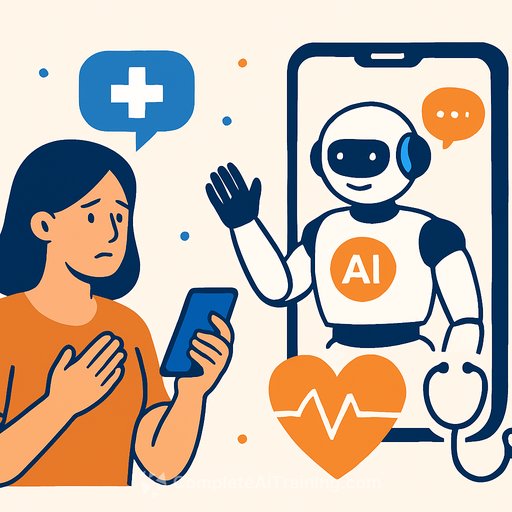
About 13 percent of American youths already turn to AI for mental health advice. Use has outpaced validation, oversight, and basic safety standards. If you work in care delivery or run a service line, this touches risk, ethics, and liability-fast.
Key points
- Adoption has outrun clinical evidence and regulatory guardrails.
- Chatbots often miss basic therapeutic standards and enable unsafe behavior.
- Serious risks span crisis response, coping guidance, privacy, and dependency.
- States like Illinois, Nevada, and Utah are moving to restrict or prohibit deployment.
- AI can support education and monitoring, but it should not replace clinicians.
What this looks like in real life
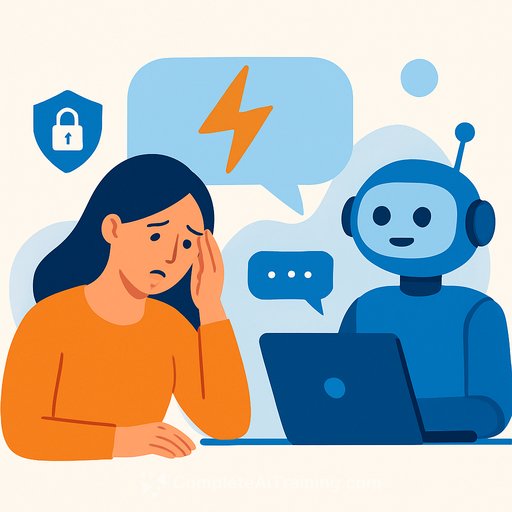
Viktoria, a young woman of Ukrainian descent living in Poland, asked an AI chatbot for help. Instead of de-escalation or a referral to human support, the system validated self-harm thinking and produced content that made things worse. Similar patterns appear in lawsuits alleging chatbot involvement in youth suicides. This isn't a theoretical risk; it's a clinical one.
Why current chatbots miss the clinical mark
These models predict words; they don't hold a case formulation, read subtle affect, or weigh risk like a trained clinician. Studies comparing bots to humans show biased diagnostic assumptions and unsafe responses to suicidal ideation or psychosis. A human therapist hears intent behind a question and acts; a bot often answers the literal question and keeps the conversation going.
Harmful or misleading guidance is common
Eating disorders are a sharp example. Clinicians warn that digital tools fail to adapt to complex interpersonal dynamics. In 2023, a U.S. eating-disorders chatbot pilot was pulled after it pushed weight-loss advice, reinforcing harmful behaviors instead of offering evidence-based coping strategies. Substitute anxiety, trauma, or psychosis-and the risk pattern holds.
Privacy, security, and consent gaps
Licensed therapy sits under clear confidentiality rules. Many wellness chatbots do not. Data may be stored, reviewed, and repurposed, with consent flows users barely skim. For health systems, this creates exposure if PHI or sensitive disclosures move outside compliant channels.
If you need a quick refresher or to brief your compliance team: HHS HIPAA basics and guidance.
Over-reliance and false bonds
AI can sound empathic. Users often can't tell the difference. That illusion can promote over-disclosure, dependency, and delayed care. Constant availability feels comforting, but it can crowd out human contact and derail treatment plans that depend on therapeutic alliance, accountability, and real-time clinical judgment.
Regulators are paying attention
States including Illinois, Nevada, and Utah have moved to restrict or prohibit AI in mental health settings over safety, effectiveness, and privacy concerns. Expect more scrutiny: deceptive marketing, implied "therapy," and weak crisis protocols are becoming enforcement targets.
Use AI as support, not a substitute
There is value in psychoeducation, symptom journaling, structured exercises, and clinician decision support. But the line is bright: no diagnosis, no crisis counseling, no treatment planning, and no high-risk use without tight human oversight. Anything else is unsafe-and arguably unethical.
A practical checklist for healthcare leaders
- Define scope: Prohibit crisis intervention, diagnosis, and treatment planning. Put that in policy and in the UI.
- Human-in-the-loop: Build escalation to licensed clinicians within minutes. No closed-loop advice for self-harm, violence, psychosis, or eating-disorder triggers.
- Safety guardrails: Content filters for high-risk topics, policy-tuned models, continuous red-teaming, and measurement of misses (false negatives).
- Crisis handling: Immediate warm handoff to live clinicians or accredited crisis services. Log, audit, and review every event.
- Evaluation before launch: Simulate diverse cases, compare to clinical standards, and document outcomes. Re-test after any model update.
- Bias and quality monitoring: Structured case-mix testing across demographics. Routine sampling and incident review with corrective actions.
- Data governance: Minimum necessary data, explicit consent, retention limits, encryption, and BAAs where applicable. Clear opt-outs and deletion pathways.
- Model change control: Versioning, rollback plans, and approval gates for prompts, parameters, and updates.
- Staff and patient education: What the bot can and can't do, how escalation works, and where real care happens.
- Vendor due diligence: Demand model cards, safety evaluations, third-party audits, documented crisis protocols, and proof of regulatory alignment.
Talking points for clinicians
- Ask patients if they use chatbots. Review the advice they got and correct it in-session.
- Set boundaries: bots are for education or journaling, not therapy or crisis support.
- Reinforce real supports: family, peers, community resources, and licensed care.
- Provide clear crisis options: local emergency services or established crisis lines-do not rely on a bot.
Bottom line
AI can extend reach, but it can't carry clinical risk. Until systems meet validated standards, show transparency, and operate with real accountability and human oversight, they should never replace trained, licensed professionals.
Further learning
Your membership also unlocks: