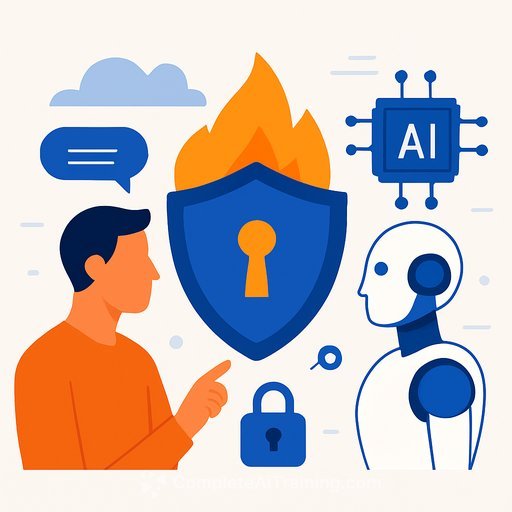
Is It Ever OK for AI Vendors to Train on Your Company Data? Yes - With Guardrails
As product leaders, we want better models, better outcomes, and fewer surprises. A blanket "no training on our data" stance feels safe, but it can slow product quality and limit which vendors you can use.
The smarter move is a scoped "yes." Allow training where it clearly improves outcomes and risk is controlled, and block it where it exposes sensitive or competitive information. Simple, practical guardrails make that possible.
Why a blanket "no training" can backfire
Quality models are built on quality data. If you block all training, vendors can't improve detection, ranking, or routing for your workloads, and you may be limited to inferior configurations.
Instead of one-size-fits-all, evaluate by purpose, data category, and sensitivity. That gives you the benefits without unnecessary exposure.
Where training clearly helps: security
Security vendors have used machine learning for years. Threat detection improves when models see more threat signals across customers, not just within one account.
That's why many security contracts include rights to train on threat telemetry collected while providing the service. Without that, detection quality drops, and some architectures simply don't work without cross-tenant correlation.
- Allow: aggregated threat indicators, network/endpoint telemetry, attack patterns.
- Protect: confidential content, personal data, and any fields not needed for detection.
- Enforce: purpose limits (security only), aggregation/anonymization, and model isolation.
Don't lump every AI feature together
Many security products now ship helpful LLM-based assistants for explanations, queries, or summaries. Those features are not required to deliver core protection.
Evaluate them separately. Permit training on threat telemetry for detection, but opt out of training on your content for LLM convenience features unless you have clear value and protections in place.
Corrections and feedback: fast path to better results
Corrections are high-signal data that improve outcomes quickly. Think flagged false positives, fixed classifications, or approved rewrites.
This aligns with standard "feedback" clauses in tech agreements. Just define "corrections" tightly and keep it separate from sensitive content.
- Define scope: what counts as a correction (labels, ratings, chosen options), how it's captured, and where it's stored.
- Limit purpose: use only to improve the service used by the customer, not general-purpose models.
- Exclude content: no training on proprietary text, source code, or pricing unless expressly permitted.
Low-risk data that can legitimately improve models
- Workflow and metadata for standard processes (e.g., invoice routing steps, timestamps, approver roles). This improves routing and accuracy without exposing sensitive content.
- Public, customer-facing content used to generate or QA marketing assets. Limit to non-confidential categories to avoid leaking competitive insights.
The key is scoping: permit metadata-level learning while excluding the content fields that matter competitively.
Data you should usually keep out
- Competitive pricing, deal terms, and margin data.
- Proprietary algorithms, product roadmaps, and unreleased features.
- Personal data or regulated data (e.g., health information) unless the use is essential and controls meet your compliance bar.
A quick decision framework for product teams
- Purpose fit: Does training directly improve the use case you care about (e.g., detection, routing, ranking)?
- Data tiers: Classify inputs as threat telemetry, workflow metadata, user-generated content, or regulated data. Assign sensitivity.
- Expected gain: What measurable lift do you expect (precision/recall, latency, cost)? Is there a vendor benchmark or pilot?
- Technical necessity: Is cross-customer training required by the architecture or just "nice to have"?
- Vendor safeguards: Aggregation/anonymization, no re-identification, encryption, access controls, and model isolation.
- Compliance: Confirm DPIA needs, regional processing, DPA terms, and deletion SLAs.
- Reversibility: Can you opt out later, request deletion, and keep service quality at an acceptable level?
Contract guardrails that work in practice
- Purpose limitation: Training only to operate, maintain, or improve the contracted service (not foundation models or unrelated products).
- Data scoping: Permit telemetry, logs, and workflow metadata; exclude content fields, attachments, source code, and pricing unless explicitly allowed.
- Aggregation/anonymization: Cross-customer learning must be aggregated and de-identified; prohibit re-identification.
- Model isolation: Improvements stay within the vendor's service-specific models; no commingling into general models.
- Feature separation: Default opt-out for optional LLM features; explicit opt-in if you want them to train on your content.
- Retention and deletion: Clear retention limits, deletion on request, and deletion after contract end.
- Security and compliance: SOC 2/ISO 27001, subprocessor disclosures, regional processing, and audit or attestation access.
- Change control: Advance notice for material changes to data use with the right to opt out or terminate if risk increases.
Helpful references
Next steps for your product team
- Map your data by category and sensitivity; define default allow/deny rules per category.
- Set a corrections policy that boosts accuracy without exposing sensitive content.
- Pilot with one vendor under tight scope and measurement; expand based on results.
- Instrument monitoring: data flows, model performance, and vendor change notices.
Saying "yes, with guardrails" keeps your data protected and your products improving. That balance is how you ship better outcomes while staying in control.
Further learning
- AI Learning Path for CIOs - governance, risk, and security strategy for enterprise leaders.
- AI Learning Path for Regulatory Affairs Specialists - covers DPIA, data privacy, and policy controls aligned with data guardrails.
- AI Learning Path for Project Managers - practical guidance for pilots, scope, measurements, and vendor coordination.
Your membership also unlocks: