Accelerating Science with AI and Simulations
Rafael Gómez-Bombarelli has spent his career bringing AI into materials discovery. He believes science is now at a second inflection point: language models, multimodal systems, and physics-based simulation are converging into general scientific intelligence. The goal is simple: reason over papers, structures, and synthesis - and move ideas to validated materials faster.
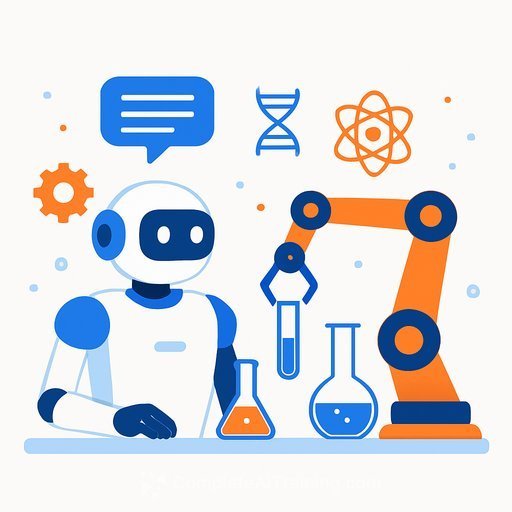
His research combines high-throughput simulations with machine learning and generative models to find new candidates for batteries, catalysts, plastics, and OLEDs. He's also helped spin out companies, most recently Lila Sciences, to build a scientific superintelligence platform for life sciences, chemicals, and materials - a practical bridge from lab insight to industry impact.
From experiments to simulations
Gómez-Bombarelli grew up in Spain, studied chemistry at the University of Salamanca, and started his PhD in experimental work on DNA-damaging chemicals. Midway through, he pivoted to simulations and never looked back. Programming gave him scale, structure, and reach.
After a postdoc in Scotland on quantum effects in biology, he joined Alán Aspuru-Guzik's group at Harvard. In 2015-2016, he worked on early deep learning for molecules and generative models for chemistry, then pushed toward high-throughput workflows. His team ran hundreds of thousands of calculations and uncovered hundreds of promising materials.
He co-founded a general materials computation startup that later focused on OLEDs - the hardest thing he's done and the most tangible. In 2018, he joined MIT's Department of Materials Science and Engineering. Since then, his lab has stayed fully computational, partnering closely with experimentalists and industry to steer efforts where they matter.
Why this inflection point matters
First, scaling works: larger models and larger simulation campaigns keep paying off. Second, language models can now read and reason across literature, protocols, and lab notes. Third, multimodality lets systems connect text, molecular graphs, crystal structures, and spectra. Put together, that means fewer manual hops between problem framing, candidate generation, property prediction, and synthesis planning.
His view: "Humans think in natural language, we write papers in natural language, and large language models that have mastered language open up the ability to accelerate science." The next phase is fusing model classes - symbolic, neural, and physics-based - into tight feedback loops.
How the lab works
The group explores how composition, structure, and reactivity connect to performance. They use high-throughput simulations to generate data, train models that get better with more physics supervision, and build tools that help experimentalists triage AI-suggested ideas. It's breadth with intent: strictly computational, but tied to real-world constraints like cost, safety, and manufacturability.
"There are virtuous cycles between AI and simulations," he says. Better physics creates better data. Better data creates better models. Better models decide which simulations and experiments to run next.
A practical playbook for research teams
- Build a clean data spine: centralize simulation outputs, instrument logs, and ELN entries with consistent units, schemas, and metadata.
- Mix physics and ML: train surrogate models on top of DFT/MD; quantify uncertainty and use active learning to select the next batch.
- Stand up a simulation factory: containerize codes, use workflow managers, and automate error recovery and provenance tracking.
- Close the loop with the lab: pre-screen large spaces, hand off ranked shortlists, and capture outcomes to retrain models.
- Evaluate prospectively: define baselines, run ablations, and measure hit rate, time-to-insight, and compute cost on real tasks.
- Right-size compute: mix CPUs/GPUs, cache intermediates, and schedule runs to keep utilization high and cost under control.
- Invest in people and process: pair modelers with experimentalists, codify coding standards, and ship reproducible notebooks.
- Align with industry early: gather constraints (price, toxicity, supply chain) and output decision-ready candidates, not just scores.
- Track governance: log data lineage, IP, and access; consider pre-registering modeling plans for critical studies.
Applications with traction
The approach has delivered candidates for energy storage, catalysis, polymers, and OLEDs - areas where search spaces are huge, experiments are expensive, and simulation can screen orders of magnitude more options than a lab bench. His group stays close to partners through programs like MIT's Industrial Liaison Program to validate priorities and speed transfer.
Signals from industry and government
Big labs at companies like Meta, Microsoft, and DeepMind now run physics-informed workflows at scale. U.S. federal efforts are leaning in as well; the Department of Energy has elevated AI-for-science initiatives, aiming to accelerate discovery and national competitiveness.
The takeaway: the consensus has shifted. Physics-informed AI and large-scale simulation are no longer fringe bets - they're becoming standard practice.
What to watch next
- Multimodal models that connect literature, structure, spectra, and synthesis steps in a single loop.
- Automated hypothesis generation with grounded simulation backends and uncertainty-aware ranking.
- Planning and control layers that translate proposed syntheses into executable steps for automated labs.
- Sharper scaling laws for "science tasks" that blend language, structure, and dynamics.
Key takeaways for researchers
- Blend physics and ML; neither alone is enough for complex materials and chemistry problems.
- Automate the full loop - data, simulation, modeling, experiment - and measure gains prospectively.
- Design for constraints: cost, safety, and manufacturability must guide search from day one.
- Culture matters: positive-sum collaboration beats siloed heroics, especially at scale.
Next steps
If you're building these capabilities in your lab or R&D team, a structured path can help: AI Learning Path for Research Scientists.
Photo credit: iStock.com
Your membership also unlocks: